Local
D.C. schools get incomplete score on LGBT youth survey
Low response rate means data not fully representative

Adam Tenner, executive director of Metro Teen AIDS, said flawed data in the biennial Youth Risk Behavior Surveillance Survey will hinder his group’s work with local youth. (DC Agenda photo by Michael Key)
A survey of risky behavior by D.C. youth, including LGBT youth, was so flawed that its data cannot be weighted, hindering local groups as they work to help gay students and fight HIV.
Leaders of two groups that provide services to LGBT youth told a D.C. City Council hearing March 5 that the Office of the State Superintendent of Education, known as OSSE, failed to ensure a required 60 percent response rate for the survey among city middle and high school students.
That failure, the group leaders said, led federal officials to declare D.C. data for the biennial Youth Risk Behavior Surveillance Survey nothing more than a snapshot of student behavior rather than an indicator of trends.
Andrew Barnett, executive director of the Sexual Minority Youth Assistance League, and Adam Tenner, executive director of Metro Teen AIDS, said the loss would adversely impact their groups’ ability to assess the needs of LGBT youth.
“This gap in data presents a tremendous loss to SMYAL and the LGBTQ youth of D.C.,” Barnett told Council Chair Vincent Gray (D-At Large), who presided over the hearing. “We rely on the [survey results] to understand the scope of problems facing youth living in D.C.”
A spokesperson for the U.S. Centers for Disease Control & Prevention, which created and funds the survey, said the CDC conducts a national version of the survey by sampling about 15,000 high school students in schools throughout the country.
Karen Hunter, the spokesperson, said the CDC also arranges for states, counties and cities to conduct their own version of the survey using a set of “core” questions established by the CDC as well as additional questions deemed important by local jurisdictions.
At the recommendation of a coalition of local community groups, including LGBT organizations, D.C. school officials agreed to add a question to the 2007 survey that gave student respondents an opportunity to disclose whether they were gay, lesbian or bisexual.
In response to a recommendation of the same coalition, OSSE agreed to add another question for the 2009 survey enabling respondents to disclose whether they are transgender. The LGBT questions are expected to be part of all future surveys.
“This was incredibly important,” said David Mariner, executive director of the D.C. LGBT Community Center.
Mariner said that identifying LGBT participants in the survey enables the community to assess the problems LGBT youth face and develop ways to address those problems.
Among the core topics included in the survey questionnaire that seek to identify “health-risk behaviors among youth” are: unintentional injuries and violence, tobacco use, alcohol and other drug use, sexual behavior, unhealthy dietary behavior and mental health issues.
Mariner and Tenner said the lack of sufficient data from D.C. students in the 2009 survey creates a four-year gap in assessing the needs of local LGBT youth because the results of the next survey, set for 2011, won’t be processed and released until 2012.
Chad Colby, an OSSE spokesperson, said that although the office is in charge of coordinating the youth survey, it is administered by the city’s public school system. Colby did not know why school officials didn’t arrange for more students to take the survey. A school spokesperson could not be immediately reached for comment.
Colby noted that the survey was “in the field” before OSSE’s new director, Kerri Briggs, was appointed to her post as the city’s State Superintendent of Education last year.
A fact sheet he released about OSSE’s views on the survey also says that the survey is not legally mandated. “Therefore, school districts are not legally required to complete the survey,” says the fact sheet.
Colby said the lack of a 60 percent return of the survey questionnaires means the data cannot be “weighted,” precluding it from being compared against data from other cities and states. He noted that the data can still be used for some purposes.
“We’re still going to be reporting it as un-weighted data,” he said. “It doesn’t mean we won’t be able to use the data to make the case for grant funding. It just means you won’t be able to compare it to other states and districts.”
But Hunter said that un-weighted data only “provides a snapshot of what’s going on among the students that were surveyed.”
She said the data cannot be used to extrapolate the behavior of the entire student population. Only “weighted data,” which is obtained from a response rate of 60 percent or greater, can be used to assess the behavior of the larger population group, she said.
Tenner said CDC officials told him the D.C. survey response rate was 36 percent for high school students and 54 percent for middle school students.
“Many of us use the Youth Risk Behavior Survey for our programs and our grants,” Tenner said in an e-mail to local activists. “From a city-wide perspective, many of us were excited to use YRBS data to objectively measure the city’s effort to improve the health of its youth and to highlight the challenges that remain.”
He called on OSSE to present a written plan on how the agency will ensure that the 2011 survey is properly implemented “with adequate student and school participation.”






Virginia
DOJ seeks to join lawsuit against Loudoun County over trans student in locker room
Three male high school students suspended after complaining about classmate
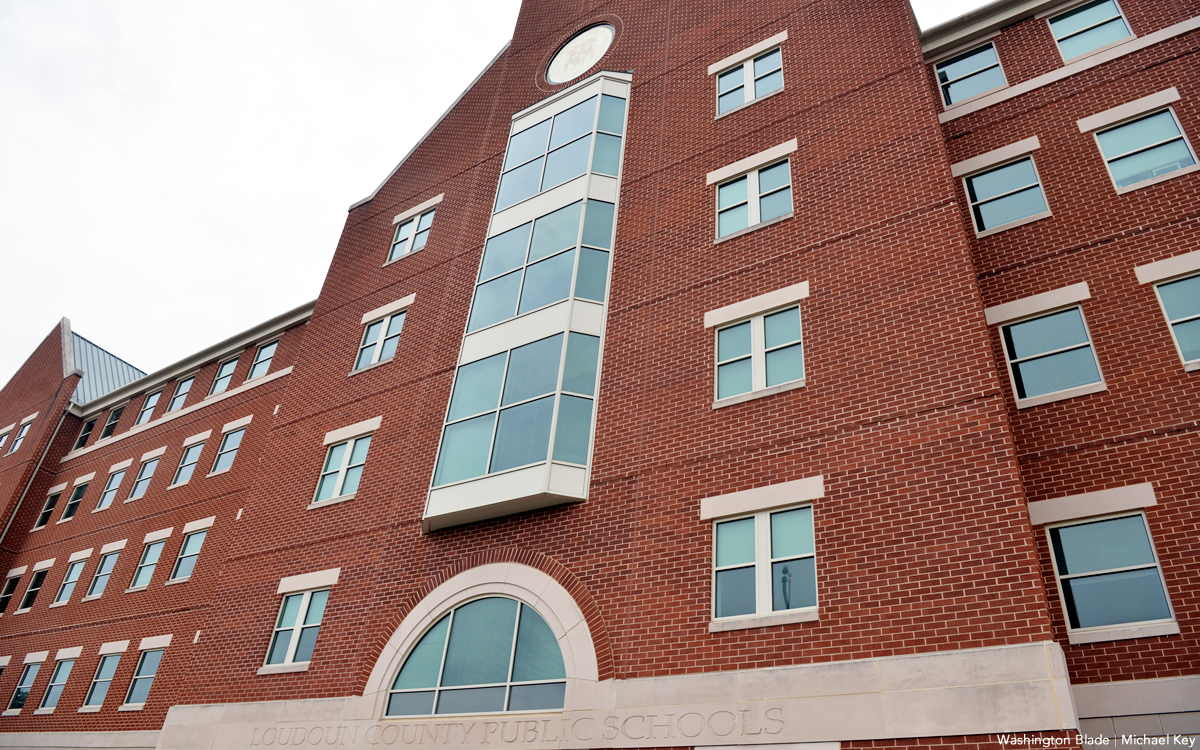
The Justice Department has asked to join a federal lawsuit against Loudoun County Public Schools over the way it handled the case of three male high school students who complained about a transgender student in a boys’ locker room.
The Washington Blade earlier this year reported Loudoun County public schools suspended the three boys and launched a Title IX investigation into whether they sexually harassed the student after they said they felt uncomfortable with their classmate in the locker room at Stone Bridge High School in Ashburn.
The parents of two of the boys filed a lawsuit against Loudoun County public schools in U.S. District Court for the Eastern District of Virginia in Alexandria. The Richmond-based Founding Freedoms Law Center and America First Legal, which White House deputy chief of staff Stephen Miller co-founded, represent them.
The Justice Department in a Dec. 8 press release announced that “it filed legal action against the Loudoun County (Va.) School Board (Loudoun County) for its denial of equal protection based on religion.”
“The suit alleges that Loudoun County applied Policy 8040, which requires students and faculty to accept and promote gender ideology, to two Christian, male students in violation of the Equal Protection Clause of the 14th Amendment to the U.S. Constitution,” reads the press release.
Assistant Attorney General Harmeet K. Dhillon of the Justice Department’s Civil Rights Division in the press release said “students do not shed their First Amendment rights at the schoolhouse gate.”
“Loudoun County’s decision to advance and promote gender ideology tramples on the rights of religious students who cannot embrace ideas that deny biological reality,” said Dhillon.
Outgoing Virginia Gov. Glenn Youngkin and outgoing Virginia Attorney General Jason Miyares in May announced an investigation into the case.
The Virginia Department of Education in 2023 announced the new guidelines for trans and nonbinary students for which Youngkin asked. Equality Virginia and other advocacy groups claim they, among other things, forcibly out trans and nonbinary students.
The U.S. Department of Education’s Office of Civil Rights in February launched an investigation into whether Loudoun County and four other Northern Virginia school districts’ policies in support of trans and nonbinary students violate Title IX and President Donald Trump’s executive order that prohibits federally funded educational institutions from promoting “gender ideology.”
District of Columbia
Capital Pride announces change in date for 2026 D.C. Pride parade and festival
Events related to U.S. 250th anniversary and Trump birthday cited as reasons for change

The Capital Pride Alliance, the D.C. based group that organizes the city’s annual LGBTQ Pride events, has announced it is changing the dates for the 2026 Capital Pride Parade and Festival from the second weekend in June to the third weekend.
“For over a decade, Capital Pride has taken place during the second weekend in June, but in 2026, we are shifting our dates in response to the city’s capacity due to major events and preparations for the 250th anniversary of the United States,” according to a Dec. 9 statement released by Capital Pride Alliance.
The statement says the parade will take place on Saturday, June 20, 2026, with the festival and related concert taking place on June 21.
“This change ensures our community can gather safely and without unnecessary barriers,” the statement says. “By moving the celebration, we are protecting our space and preserving Pride as a powerful act of visibility, solidarity, and resistance,” it says.
Ryan Bos, the Capital Pride Alliance CEO and President, told the Washington Blade the change in dates came after the group conferred with D.C. government officials regarding plans for a number of events in the city on the second weekend in June. Among them, he noted, is a planned White House celebration of President Donald Trump’s 80th birthday and other events related to the U.S. 250th anniversary, which are expected to take place from early June through Independence Day on July 4.
The White House has announced plans for a large June 14, 2026 celebration on the White House south lawn of Trump’s 80th birthday that will include a large-scale Ultimate Fighting Championship (UFC) event involving boxing and wrestling competition.
Bos said the Capital Pride Parade will take place along the same route it has in the past number of years, starting at 14th and T Streets, N.W. and traveling along 14th Street to Pennsylvania Ave., where it will end. He said the festival set for the following day will also take place at its usual location on Pennsylvania Avenue, N.W., between 2nd Street near the U.S. Capitol, to around 7th Street, N.W.
“Our Pride events thrive because of the passion and support of the community,” Capital Pride Board Chair Anna Jinkerson said in the statement. “In 2026, your involvement is more important than ever,” she said.
District of Columbia
Three women elected leaders of Capital Pride Alliance board
Restructured body includes chair rather than president as top leader
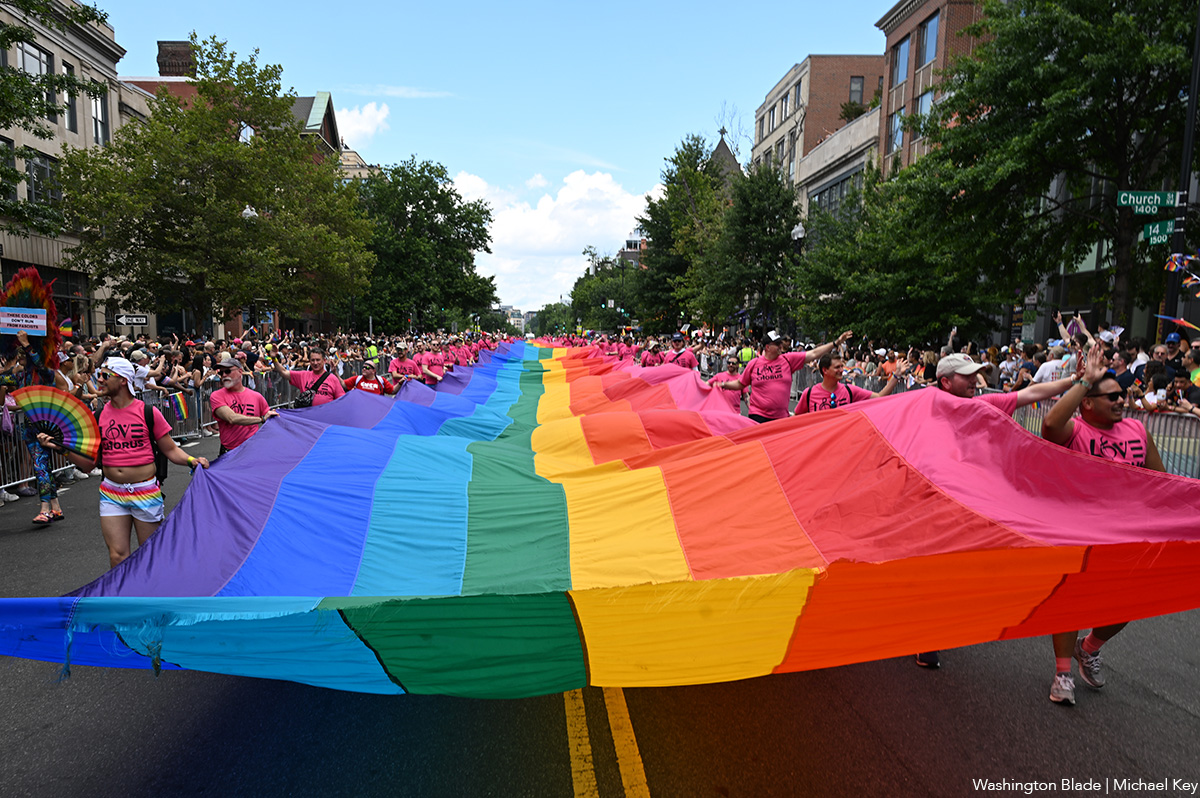
The Capital Pride Alliance, the D.C.-based group that organizes the city’s annual LGBTQ Pride events, announced it has restructured its board of directors and elected for the first time three women to serve as leaders of the board’s Executive Committee.
“Congratulations to our newly elected Executive Officers, making history as Capital Pride Alliance’s first all-women Board leadership,” the group said in a statement.
“As we head into 2026 with a bold new leadership structure, we’re proud to welcome Anna Jinkerson as Board Chair, Kim Baker as Board Treasurer, and Taylor Lianne Chandler as Board Secretary,” the statement says.
In a separate statement released on Nov. 20, Capital Pride Alliance says the restructured Board now includes the top leadership posts of Chair, Treasurer, and Secretary, replacing the previous structure of President and Vice President as the top board leaders.
It says an additional update to the leadership structure includes a change in title for longtime Capital Pride official Ryan Bos from executive director to chief executive officer and president.
According to the statement, June Crenshaw, who served as acting deputy director during the time the group organized WorldPride 2025 in D.C., will now continue in that role as permanent deputy director.
The statement provides background information on the three newly elected women Board leaders.
• Anna Jinkerson (chair), who joined the Capital Pride Alliance board in 2022, previously served as the group’s vice president for operations and acting president. “A seasoned non-profit executive, she currently serves as Assistant to the President and CEO and Chief of Staff at Living Cities, a national member collaborative of leading philanthropic foundations and financial institutions committed to closing income and wealth gaps in the United States and building an economy that works for everyone.”
• Kim Baker (treasurer) is a “biracial Filipino American and queer leader,” a “retired, disabled U.S. Army veteran with more than 20 years of service and extensive experience in finance, security, and risk management.” She has served on the Capital Pride Board since 2018, “bringing a proven track record of steady, principled leadership and unwavering dedication to the LGBTQ+ community.”
• Taylor Lianne Chandler (Secretary) is a former sign language interpreter and crisis management consultant. She “takes office as the first intersex and trans-identifying member of the Executive Committee.” She joined the Capital Pride Board in 2019 and previously served as executive producer from 2016 to 2018.
Bos told the Washington Blade in a Dec. 2 interview that the Capital Pride board currently has 12 members, and is in the process of interviewing additional potential board members.
“In January we will be announcing in another likely press release the full board,” Bos said. “We are finishing the interview process of new board members this month,” he said. “And they will take office to join the board in January.”
Bos said the organization’s rules set a cap of 25 total board members, but the board, which elects its members, has not yet decided how many additional members it will select and a full 25-member board is not required.
The Nov. 20 Capital Pride statement says the new board executive members will succeed the organization’s previous leadership team, which included Ashley Smith, who served as president for eight years before he resigned earlier this year; Anthony Musa, who served for seven years as vice president of board engagement; Natalie Thompson, who served eight years on the executive committee; and Vince Micone, who served for eight years as vice president of operations.
“I am grateful for the leadership, dedication, and commitment shown by our former executive officers — Ashley, Natalie, Anthony, and Vince — who have been instrumental in CPA’s growth and the exceptional success of WorldPride 2025,” Bos said in the statement.
“I look forward to collaborating with Anna in her new role, as well as Kim and Taylor in theirs, as we take on the important work ahead, prepare for Capital Pride 2026, and expand our platform and voice through Pride365,” Bos said.

PHOTOS: The Holiday Show

The best books to give this holiday season

Studio’s ‘Mother Play’ draws from lesbian playwright’s past

Choose U ambassadors share lived experiences with HIV, personal reflections, and insights

DOJ seeks to join lawsuit against Loudoun County over trans student in locker room

EXCLUSIVE: George Santos speaks out on prison, Trump pardon, and more

Victory Institute honors transgender Spanish senator in D.C.

The beginning of the fall of Trump

Markey reintroduces International Human Rights Act in Senate