Local
Local news in brief
Gay activists missing at Fenty campaign kick-off & more
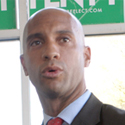
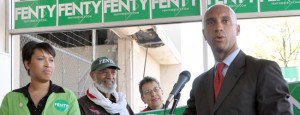
A rally marking the opening of D.C. Mayor Adrian Fenty’s re-election campaign headquarters had few gay Democratic activists in the crowd. (DC Agenda photo by Michael Key)
Gay activists missing at Fenty campaign kick-off
Few gay Democratic activists attended a rally last week that marked the opening of D.C. Mayor Adrian Fenty’s re-election campaign headquarters on Georgia Avenue, N.W.
About 300 supporters and volunteers cheered April 10 as Fenty opened his campaign with a speech highlighting his administration’s accomplishments, including reforms in education and crime fighting that he acknowledged weren’t always popular.
“We did it because it was the right thing to do,” he said, reciting a litany of policy changes and actions that would make D.C. a “world-class city.”
Among the gays seen at the event were Christopher Dyer, director of the mayor’s Office of GLBT Affairs, and Joe Martin, director of the mayor’s office of constituent services for Ward 4. Also present were gay civic activists John Fanning of Logan Circle and Martin Moulton, the gay president of the Convention Center Community Association.
Fanning, who works for the city’s Department of Parks & Recreation and is a former Advisory Neighborhood Commission member, said he believes Fenty will receive “solid” support from the LGBT community.
“I think the mayor has made some very tough decisions and has significantly improved city services and the delivery of them in many areas,” he said. “The mayor has always been a longtime supporter of the LGBT community and I believe that he remains very sensitive to our causes and issues.”
Don Colodny, a member of the Gertrude Stein Democratic Club, the city’s largest LGBT political group, was one of the few club members present. He said the lack of a large gay presence at the event was not a sign that gays won’t vote for Fenty.
“It was held at 10 in the morning on a Saturday in the far side of the city,” he said, noting that the location and early hour most likely discouraged gays from attending the event. Other people noted that the event wasn’t widely publicized in the LGBT community.
In his speech at the rally, Fenty did not mention LGBT issues or the city’s same-sex marriage bill, which he signed into law in December. He also did not reference two recent city studies that show record high numbers of HIV infections among city residents, including African Americans and men who have sex with men.
He instead pointed to the more positive findings of the AIDS studies showing that the city’s aggressive programs to administer HIV testing over the past several years — and placing people who test positive into city-funded treatment — has reduced the number of AIDS cases.
“We knew we had to fight the spread of AIDS,” Fenty said. “The number of new AIDS cases, ladies and gentlemen, declined 33 percent between 2004 and 2008. We have doubled the amount of testing, distributed three-and-a-half million free condoms, [and] removed 350,000 needles from our streets.”
DC Agenda boxes stolen in Georgetown
Boxes used to distribute the DC Agenda at the corner of Wisconsin Avenue and M Street, N.W., in Georgetown were discovered to be missing on three occasions in March, prompting the paper’s publisher to file a stolen property report with D.C. police.
The boxes were positioned on the sidewalk on Wisconsin Avenue in front of the United Colors of Benetton clothing store, next to distribution boxes for Politico, The Hill and Washington City Paper.
Publisher Lynne Brown said that when the first DC Agenda box disappeared at the Georgetown location, the newspaper’s distribution company quickly replaced it with another box. When that replacement box disappeared a short time later, a heavier metal box was installed, Brown said.
She noted that that box disappeared sometime before DC Agenda’s delivery person arrived to deliver the subsequent issue. Because the DC Agenda is distributed free of charge, Brown said she concluded someone appears to be taking the boxes and the newspapers inside with the intent of stopping their distribution at that location.
Brown is asking that anyone with information that might lead to the identification of the person or people responsible for stealing the boxes contact the DC Agenda’s distribution department at 202-747-2077, ext. 8080.
Virginia man sentenced for hate crime
A 27-year-old Virginia man has been sentenced to 120 days in jail after pleading guilty to assaulting a group of lesbians on a sidewalk in Adams Morgan in September, a crime that police listed as a hate crime.
D.C. Superior Court Judge Craig Iscoe handed down the sentence April 5 against Christopher McDonald, who pleaded guilty to charges of simple assault and bias-related threats to do bodily harm.
The United States Attorney’s office, which prosecuted the case, dropped separate charges of possession of a prohibited weapon — a knife — and a second count of bias-related threats to do bodily harm in exchange for McDonald’s agreeing to plead guilty in February.
According to prosecutors, McDonald admitted to “confronting the women about their sexual orientation and made derogatory, profanity-laced remarks about their appearance and sexual orientation.”
In an unprovoked action, McDonald, who was born in Jamaica, “pulled out a knife and began advancing toward one of the women, saying ‘if we were in Jamaica I’d shoot you in the face for being gay,’” says a statement released by prosecutors.
Police said the incident took place on the 2400 block of 18th Street, N.W., on Sept. 7.
Under the terms of his sentencing, McDonald’s incarceration will be followed by a two-year period of supervised probation. He must also complete 50 hours of community service, obtain substance abuse treatment, and “complete courses in anger management and sensitivity to issues of sexual orientation,” according to the prosecutors’ statement.
Attorneys spar over evidence rules in Wone murder case
Attorneys are still arguing over procedures and rules for the submission of evidence at the upcoming trial of three gay men charged in connection with the August 2006 murder of Washington attorney Robert Wone.
At a status hearing in D.C. Superior Court on April 5, Judge Lynn Leibovitz acted as a taskmaster to facilitate agreement between the two sides on how to deal with a mountain of evidence. Among the items of evidence is a knife that the three defendants claim an unidentified intruder used to stab Wone to death while he was asleep in a guest bedroom at their Dupont Circle home.
The defendants, Joseph Price, Victor Zaborsky and Dylan Ward, have pleaded not guilty to charges of conspiracy to obstruct justice and evidence tampering. No one has been charged with Wone’s murder.
Prosecutors have alleged in a detailed arrest affidavit that the three men, among other things, cleaned Wone’s blood off a kitchen knife they say they found beside Wone’s body as part of a conspiracy to prevent investigators from determining who killed the prominent Asian-American attorney.
Prosecutors have said they believe the actual knife used to stab Wone may have been part of a three-knife cutlery set found in Ward’s bedroom. One of the knives was missing upon police inspection.
Leibovitz scheduled another status hearing for April 23. The trial in the case is scheduled to begin May 10.
Richmond’s gay center hosts musical, comedy shows
The Gay Community Center of Richmond in Virginia is hosting three musical and comedy shows in coming weeks.
Musicians Gaye Adegbalola and Roddy Barnes will be in concert together at the Center’s event hall at 8 p.m. April 24. Gregg Johnson, a Center director, said the joint performance is expected to be “one hell of a show.”
“Gaye Adegbalola embraces and redefines the classic style of the great blues divas of the 1920s and 1930s, those of 10 fiercely independent wild women who were unashamed to lay their souls bare and unafraid to give advice,” he said. “She invokes the spirit and addresses the lyrics and improvisational techniques of the classic blues women and brings history to life.”
Johnson said Adegbalola was a founding member of Saffire the Uppity Blues Women, and is “truly the epitome of uppity.”
“Roddy Barnes is a classically trained pianist and can play any genre, but excels in the old-timey sound that works best with this music,” he said. “Experience the dynamic and compelling performance of Adegbalola and Barnes as they conjure up another era and put on one hell of a show.”
Tickets for the event are $10 and can be purchased at the Center or online by following a link at GayRichmond.com.
On April 25, students from Virginia Commonwealth University will stage a comedy and improvisation show at the Center’s event hall. Tickets to the three-hour event that begins at 7 p.m. are $3 and available at the door.
And early next month, Johnny Blazes will stage his “wo(n)man show” at the Center. Johnson described the performance as blending “cabaret arts with theater to create a series of vignettes that are a humorous look at gender stereotypes that pervade our world.”
Blazes has a background in theater, clowning and drag. Tickets to the 8 p.m. show May 5 are $10 and available at the door.
The Gay Community Center of Richmond is located at 1407 Sherwood Ave. in Richmond.
LGBT elder group opens D.C. office
The New York-based Services & Advocacy for Gay, Lesbian, Bisexual & Transgender Elders, also known as SAGE, has opened an office in Washington, D.C., to strengthen its advocacy for LGBT elders with the federal government, the group said in a statement.
With the Washington office in place this month, SAGE “will ensure that the needs of LGBT older people are addressed in public policy and public discussion across the country,” said Michael Adams the group’s executive director.
John Johnson, the group’s director of federal government relations and currently the sole staff person in the Washington office, said the office is operating out of space rented from the National Caucus & Center on Black Aged at 1220 L St., N.W., Suite 800.
The opening of the Washington office comes after the U.S. Department of Health & Human Services awarded SAGE a contract to create and help operate an LGBT Elder National Technical Assistance Resource Center. SAGE will manage the center with a network of partners, including the American Society on Aging and the National Council on Aging.
Johnson, however, said the SAGE Washington office will be involved solely in advocacy work and won’t take part in operating the new elder center.
Since its founding in 1978, SAGE and its affiliate member groups have expanded significantly their support services for older LGBT people across the country, according to the group’s statement.




District of Columbia
Campaign launched to elect more LGBTQ candidates to ANC seats
Capital Stonewall Democrats behind Queering ANCs effort

The Capital Stonewall Democrats, D.C.’s largest local LGBTQ political group, announced on July 7 it has launched a campaign to help elect large numbers of LGBTQ candidates to the city’s Advisory Neighborhood Commissions.
The D.C. local government is believed to be unique among U.S. cities in currently having 46 Advisory Neighborhood Commissions consisting of 345 single-member districts in neighborhoods throughout the city in which unpaid Advisory Neighborhood Commissioners are elected for two-year terms.
The commissions are charged with considering a wide range of policies and programs impacting their neighborhoods, including traffic, parking, recreation, street improvements, liquor licenses, zoning, economic development, police protection, sanitation and trash collection, and D.C.’s annual budget, according to the ANC website.
Although the ANCs do not have authority to set or reject policies or proposals, such as applications for liquor licenses, city agencies are required to give “great weight” to ANC recommendations, according to the law creating the ANCs.
Kent Boese, a gay former ANC commissioner, currently serves as executive director of the D.C. Office of ANCs.
“We are launching the most ambitious hyperlocal LGBTQ+ candidate pipeline initiative in the country,” said Stevie McCarty, the Capital Stonewall Democrats president, in a July 7 statement that announced the Queering ANCs campaign.
“As an ANC member, I know firsthand how these seats shape our neighborhoods, from housing and public safety to sanitation,” McCarty says in the statement. “I’m proud to lead this effort to ensure more LGBTQ+ Washingtonians see themselves as leaders in their communities,” he said.
The ANC Rainbow Caucus, which was created by LGBTQ ANC members, shows on its website that there are currently 38 caucus members consisting of elected LGBTQ ANC commissioners serving in the current 2025-2026 two-year term.
The website shows there are LGBTQ commissioners who are caucus members in each of the city’s eight wards, with six in Ward 1, eight in Ward 2, one in Ward 3, six in Ward 4, five in Ward 5, three in Ward 6, eight in Ward 7, and one in Ward 8.
The Washington Blade couldn’t immediately determine how many of them will be running for re-election in D.C.’s general election in November. But McCarty said Capital Stonewall Democrats hopes to recruit many more LGBTQ candidates to run for ANC seats.
The D.C. Board of Elections website shows the deadline for filing 25 required petition signatures to be placed on the ballot is Aug. 5.
A Queering ANCs website launched this week by Capital Stonewall Democrats provides details on how to run for an ANC seat and offers help for those interested in running.
“Think of someone in your building, neighborhood, friend group, community organization, or professional network who cares deeply about D.C. and would make a strong leader,” McCarty says in his statement. “Send them QueeringANCs.org and personally ask them to consider running,” he said.
The website can be accessed at QueeringANCs.org.
Baltimore
Ron Singer, owner of popular Mount Vernon gay bar Leon’s, dies
66-year-old’s funeral to take place Friday
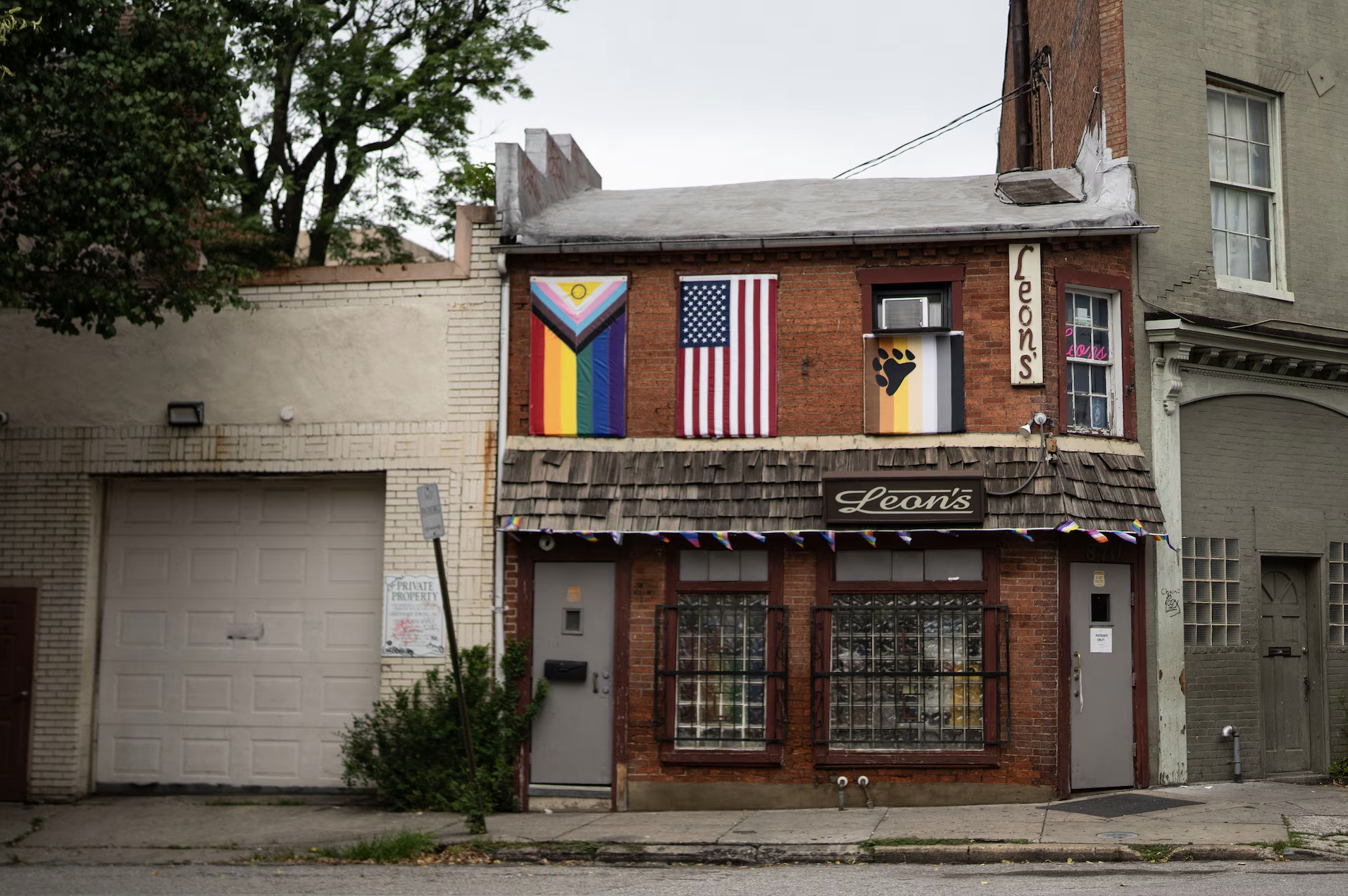
By CAYLA HARRIS | Ron Singer, the owner of Baltimore’s popular gay bar Leon’s Backroom, died Tuesday, the venue announced in a social media post. He was 66.
“For more than 20 years, Ron made Leon’s a place so many people were proud to call home,” the post reads. “He will be deeply missed.”
The Mount Vernon bar, typically open from 4 p.m. to 2 a.m. daily, is still open Thursday, but doors will close at midnight so staff can attend his funeral Friday morning. Services are scheduled to begin at 9:30 a.m. at Sol Levinson’s Chapel.
The rest of this article can be read on the Baltimore Banner’s website.
District of Columbia
Mary’s House founder, CEO retires
Dr. Imani Woody played leading role in opening DC’s first home for LGBTQ seniors
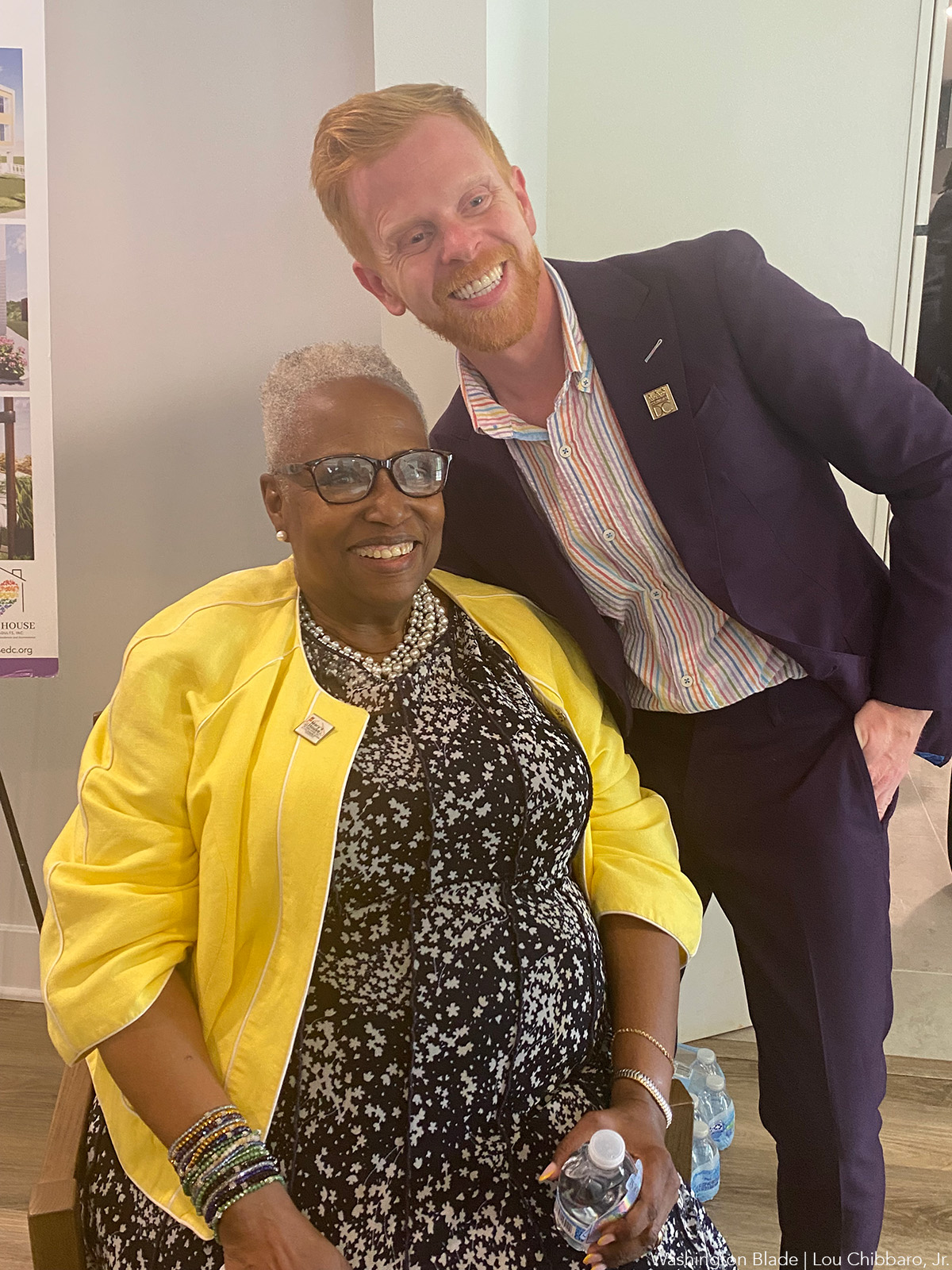
The board of directors for Mary’s House for Older Adults, DC’s first official home dedicated to providing affordable housing for LGBTQ seniors, announced on July 7 that its founding president and CEO, Dr. Imani Woody, has retired.
Woody, who holds a PhD in Human Services, is credited with playing a leading role over many years in arranging both city and private funding needed to construct and operate the Mary’s House three-story building located at 401 Anacostia Road, S.E., in the city’s Fort Dupont neighborhood.
The house, which opened in March 2025, with a grand opening ceremony held in May 2025, includes 15 single-occupancy residential units and more than 5,000 square feet of shared communal living space.
“It is with profound gratitude and hearts full of celebration that the board of directors of Mary’s House for Older Adults, DC (MHFOA) announces the retirement of our visionary founder, Dr. Imani Woody, from her role as president and CEO,” the Mary’s House board says in a statement.
“Dr. Woody’s journey with Mary’s House began with her vision and a kitchen table gathering of women with a bold, urgent, and loving vision: to create safe, affirming, affordable housing for LGBTQ/SGL older adults in Washington, DC,” the statement says.
It adds, “What started as a dream has grown into DC’s first affordable LGBTQ+/SGL affirming communal living space for adults 60 and over, a 15-room community residence at 401 Anacostia Road in Southeast Washington.”
The statement says Woody will continue to serve on Mary’s House board.
“The board will be sharing information about the leadership transition process in the coming weeks,” the statement continues. “We are committed to honoring Dr. Woody’s legacy by ensuring Mary’s House continues to thrive and grow in faithful service to LGBTQ/SGL elders experiencing housing insecurity and isolation.”

Campaign launched to elect more LGBTQ candidates to ANC seats

Gay librarian to discuss new novel at Green Lantern

Calendar: July 10-16

Gay Fla. Democrat Elijah Manley sees opportunity in Trump’s second term

Ron Singer, owner of popular Mount Vernon gay bar Leon’s, dies

‘My Favorite Sociopath’ debuts at Shepherdstown’s CATF

Under-the-radar Delaware beach towns smart buyers are targeting

In Trump’s divided America, Michael Weinstein’s AHF responds

Turkish authorities refuse to allow gay cruise to dock in country

When a church fears the rainbow
-

 Theater5 days ago
‘My Favorite Sociopath’ debuts at Shepherdstown’s CATF
-
Real Estate5 days ago
Under-the-radar Delaware beach towns smart buyers are targeting
-
Politics4 days ago
In Trump’s divided America, Michael Weinstein’s AHF responds
-
Turkey4 days ago
Turkish authorities refuse to allow gay cruise to dock in country