Local
Gray secures Stein Club endorsement
Fenty, opponent clash over issues in D.C. mayor’s race

The Gertrude Stein Democratic Club this week endorsed D.C. Council Chairman Vincent Gray in the mayor’s race. (Washington Blade photo by Michael Key)
D.C. Council Chairman Vincent Gray won the Gertrude Stein Democratic Club mayor’s race endorsement Monday, exceeding a required vote threshold of 60 percent by just three votes.
Activists familiar with the club, the city’s largest gay political group, had expected Gray to win more votes than D.C. Mayor Adrian Fenty. But most thought club members were more evenly split between the two contenders and that neither candidate would reach the 60 percent requirement.
“You can count on me as mayor of the District of Columbia to work with you to continue to make progress so that we could be the best jurisdiction in America for the GLBT community,” Gray said minutes after winning the endorsement.
A total 76 votes were cast in the mayor’s endorsement decision. Gray took 48 votes, or 63 percent, while Fenty received 24 votes, or 32 percent. Four people, or 5 percent, voted for no endorsement.
The endorsement came after club members voted 87 percent to 8 percent to endorse D.C. Congressional Delegate Eleanor Holmes Norton over challenger Douglas Sloan, a Ward 4 Advisory Neighborhood Commissioner. Norton is seeking re-election to an eleventh term in office.
Norton is considered to be among the most LGBT-supportive members of Congress and has a longstanding record of pushing pro-LGBT bills.
The club’s endorsement vote for Gray also came after Gray and Fenty challenged each other’s record on LGBT and non-LGBT issues during a part of the endorsement meeting designated as a candidates’ forum.
Stein Club member and radio talk show host Mark Levine, who served as moderator of the forum, said Fenty and Gray both have “very, very good records” in support of LGBT civil rights. He noted that both have been strong supporters of same-sex marriage, with Gray voting for the city’s marriage bill and Fenty signing it into law.
But written questions submitted by club members and read by Levine questioned Fenty’s record on LGBT issues during his time as mayor. One asked why his highly regarded AIDS office director, Dr. Shannon Hader, abruptly resigned two weeks ago. Another questioned why Fenty hasn’t issued a formal rescinding of a mayoral award to the anti-gay group PFOX, which Fenty has said was a mistake.
Others wanted to know why Fenty hasn’t attended the main Black Pride festival since becoming mayor and why he hasn’t used his “bully pulpit” as mayor to speak out against anti-LGBT hate crimes.
On the PFOX issue, Fenty gave his most detailed explanation to date as to why his office presented a ceremonial resolution to a group that says sexual orientation can be changed.
“The minute that this happened, when we found out that we had issued this ceremonial proclamation to PFOX, I personally said that my administration should not have done that, that it is my fault that it happened, and my apologies went out to each and every person in the city whom we had offended,” Fenty said.
“The fact of the matter is that when you have a lot of people working for you, sometimes mistakes happen,” he said. “The fact of the matter also is that as mayor of the District of Columbia, as a person who you elected, this should not have happened. I personally, professionally apologize to each and every person in this room, to each and every person in this city. … You have my assurance that I will work extremely hard to make sure nothing like this ever happens again.”
Gray, who criticized Fenty over the PFOX matter when it first surfaced earlier this year, did not address it during the Stein Forum.
Instead, he criticized Fenty for what Gray called a “confrontational” leadership style that has negatively affected his ability to lead the city on a wide range of issues.
Gray pledged to adopt a leadership marked by “cordiality” and “collegiality” that he said would foster cooperation, even on issues that are contentious, such as the public schools reform programs started by Fenty and that Gray said he supports.
Fenty said his administration has been on the forefront in support of LGBT civil rights in a number of areas at the same time it has improved city services for all residents, including LGBT residents and people with HIV/AIDS.
He praised Hader, director of the city’s HIV/AIDS Administration, for turning around what had been a trouble-plagued agency into an agency recognized nationally for its effectiveness in helping a city with the nation’s highest rate of HIV infection. He did not say during the Stein Club forum why Hader resigned.
Last week, the mayor told the Blade he believed she left in a career move to take another important job with an international health organization. He told the forum that Hader’s interim replacement, Dr. Nnemdi Kamanu-Elias, has training as a public health expert and AIDS specialist equal to that of Hader.
On public safety matters, Fenty said D.C. Police Chief Cathy Lanier has put together a “first-ever biased-crime report which hopefully will serve as a benchmark” to help police monitor and better fight hate crimes by encouraging more people to report hate crimes.
He cited Lanier’s decision to expand and decentralize the department’s Gay & Lesbian Liaison Unit — which requires all officers to be trained in LGBT-related issues and assigns GLLU-affiliated officers to each of the department’s seven police districts — as other ways to address bias-related crime.
“We can’t just have one specialized unit focusing on GLBT affairs and hate crimes,” Fenty said. “We need the entire department to do that.”
Gray, however, appeared to side with a number of activists who expressed skepticism over Lanier’s changes to the GLLU. Some activists have said the decentralized operation has detracted from the unit’s successful track record of operating as a cohesive team of mostly LGBT officers who responded to calls for service and investigated crimes against LGBT people.
“I absolutely think we do need a special unit within the [police department],” Gray said. “I think we’ve seen the success of it. One of the things I would do as mayor is hire a sergeant to run that unit, someone we know has the sensitivity to the issues that are important to us so that we will concentrate our efforts on hate crimes and other heinous crimes that are perpetrated on the basis of discrimination.”
As he has in other candidates’ forums, Fenty cited his public school reform program and the work of his public schools chancellor, Michelle Rhee, in accomplishing what he said are major improvements in student test scores. He criticized Gray for not disclosing whether he would retain or replace Rhee if elected mayor.
Following the forum, Levine asked the two candidates to step outside the hall at Town nightclub, where the event was held, to allow club members to discuss who they would support. Veteran gay activist and former Lambda Rising bookstore owner Deacon Maccubbin, former Stein Club officers Jeff Marootian and John Lazar spoke on Fenty’s behalf, saying he has been a highly effective mayor who deserves another term.
Former Whitman-Walker Clinic Deputy Director Pat Hawkins and gay Democratic activist Lane Hudson urged the club to endorse Gray, saying the Council chairman has a demonstrated record of strong support on LGBT issues.
Some Stein Club members, including Bob Summersgill, former president of the Gay & Lesbian Activists Alliance, who has not yet taken sides in the mayor’s race, said they were surprised that the Fenty campaign did not arrange for more supporters to join the club and vote for him.
“The Stein endorsement is largely an issue of campaign organizational strength,” Summersgill said. “I think that had the Fenty campaign wanted to win the endorsement, they had the means to get enough people to join and attend to swing the vote.
“It seemed like the Fenty campaign wasn’t really trying,” he said.
Other people noted that many of the same club members who voted Monday for a Gray endorsement voted four years ago to endorse then City Council Chairwoman Linda Cropp over Fenty in the mayor’s race. Fenty defeated Cropp by an overwhelming margin, and a Blade analysis of precincts with high concentrations of gay voters showed the gay vote going to Fenty by more than a three-to-one margin.
“So the question is does the Stein endorsement reflect the sentiment of the rank and file LGBT person in this city,” said Stein Vice President Sheila Alexander Reid, who supported Fenty in 2006.
Asked if she were supporting Fenty again this time, Reid said, “I want to wait until tomorrow to talk about this. I’m an officer and tonight the club made its endorsement.”




District of Columbia
SMYAL receives $25,000 award for ‘courageous acts’
D.C. group provides support services for LGBTQ youth
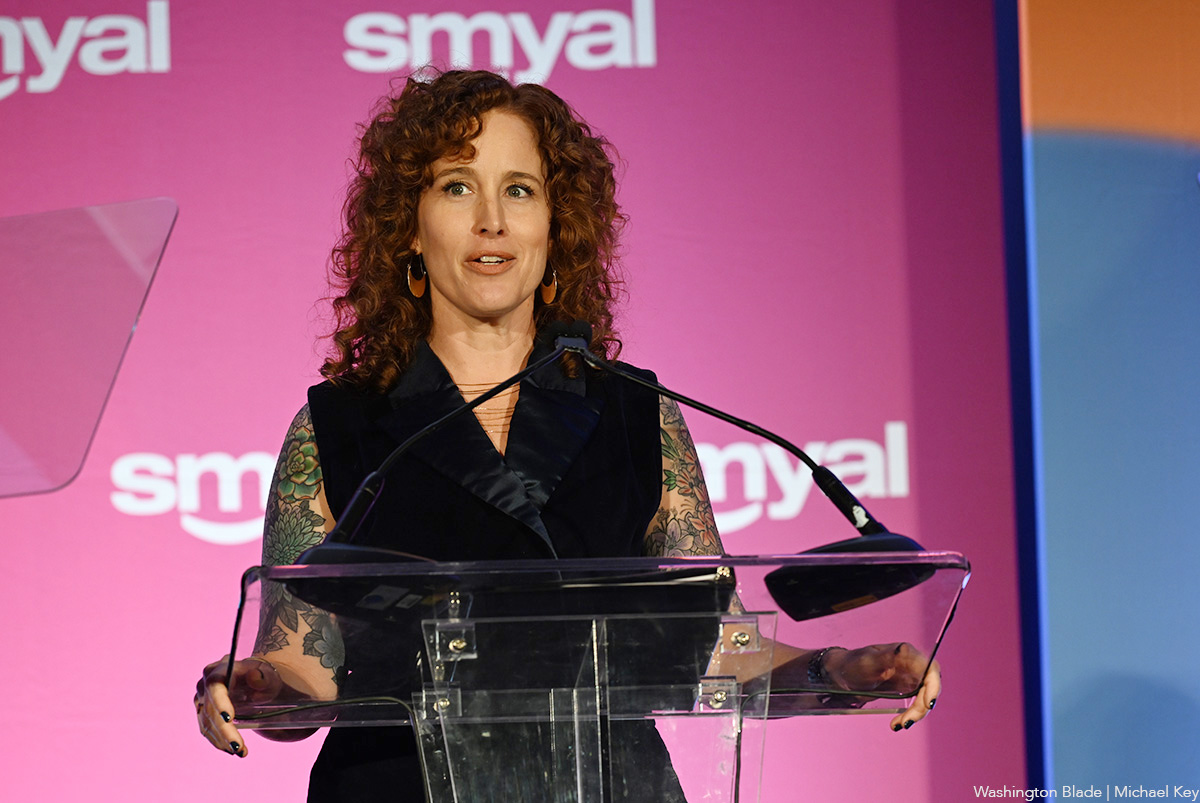
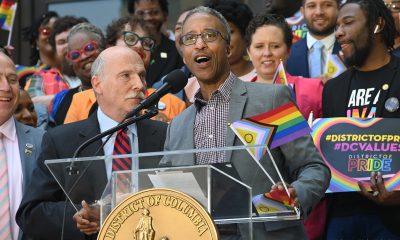
The D.C.-based organization SMYAL, which provides services for LGBTQ youth in the D.C. metro area, including housing for homeless LGBTQ youth, announced on June 30 that it received a $25,000 award for its “courageous acts” in support of the community it serves.
The award was a monetary grant from The Courage Project, which describes itself as a “national initiative investing in acts of courage and compassion that strengthens our communities and democracy.”
A statement on its website says it was launched in May 2025 and is funded and backed by leading national foundations in the U.S.
“At SMYAL, we are deeply grateful to receive support from The Courage Project and are inspired by their bold investment in LGBTQ+ youth at such a critical moment,” SMYAL CEO Erin Whelan said in a statement. “For queer and trans young people, simply showing up as themselves each day requires immense courage, and that courage is strengthened when organizations like The Courage Project stand behind them loudly, proudly, and without hesitation,” Whelan said.
In its statement announcing the award SMYAL says The Courage Project will recognize SMYAL and other awardees and their work on July 3 at the Washington National Cathedral as part of a special interfaith service marking the U.S. 250th anniversary.
“The Courage Project is a bold initiative honoring everyday acts of bravery – the quiet, often unseen acts of heroism that reflect the best of the American spirit and strengthen democracy at the community level,” the project states on its website.
Delaware
Delaware approves amendment protecting same-sex marriage
Measure must pass second vote in next year’s session

The Delaware General Assembly passed Senate Substitute 2 for Senate Bill 100 on the last day of the legislative session on Tuesday after being rescinded last week.
Senate Substitute 2 for Senate Bill 100 (SB-100) passed with 28 ‘yes’ votes, meeting the two-thirds threshold required for the bill to pass. Tuesday was the last day of the 153rd General Assembly.
The amendment would enshrine the right to same-sex and interracial marriage in the Delaware Constitution.
SB-100 was rescinded last week after it did not receive enough votes to pass. Democrats were short by three votes, with two Democratic members missing from the vote.
Rep. Josue Ortega (D-03) voted ‘no’ on SB-100 and Rep. Medinah Anton-Wilson (D-27) did not vote. However, both members voted ‘yes’ for Senate Substitute 2 for SB-100 on Tuesday.
Prime sponsor of SB 100, Rep. Claire Snyder-Hall (D-14), made the technical decision to change her vote last week from a ‘yes’ to a ‘no’ at the last minute to keep the bill alive.
Additionally, Republican Assemblyman Michael Smith (R-22) joined the Democrats with a ‘yes’ vote after voting ‘no’ on SB-100 last week.
In order for SB 100 to be enshrined into the state Constitution, it must be passed by two consecutive General Assemblies. Thus, the amendment will not be officially added to the Constitution unless it passes in the 154th General Assembly next year.
Rep. Snyder-Hall introduced the measure earlier this week.
“Just one week ago, we failed to pass this legislation. We failed the people of Delaware. But today, on the final day of the legislative session, the 153rd General Assembly affirmed that every Delawarean has the fundamental right to marry the person they love, regardless of race or gender,” said Snyder-Hall.
“Thank you to my colleagues for recognizing that the right to marry is a right worthy of protection and for voting yes on this important constitutional amendment.”
District of Columbia
Longtime Blade staffer Stephen Rutgers steps down after 14 years
Plans to focus on running Crush Dance Bar, other ventures

Longtime Washington Blade employee Stephen Rutgers announced he is stepping down after 14 years to focus on other ventures, including his part ownership of the popular Crush Dance Bar.
Rutgers was hired by the Blade in 2012 to help plan Pride festivities and over the years was promoted to director of sales and marketing. In addition to his broad set of responsibilities, Rutgers planned the annual Pride on the Pier celebration at the Wharf, which has exploded in popularity over the seven years since its launch.
“Watching Pride on the Pier grow from a new community event into one of D.C.’s signature Pride celebrations has been incredibly rewarding,” Rutgers said. “Expanding Pride on the Pier into a two-day festival for WorldPride in 2025 was definitely a career highlight. Seeing thousands of people come together to celebrate our community while supporting the Blade’s mission is something I’ll always be proud of.”

Rutgers described his biggest challenge as navigating the changing media landscape.
“More than ever, we’ve had to remind our community that local journalism matters and that it needs their support,” he said.
He added that he’s most proud of helping to ensure the Washington Blade is positioned to thrive for the next 50 years.
“I was fortunate to be part of the Blade during its 50th anniversary — a milestone that reflects its incredible history and impact,” Rutgers said. “The Blade has been an important voice for the LGBTQ community for more than five decades, and knowing I played a small part in helping its future is most important to me.”
Blade Publisher Brian Pitts praised Rutgers for juggling multiple responsibilities.
“We wish Stephen all the best,” Pitts said. “For the past 14 years, Stephen has been a vital part of the Blade, handling many things — marketing and advertising, sponsorships, and Blade signature events. We will all miss him.”
Blade Editor Kevin Naff thanked Rutgers for his years of service to the community.
“After 14 years, it’s hard to imagine the Blade without Stephen and his boundless energy and creativity,” Naff said. “He’s one of the hardest working and most dedicated people I’ve ever known and he will be missed. But change is the only constant and I know Stephen will move on successfully to new challenges and the Blade will expand on Stephen’s important work.”
As for what’s next for Rutgers, he said he plans to focus on Crush as well as his real estate business.
“I’ve always been someone who likes to stay busy,” Rutgers said. “For the past 12 years, I’ve balanced my work at the Blade and in real estate. Two years ago when I opened Crush, I never realized just how much time and energy it would take. The passing of my father earlier this year also gave me a new perspective. It reminded me that life is short and that it’s important to make time for the people and experiences that matter most. Stepping away from the Blade will allow me to focus on those ventures while also creating more balance in my life. After 14 incredible years, it feels like the right time for a new chapter.”
Naff said that for now Rutgers’s responsibilities will be divided between existing staff along with several new freelance contractors.
“The Washington Blade plays a unique role in our community’s fight for equality,” Rutgers said. “It’s the only LGBTQ news organization with White House credentials, giving it direct access to the people and institutions shaping policies that affect our community. The Blade continues to hold elected officials accountable, report on the issues that matter most to LGBTQ people, and tell the stories that often go uncovered by mainstream media.
“The Blade has been my family for most of my adult life. For 14 years, it has been part of my daily routine, so it’s going to feel very strange waking up and not logging on each morning.”

Turkish authorities refuse to allow gay cruise to dock in country

PHOTOS: Crush Dance Bar

In Trump’s divided America, Michael Weinstein’s AHF responds

When a church fears the rainbow

Under-the-radar Delaware beach towns smart buyers are targeting

Queen Camilla meets with JK Rowling

SMYAL receives $25,000 award for ‘courageous acts’

‘Transcendent’ a tough but important read
Under-the-radar Delaware beach towns smart buyers are targeting