Local
Equality Maryland board chair resigns
Departure comes one week after public spat with former director
The chair of the board of directors of Equality Maryland resigned on Tuesday and the financially troubled LGBT group reduced the salary of its interim executive director and significantly changed her duties, according to a statement released by the board.
Attorney Charles Butler resigned both from his post as chair of Equality Maryland’s board and from the board itself, according to Patrick Wojahn, who chairs a separate board of the Equality Maryland Foundation.
The statement released by the Equality Maryland board didn’t give a reason for Butler’s resignation. But his departure comes one week after he startled some of the group’s supporters and members by publicly blaming the group’s former executive director, Morgan Meneses-Sheets, for the organization’s serious financial woes.
Meneses-Sheets, whom the board fired in April, denounced Butler’s claim that she entered into expensive contracts on behalf of Equality Maryland and hired staff without the board’s approval or knowledge. In what observers called a messy public fight, Butler and Meneses-Sheets each told the Blade that the other shared the blame for a funding shortage that threatens to force the group to close its doors.
“As we announced last Tuesday, the financial situation of Equality Maryland is very serious,” Wojahn said in the statement released by the board on Tuesday.
“We are also hearing clearly through our Listening Tour that people in Maryland want to see significant change in how we operate,” he said. “As custodians of the statewide community’s equality organization, we are committed to building an Equality Maryland that takes community input into consideration and that relies on a sustainable funding model.”
Wojahn was referring to a series of community meetings that Equality Maryland has held over the past two weeks throughout the state that the group has dubbed “listening tour stops.” The next tour meeting was scheduled to take place June 9 in Silver Spring and another is scheduled for July 14 in Temple Hills.
The statement says part of the immediate change the board has approved is a new contract for the group’s recently hired interim executive director, Lynne Bowman, former executive director of the statewide LGBT group Equality Ohio.
“Effective June 1, Bowman’s focus will shift from external outreach and programmatic involvement to management of internal operations and an increased role directly supporting the board’s efforts to revamp the organization,” the statement says. “As part of the new contract, Bowman will work at a reduced fee and spend half of the month in Baltimore and the other half working virtually from Ohio. She will be contracted on a month-to-month basis.”
Wojahn told the Blade the board will fulfill, on a temporary basis, the duties that Bowman carried out as of this week in advocating for LGBT-related legislation before the Maryland Legislature along with other LGBT-related advocacy efforts.
He said that unless new sources of funding emerge within the next few weeks, all but one of the group’s staff members, the office manager, could be laid off by July 1.
“We offered the staff the opportunity to stay on for the next month,” Wojahn said. “We can’t promise anyone anything beyond that.”
“As part of the organization’ s focus on the future, the board will be meeting to develop a short-term strategic plan meant to guide the organization’ s non-programmatic activities through the end of 2011,” the statement released on Tuesday says. “In addition to a renewed focus on fundraising with individual donors, it is expected that the plan will also address ways to increase and diversify the membership of the board of Equality Maryland, enhance community involvement in the direction-setting and decision-making of the organization, and identify ways to tighten internal operations and governance. It is expected that the board will report back out to the community when the short-term plan is finalized.”
Sources familiar with LGBT politics in Maryland have said the Human Rights Campaign, which is based in Washington, D.C., was expected to lead a coalition of national and local groups in an effort next year to push for a same-sex marriage bill in the Maryland Legislature.
Some of the state’s leading transgender rights advocates announced two weeks ago that they have formed a new statewide group called Gender Rights Maryland, which they said would lead lobbying efforts for a comprehensive gender identity non-discrimination bill.



District of Columbia
Lewis George holds strong lead over McDuffie in D.C. mayor’s race
Gay Council member Parker wins in Ward 5; bi candidate leads in Ward 1

D.C. Council member Janeese Lewis George (D-Ward 4) was leading former D.C. Council member Kenyan McDuffie (D-At-Large) in the D.C. primary race for mayor late Tuesday night by a margin of 52.79 percent of the vote compared to 36.57 percent for McDuffie with 64 percent of the votes counted, according to information released by the D.C. Board of Elections at 11:55 p.m.
A Board of Elections spokesperson informed the media by email that the board had stopped its vote counting shortly before midnight and would resume its counting Wednesday morning, June 17.
The late-night returns showed Lewis George and McDuffie were far ahead of the other five candidates competing in the Democratic primary for mayor, with candidate Rini Sampath, who self-identifies as queer, receiving 2.93 percent of the vote.
Of the remaining Democratic mayoral candidates, former Council member Vincent Orange received 3.73 percent; businessman Gary Goodweather received 3.0 percent; and civic activists Hope Solomon, 1.09 percent; and Ernest Johnson 0.53 percent.
Election board spokesperson Sarah Graham noted in her email to the media that the initial vote percentages released Tuesday night were counted under the city’s newly implemented ranked choice voting system, which was in place for mayor, D.C. Council, D.C. congressional delegate, and D.C. attorney general. She said the follow-up “round-by-round tabulation results” when voters’ second, third, fourth and possibly fifth choices are counted under the ranked choice system, they are estimated to be released between Sunday, June 21 and Wednesday, June 24.
“The final round-by-round tabulation results will be released on or after June 26, 2026,” she stated. The ranked-choice system does not go into effect if a candidate receives at least 50 percent of the vote.
Lewis George and McDuffie have strong records of support on LGBTQ issues, and Goodweather expressed strong support for LGBTQ issues during the campaign. The Capital Stonewall Democrats, the city’s largest LGBTQ political group, endorsed Lewis George for mayor.
Although the election board had yet to declare a winner in the mayor’s race, with 36 percent of the votes cast not yet counted, Lewis George delivered a rousing speech at her election-night event at the Howard Theatre that many of her supporters considered a victory speech. Among those attending the event and expressing the belief that Lewis George was the expected winner was Capital Stonewall Democrats President Stevie McCarty.
“There’s still a lot of votes to count, but I feel very confident and it looks really good,” he said in referring to Lewis George and the LGBTQ community members who supported her campaign.
Like the other races for D.C. Council, the D.C. congressional delegate seat, and D.C. attorney general, most if not all of the candidates had either expressed support for LGBTQ rights or had strong records of support, like McDuffie and Lewis George. LGBTQ activists have said that meant LGBTQ voters would be choosing a candidate based on issues other than LGBTQ rights issues.
In other races, D.C. Council member Zachary Parker (D-Ward 5), the Council’s only gay member, was far ahead of two Democratic challengers, with 76.37 percent of the vote. Challengers Bernita Carmichael and Bridgete French received 15.28 percent and 7.57 percent respectively.
Political observers believe Parker is the strong favorite to win re-election in November against a Republican and a Statehood Green Party candidate.
In the Ward 1 D.C. Council race, where five LGBTQ supportive candidates were competing for the seat being vacated by Democratic incumbent Brianne Nadeau, who is not running for re-election, community activist Aparna Raj, who identifies as bisexual, was leading gay candidate and LGBTQ rights activist Miguel Trindade Deramo by a margin of 46.7 percent to 20.27 percent in a five-candidate race.
The other candidates were Rashida Brown, 17,18 percent; Jackie Reyes Yanes, 9.98 percent; and Terry Lynch, 5.75 percent.
In the race for the D.C. delegate seat to the U.S. House of Representatives, which is being vacated by retiring Del. Eleanor Holmes Norton (D), D.C. Council member Robert White (D-At-Large) was leading in a five-candidate race with 63.16 percent of the vote. His leading opponent, D.C. Council member Brooke Pinto (D-Ward 2) had 21.45 percent of the vote.
The vote count for the other candidates was 7.66 percent for Kinney Zalene; 4.55 percent of Trent Holbrook; and 2.8 percent for Greg Jaczko.
In other D.C. Council races Council Chair Phil Mendelson (D-At-Large) and Council member Matthew Frumin (D-Ward 3) were unopposed in the Democratic primary and are considered strong favorites to win re-election in November.
Nine Democrats competed for the At-Large D.C. Council seat being vacated by Council member Anita Bonds (D), who is not seeking re-election. Community activist and local pharmacist Oye Owolewa, who was endorsed by Capital Stonewall Democrats, was leading in the Democratic primary with 33.77 percent of the vote.
The vote count percentage for the other candidates were: Lisa Raymond, 15.22; Kevin Chavous, 13.84; Greg Jackson, 10.95; Candis Nelson, 7.67; Dwight Davis, 6.02; Dyana Forester, 3.72; and Leniqua Jenkins, 3.0.
In the Ward 6 D.C. Council race, Democratic incumbent Charles Allen, a longtime LGBTQ rights supporter who received the Capital Stonewall Democrats endorsement, was far ahead of his two Democratic challengers with 74.43 percent of the vote. Gloria Ann Nauden had 18.68 percent, and Michael Murph had 6.51 percent.
D.C. Attorney General Brian Schwalb, an outspoken supporter of LGBTQ rights who also received the Capital Stonewall Democrats endorsement, had 90.34 percent of the vote in the Democratic primary, with his sole opponent J.P. Szymkowicz receiving 9.15 percent.
In the special election to fill the At-Large Council seat that must go to a non-Democrat under the city’s Home Rule Charter, and which was vacated by McDuffie when he decided to run for mayor as a Democrat, former Council member Elissa Silverman was leading with 54.75 percent of the vote. Incumbent Council member Doni Crawford, who was temporarily appointed to the seat, was in second place with 34.81 percent of the vote. A third candidate, Jaque Patterson, had 19.27 percent. All three candidates ran as independents.
In the separate D.C. Republican and D.C. Statehood Green Party primaries held on June 16, all the offices for which a candidate from those two parties were on the ballot ran unopposed. No Republican candidate ran for D.C. mayor in the primary. With a large majority of D.C. voters being registered as Democrats, no Republican or Statehood Green Party candidate has won election to public office in D.C. for at least the past 10 years or longer. No known LGBTQ Republican or Statehood Green Party candidate was on the ballot in the June 16 primary.
Delaware
57 towns in 57 hours: Rep. McBride kicks off re-election campaign
Touts record of championing bipartisan legislation
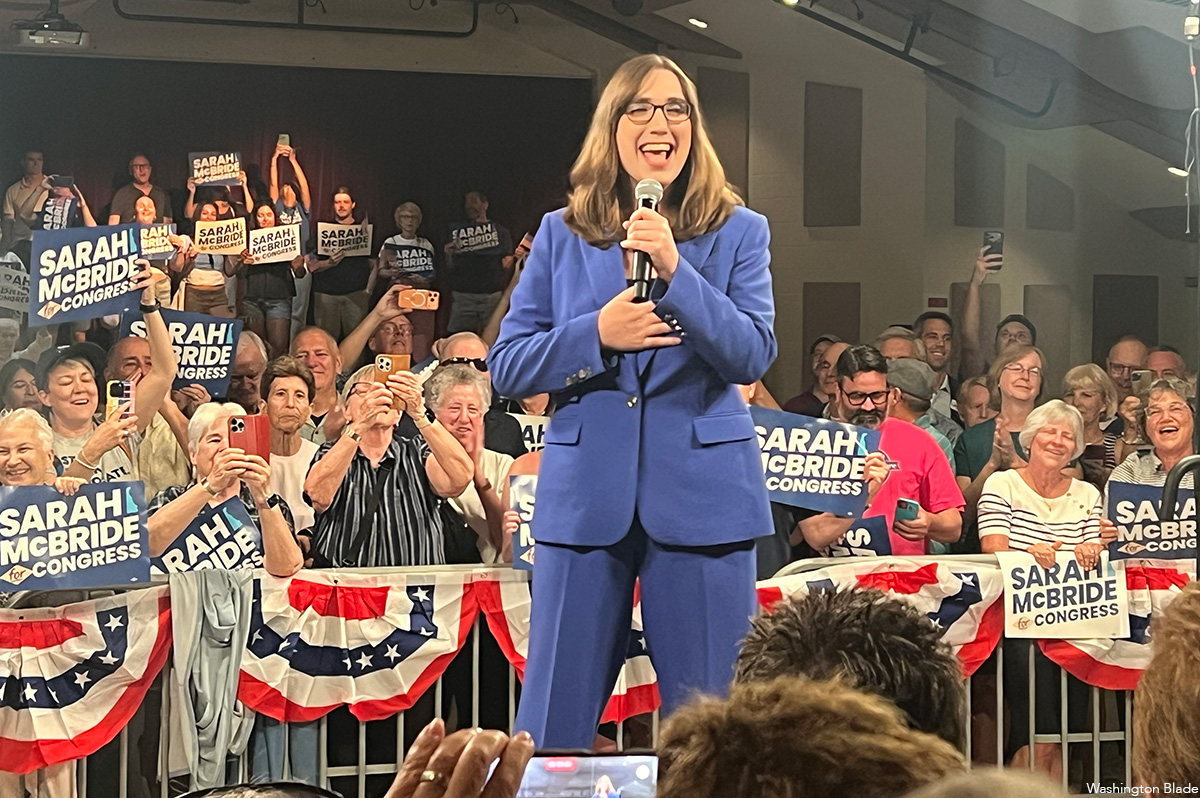
Rep. Sarah McBride (D-Del.) officially kicked off her re-election campaign this week with a grueling tour of her state that saw her visit 57 municipalities in just 57 hours.
The tour culminated Monday evening in Rehoboth Beach with a packed crowd at the Convention Center. At least 400 attendees stood patiently in a line that wrapped around the block and snaked down Rehoboth Avenue. Once inside, a DJ entertained the ebullient crowd that kept busy batting beach balls around the venue.
The crowd featured a large LGBTQ presence that cheered speakers including state Rep. Claire Snyder-Hall, state Sen. Russ Huxtable, and Delaware Democratic Party Chair Evelyn Brady, who introduced McBride.
McBride took the stage to Chumbawamba’s “Tubthumping” and the lyrics “I get knocked down, but I get up again.” In her remarks, she touched on a record of introducing more bipartisan legislation than any other freshman lawmaker and touted an award her office won for providing superior constituent service.
“People want leaders who are focused on lowering costs, solving problems, and delivering results,” she said. “That’s exactly what I’ve worked to do in Congress, and that’s why I’m running for re-election – to continue delivering for and defending Delaware.”
McBride is the first transgender member of Congress and is Delaware’s sole representative in the U.S. House. She will face the winner of the Republican primary in November. Rev. Earl Cooper — a former Democrat McBride defeated two years ago — is running for the GOP nomination. The state primary election is Sept. 15 and the general election is Nov. 3.
District of Columbia
D.C. nude dance club Archibald’s to feature male strippers beginning Pride weekend
Popular downtown venue to debut new lower floor gay ‘underworld’
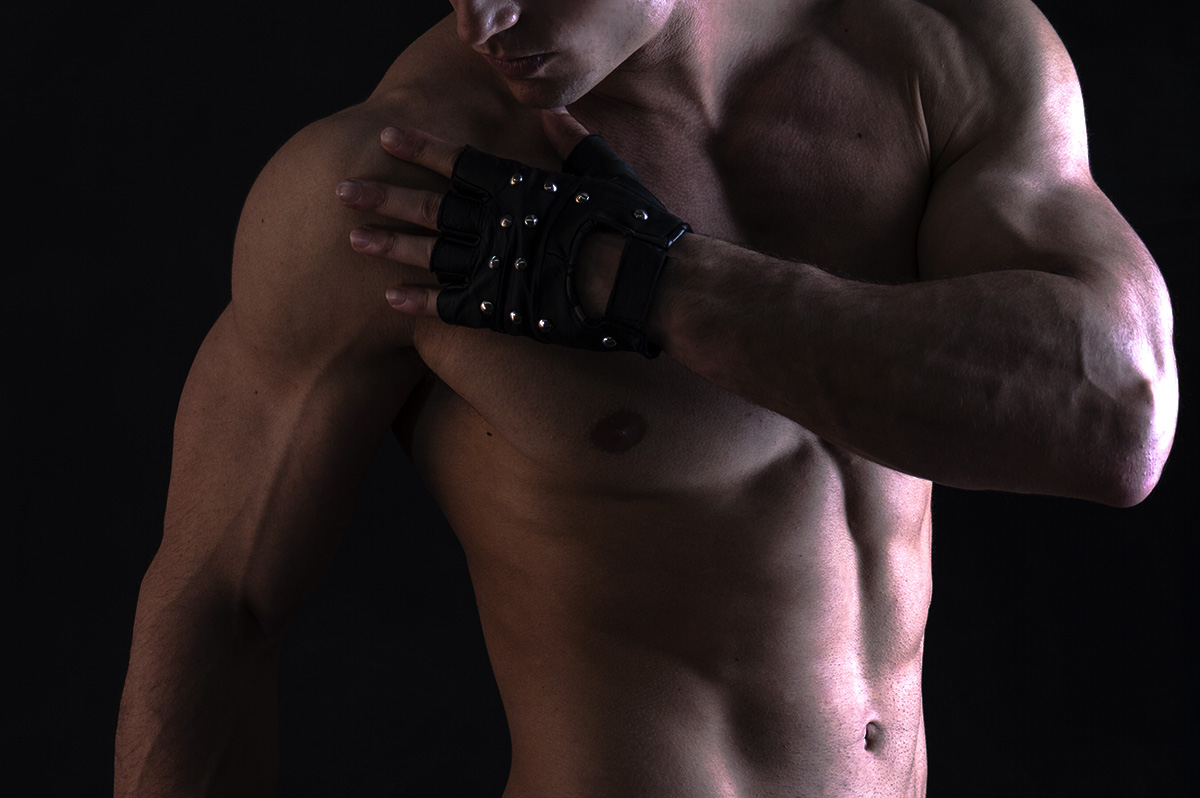
Archibald’s Gentlemen’s Club, which has offered adult entertainment in the nation’s capital involving nude female dancers since it first opened in 1969 at 1520 K St., N.W., will offer nude male dancers beginning Saturday night, June 20, according to co-owner Thom Naylor.
The female dancers will continue as usual on the upper two floors of Archibald’s three-story building, according to Naylor, who released a flier promoting the opening of the male dancer venue as an event “for Gay Pride.”
He told the Washington Blade he expects a dozen male dancers to perform beginning at 9 p.m. Saturday when D.C.’s LGBTQ Pride Parade will take place earlier in the day.
Following its opening night for the male dancers, Naylor said he plans to continue offering male nude dancers on Thursday, Friday, and Saturday evenings. The club is closed on Sundays and Mondays.
“I want to have an official Champagne grand opening probably in July,” he said referring to the male dance venue. “This is like a soft opening just to get going and to get everybody acclimated.”
The decision by Archibald’s to offer nude male dance entertainment for an LGBTQ clientele will mark the first time such entertainment will take place in D.C. since March 2020, when the LGBTQ nightclub Ziegfeld’s-Secrets, which featured nude male dancers, was forced to close at the start of the coronavirus pandemic.

The owner of the building at 1824 Half St., S.W., discontinued the Ziegfeld’s-Secrets lease a short time later to demolish the building and construct a high-rise residential condominium.
Naylor, who identifies as gay, said he has long believed nude male entertainment should be available in D.C. for a gay clientele as well as anyone else interested in that type of entertainment.
“So, we decided to go with three days in the summer and then come September go into a full swing when we’re open five days a week,” he said, referring to the male dancers.

Netherlands to ban conversion therapy

Lewis George holds strong lead over McDuffie in D.C. mayor’s race

War, geopolitical tensions with U.S. overshadow Pride month events

Confronting homophobia at school

57 towns in 57 hours: Rep. McBride kicks off re-election campaign

PHOTOS: Lost River Pride

PHOTOS: Pride on the Pier

The advantages of owning your home

David Archuleta on Mormon faith, ‘Idol,’ more in new book