National
The next champion of LGBT workplace rights?
Shiu would enforce ENDA-like executive order for federal contractors
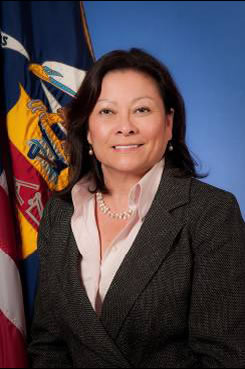
Patricia Shiu (Photo courtesy the Labor Department)
The Obama administration official who would be responsible for enforcing a proposed federal ban on discrimination against LGBT workers by federal contractors boasts a long record of advocating for LGBT rights.
Patricia Shiu heads the Labor Department’s Office of Federal Contract Compliance Programs (OFCCP), which enforces contractual promises of equal employment opportunity for companies doing business with the federal government.
If, as advocates have been pushing him to do, President Obama issues an executive order requiring federal contractors to adopt non-discrimination policies inclusive of sexual orientation and gender identity, Shiu would be responsible for ensuring companies live up to that obligation.
Federal contractors that discriminate against LGBT employees would have to answer to Shiu — and potentially have to pay back wages and reinstate workers fired for discriminatory reasons.
Tico Almeida, president of Freedom to Work and one of the chief advocates calling for the order, called Shiu a “smart and talented attorney” and said she’s “demonstrated throughout her career a real passion and commitment to enforcing civil rights laws.”
“As the executive order has advanced through the slow bureaucratic process over the course of the last year, I have felt reassured knowing that we have strong straight allies like Director Shiu on the inside advocating for workplace fairness for LGBT Americans,” Almeida said. “She knows the legal issues backwards and forwards, in part because she has real world experience at the Employment Law Center representing LGBT Americans who have faced workplace discrimination just because of who they are or whom they love.”
Because the measure is similar in its goal to the Employment Non-Discrimination Act, the directive has sometimes been referred to as the “ENDA” executive order, although the order would be more limited in scope because it only affects federal contractors. Multiple sources have said the Labor and Justice Departments have cleared such a measure, but the White House hasn’t said whether Obama will issue the directive.
Almeida said he met with staffers from OFCCP to advocate for the executive order, and had two meetings with Shiu herself. Almeida wouldn’t comment on the substance of the meetings, and Shiu declined an interview for this article.
If Obama issues the order, Shiu would be responsible for drafting and implementing regulations, putting them through a 90-day public comment period, revising the regulations and then publishing final rules.
“That could take six, eight, 10 or even 12 months, which is why it is so critical that President Obama get the process started by signing the executive order as soon as possible,” Almeida said.
No federal law protects LGBT people from discrimination in the workplace, but observers say Shiu has distinguished herself by protecting civil rights for other groups using as tools protections already in place since she took over at OFCCP in 2009.
Executive Order 11246, signed in 1965 by President Johnson, prohibits federal contractors from discriminating on the basis of race, color, religion, sex or national origin.
Several statutes also prevent companies doing business with the federal government from discriminating against employees. Section 503 of the Rehabilitation Act of 1973 prohibits job bias based on disability and Section 4212 of the Vietnam Era Veterans’ Readjustment Assistance Act of 1974 prohibits job bias based on veteran status.
OFCCP’s work is focused on compliance evaluations of contractors who are scheduled for reviews, when compliance officers check to make sure contractors are meeting these obligations. According to the Labor Department, Shiu’s office investigated 356 complaints filed under Executive Order 11246, Section 503 of the Rehabilitation Act of 1973 and Section 4212 of the Vietnam Era Veterans’ Readjustment Assistance Act of 1974.
Under the Obama administration, OFCCP has recovered more than $30 million in financial remedies on behalf of nearly 50,000 victims of discrimination. In the past three years, the agency has evaluated more than 12,000 businesses that employ almost 5 million workers. In addition to back wages, interest and benefits, OFCCP has negotiated more than 4,800 potential job offers for workers who have been illegally subjected to discrimination.
Nancy Zirkin, executive vice president for policy at the Leadership Conference on Civil and Human Rights, had high praise for Shiu’s work in enforcing non-discrimination rules with federal contractors.
“Overall, her commitment to reinvigorate and ramp up the enforcement of the agency has been amazing, which is not surprising because she has dedicated her whole career to protecting workers and promoting diversity and enforcing the law,” Zirkin said. “In her previous role, she was always very well respected in the legal and policy advocacy community.”
Zirkin said the Employment Task Force of the Leadership Conference on Civil and Human Rights has worked with her on the National Equal Pay Enforcement Task Force, which was charged with cracking down on violations of equal pay laws affecting women.
“We think she has been throughout her career and continues to be a stellar point for the civil rights community,” Zirkin said.
If Obama were to issue the ENDA executive order, Zirkin predicted that Shiu would be an effective enforcer of that directive.
“Based on her entire life’s work, she would implement and enforce it, and as I said in the beginning, she has made a demonstrated commitment to reinvigorate and ramp up enforcement at the agency,” Zirkin said.
In June, Shiu secured one such major financial reward from a pharmaceutical giant and federal contractor as the result of allegations of gender discrimination in violation of Executive Order 11246.
AstraZeneca, among the largest pharmaceutical companies in the world, agreed to pay $250,000 to 124 women subjected to discrimination while working at the corporation’s Philadelphia Business Center in Wayne, Pa. The action resolved a lawsuit filed by the Labor Department in May 2010 alleging the company discriminated against female sales specialists by paying them salaries that were, on average, $1,700 less than their male co-workers.
OFCCP conducted a scheduled compliance review of the business center in 2002 and found AstraZeneca had violated Executive Order 11246 by failing to meet its obligations as a federal contractor to ensure employees were paid fairly. According to the Labor Department, the company holds a contract valued at more than $2 billion with the Department of Veterans Affairs to provide pharmaceutical products to hospitals and medical centers throughout the country.
Shiu is credited with being a stalwart supporter of civil rights and LGBT rights even before she came to the Labor Department. Prior to joining the Obama administration, Shiu was an attorney for 26 years at the San Francisco-based Legal Aid Society Employment Law Center and worked on employment discrimination cases, including LGBT-related cases.
Elizabeth Kristen, current director of the Employment Law Center’s Gender Equity and LGBT Rights Program, said Shiu was her mentor at the organization before she left and “an incredible champion for civil rights.”
“She is a tough litigator and she’s a passionate advocate and she’s incredibly smart and she really when she was here just went to bat for her clients,” Kristen said.
Kristen said Shiu worked on cases at the Legal Aid Society Employment Law Center affecting LGBT employees and said she “fully gets the issues and is a staunch, staunch ally to the LGBT community.” The Law Center wouldn’t reveal information about these cases, citing confidentiality agreements.
A lesbian who married her spouse in San Francisco in 2008, Kristen said Shiu in addition to her legal work was outspoken against Proposition 8, the ballot measure that ultimately eliminated marriage rights for gay couples in California.
“Many of our straight allies were working to get President Obama elected, which is great and wonderful but some of us also were fighting Prop 8 on Election Day, and Pat was also with us fighting Prop 8,” Kristen said.
Kristen added Shiu was involved in a Legal Aid Society Employment Law Center decision to gross up the pay for employees in same-sex marriages to offset the tax inequities faced by these individuals. Because of the Defense of Marriage Act, individuals in same-sex marriages have to pay a federal tax on health care benefits, unlike those in opposite-sex unions.
Should Obama issue the ENDA executive order, Kristen said Shiu “would do everything in her power to enforce it.”
“She would do everything she could to make sure that this order was fully effective because I know the rights of the LGBT community are near and dear to her heart,” Kristen said.



Florida
Gay Fla. Democrat Elijah Manley sees opportunity in Trump’s second term
State’s 20th Congressional District’s includes Broward, Palm Beach Counties

Just over two and a half miles from President Donald Trump’s primary residence lies one of Florida’s most reliably Democratic congressional districts. There, a 27-year-old progressive is mounting a campaign centered on resisting what he calls the Trump-Vance administration’s attacks on civil rights, immigrants, and LGBTQ Americans.
Elijah Manley, an openly gay Democrat, sat down with the Washington Blade to discuss why he is running for Florida’s 20th Congressional District, why he believes this moment calls for a new generation of leadership, and what he hopes to accomplish if elected to Congress.
Born and raised in Fort Lauderdale’s historic Sistrunk neighborhood — the city’s oldest African American community — Manley was raised by a single mother who struggled to make ends meet. His family experienced housing insecurity and, at one point, homelessness, experiences he says continue to shape both his politics and his policy priorities.
For Manley, those experiences are precisely what he believes Congress is missing.
“I think now the country is in need of somebody like me, with my story, my lived experience, the struggles I’ve been through in my life. We’re going through a really dark time in the country with the Trump administration coming for our civil rights and an economy that is not working for everybody. In a time where we have MAGA fascism, we need progressive leadership, and we need people who are really going to do the work of fighting back and resisting and obstructing Donald Trump and MAGA Republicans’ agenda in Congress.”
Manley said his campaign is also about ensuring people from marginalized communities — those without wealth, political connections, or institutional backing — have a voice in Congress.
“I think my story sets me aside from everyone else. I’m the only one in this race who has a story to tell voters that lines up with their lived experiences and their struggles. Growing up in poverty and experiencing homelessness was instrumental in developing my worldview and how I fight for people, and I think that’s something that’s absent on Capitol Hill.”
He argues that lived experience offers a perspective often missing on Capitol Hill.
“There are too many lawyers and people coming from professional and political backgrounds. Then you have somebody like me who is rooted in the story of this district. That’s what sets me apart from everyone else in this race.”
According to his campaign website, Manley’s interest in public service dates back to childhood. He cites the election of President Barack Obama as a defining moment that inspired him to pursue politics.
“He was inspired by Barack Obama’s historic election, igniting his passion for public service. He began writing to elected officials, speaking at school board and city council meetings, and advocating for issues affecting his community,” the website states. It goes on to describe his involvement in criminal justice and law magnet programs, Navy JROTC, and hundreds of hours of volunteer service while in high school.
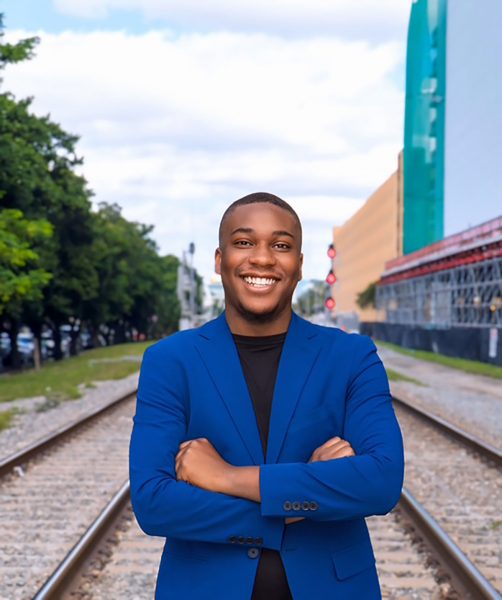
As an openly gay candidate running during Trump’s second administration, Manley said Congress must take a far more aggressive approach to protecting LGBTQ Americans, particularly as Republican-led states continue passing restrictions targeting transgender people.
“I think we need to bring the hammer down on some of these states. I’m not one of these states’ rights people — Congress has the power to preempt laws that states pass through the Supremacy Clause. There’s never been a more important time in our history when we’re seeing fascism, we’re seeing an administration out of control, and we need Congress to act.”
His campaign has also drawn criticism from both Republicans and establishment Democrats for his positions on Gaza, immigration, and his call to abolish U.S. Immigration and Customs Enforcement.
Manley said abolishing ICE does not mean eliminating immigration enforcement altogether.
“I’m not saying there should be no immigration laws. We want laws around immigration, but we want dignity. We don’t need a hypermilitarized, paramilitary group chasing people through the streets, terrorizing communities, churches, schools, and families.”
His personal experiences also inform his healthcare agenda.
“When we talk about healthcare, my experience growing up on Medicaid is seeing the failure of the government to expand Medicaid here in Florida, and now we’re seeing cuts from the Trump administration. I’m not just looking at statistics or numbers on paper — this is based on lived experience. I know how the people in this district are going to be hurt by these policies because I’ve lived it.”
California Democratic Congressman Ro Khanna, who has generated early buzz as a potential 2028 presidential contender for his “progressive capitalist” approach to governing, has endorsed Manley’s campaign, giving the first-time congressional candidate one of his highest-profile endorsements.
Manley faces six other Democrats in the primary, including U.S. Rep. Debbie Wasserman Schultz and former U.S. Rep. Sheila Cherfilus-McCormick, along with four Republican candidates in the general election field. Cherfilus-McCormick resigned from Congress ahead of a potential expulsion and is running again while facing federal criminal charges.
Despite running as the youngest candidate in the field, Manley said he hopes voters leave the race remembering one thing above all else.
“I want people to remember bold and authentic leadership. I want them to know I’m running because I’ve been through what people are going through right now — and it’s not that I’ve been through it, I’m actually still going through it. We need bold people who are going to fight for everybody and stand up for what’s right, and that’s what I hope voters see when they go to the polls.”
Florida
Former Fla. gubernatorial candidate Andrew Gillum arrested on drug charges
Democrat narrowly lost to DeSantis in 2018, later came out as bisexual
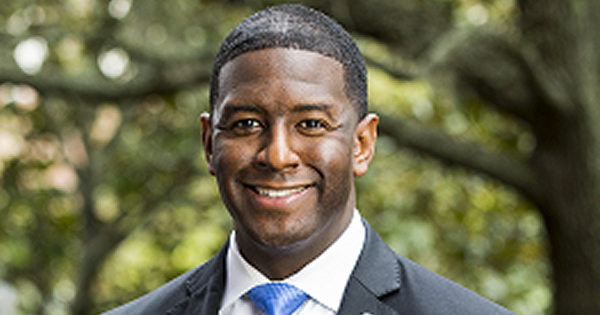
Andrew Gillum, the former Democratic nominee for governor of Florida and former mayor of Tallahassee, was arrested on drug possession charges in Alabama last week.
Police in Daphne, Ala., said they pulled Gillum over for erratic driving and found marijuana and methamphetamine in his vehicle. He was charged with possession of marijuana and unlawful possession of a controlled substance, according to the Daphne Police Department. Jail records show he was arrested on July 2 and released on July 3, the Associated Press reports.
Gillum, the first Black nominee of a major political party for governor in Florida, lost the 2018 election to current Republican Gov. Ron DeSantis in a highly contentious race.
Once considered a rising star in national politics, Gillum served in Tallahassee’s local government, first as a city commissioner and then as mayor of Florida’s capital from 2014- 2018.
The Daphne Police Department said officers stopped Gillum’s vehicle around 10:45 p.m. and initiated a probable cause search after one officer noticed a glass pipe on the center console.
During the search, officers found several rolled marijuana cigarettes and three packages containing a substance that tested positive for methamphetamine, police said.
The day after his arrest he was charged with possession of dangerous drugs, use or possession of drug paraphernalia, and possession of marijuana.
In 2020, Gillum was involved in a similar incident when he was found in a Miami Beach, Fla., hotel room with a man identified as an escort who had apparently overdosed on drugs. Police also found three bags of suspected crystal methamphetamine in the room. The man survived, and no one was ever charged with a crime.
Later that year, Gillum came out as bisexual during an appearance on “The Tamron Hall Show,” where he discussed his struggles with drug and alcohol addiction and his decision to seek treatment following the 2020 incident.
In the same interview he shed light onto this, saying his substance use was a byproduct of the emotional struggles he experienced after losing the 2018 gubernatorial race to DeSantis.
This is not the first time Gillum has faced legal scrutiny.
During his 2014 mayoral campaign, he faced allegations of misconduct after hiring private equity investor Adam Corey as his campaign treasurer, raising questions about a potential conflict of interest. However, the FBI ultimately concluded there was no conflict of interest.
Pennsylvania
Philadelphia murder suspect remains at large
Two killed, one injured in attacks motivated by victims’ sexual orientation

Police seek the public’s support in finding a suspect wanted in connection with three Philadelphia shootings, including two murders, who may have targeted his victims because they were gay. All three shootings took place near Hunting Park Recreation Center between May 29 and June 26.
The suspect is 21-year-old Jahylin Melchur, who has not been located by police and is not in police custody as of July 7. Police seek the public’s support in tracking down the suspect, whose image was captured on surveillance cameras. Previous reporting underlined that Melchur should be considered armed and dangerous.
Each of the victims was found partially clothed between 10 and 11 p.m.
On May 29, a 55-year-old in Juniata Park was found two miles from the rec center. The victim, who survived the encounter with critical injuries, said a man approached him and announced his intention to rob him, before shooting him in the elbow and torso.
Martin Higgins, 45, was pronounced dead on the bleachers of the rec center’s baseball field on June 20, suffering from a gunshot wound to the abdomen. Sharef Holman, 29, was found near the basketball courts on June 26, suffering from multiple gunshot wounds. He was transported to Temple University Hospital but died shortly thereafter.
Deputy Police Commissioner Frank Vanore declined to answer the Philadelphia Inquirer’s question regarding whether the victims may have met Melchur on a dating app, citing the ongoing investigation. Sources told the Philadelphia Inquirer that investigators are exploring this possibility
Although robbery may be at least part of the motive in the first shooting, other movies are unclear.
NBC10 reported that law enforcement sources told the station all three victims were targeted because they were gay, but the Philadelphia Police Department did not confirm this.
The Philadelphia Police Department replied to PGN’s questions with an email stating, “This remains a very active investigation, and investigators are looking at all aspects of the case, including underlying motivations for committing these crimes.
“At this point, we can confirm that Melchur is wanted for two homicides by shooting and one non-fatal shooting, all of which occurred in the Hunting Park area.
“The investigation has not established that the victims were specifically targeted because of their sexual orientation.”
The Philadelphia Police Department is urging anyone with information to contact the Homicide Unit at 215-686-3334 or submit an anonymous tip by calling the PPD Tip Line at 215-686-TIPS (8477).
(This story is republished with permission of the Philadelphia Gay News.)

Campaign launched to elect more LGBTQ candidates to ANC seats

Gay librarian to discuss new novel at Green Lantern

Calendar: July 10-16

Gay Fla. Democrat Elijah Manley sees opportunity in Trump’s second term

Ron Singer, owner of popular Mount Vernon gay bar Leon’s, dies

In Trump’s divided America, Michael Weinstein’s AHF responds

Turkish authorities refuse to allow gay cruise to dock in country

When a church fears the rainbow

PHOTOS: Crush Dance Bar