Local
Pappas: D.C. making progress in fight against HIV
2.7 percent of Washingtonians were living with disease in 2010.
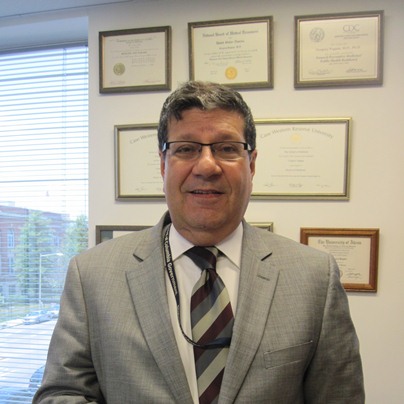
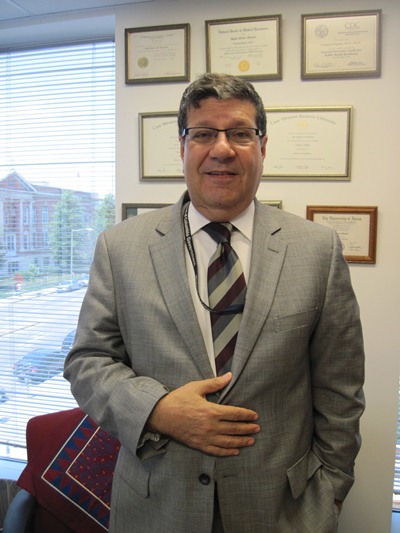
Dr. Gregory Pappas (Blade photo by Michael K. Lavers)
The head of D.C.’s response to HIV/AIDS stressed on Monday that the city continues to make progress in its fight against the epidemic.
“We’re catching people earlier in the disease,” noted Dr. Gregory Pappas, director of the Department of Health’s HIV/AIDS, Hepatitis, Sexually Transmitted Disease and Tuberculosis Administration. “It used to be everybody who was tested pretty much had AIDS or was very close to having AIDS. Now, we’re finding people earlier in the disease.”
A total of 14,465 people — or 2.7 percent — of Washingtonians were living with the virus at the end of 2010. The report further noted that African Americans remain disproportionately impacted by the epidemic with 4.3 percent of black D.C. residents living with HIV. 6.3 percent of black D.C. men had the virus, compared with 2.4 percent of whites and three percent of Latinos. DOH further noted that black women accounted for 92.4 percent of D.C. women with HIV.
The report further indicates that the number of new HIV diagnoses among black Washingtonians between 2006 and 2010 decreased 24 percent, compared to a 36 percent decrease among white D.C. residents during the same period.
Same-sex and heterosexual sexual contact remain the two leading modes of HIV transmission in the city. Slightly more than 77 percent of white D.C. residents and 55.5 percent of Latino Washingtonians who tested positive between 2006 and 2010 contracted the virus through men who have sex with men, compared to only 30.7 percent of black D.C. residents. Nearly 39 percent of black Washingtonians who tested positive during this period contracted the virus through heterosexual sexual contact.
DOH further noted that it distributed more than five million male and female condoms in 2011, and has tripled the number of publicly supported HIV tests from 2007. The city recommends that Washingtonians get tested at least once a year – and MSM have an HIV test every six months. Pappas said that one-third of D.C. residents get tested annually.
“We’re a national leader on that, but it’s way off from where we need to be,” he said.
D.C. Council member David Catania [I-At Large] introduced a bill last fall that would require doctors and other health care providers to attend HIV/AIDS workshops as part of their ongoing education requirements. Lawmakers subsequently approved the measure.
“We’re using that as a way to try and promote doctors to offer the test,” said Pappas.
In addition to increased testing, the DOH report further noted that roughly 89 percent of the 4,879 people who tested positive for the virus in D.C. between 2005 and 2009 were connected to HIV-specific care by the end of 2010. “We do well with connecting to care,” said Pappas, stressing the need for improved coordination between publicly funded clinics and HIV/AIDS community service providers. “The big problem is people don’t stay in care. And that’s where we’re falling down.”
Pappas credited the city’s needle exchange program for a 72 percent drop in HIV rates among intravenous drug users between 2007 and 2010—the city disposed of more than 340,000 syringes through its needle exchange program last year, which is an increase of 3,000 from 2010.Mortality rates for Washingtonians with HIV also fell by almost 50 percent from 2006 to 2010.
Pappas noted that half of those with HIV who die each year succumb to an unrelated illness, while the remaining 50 percent of people with the virus in D.C. die from HIV-related causes. He said liver failure associated with Hepatitis C has become one of the leading causes of death among people with HIV.
“It’s about 75 people annually, but that’s still too high in the District of Columbia,” said Pappas, referring to the city’s overall HIV mortality rate. “We can get to near zero deaths. We’ve gotten to zero new infections among kids, we can get to zero deaths or very near.”
Pappas further stressed that these HIV-related deaths once again highlight what he describes as the need for people with the virus to stay in treatment and continue to take their medication. “At this point since there’s no one in the District of Columbia that’s totally virally resistant now, right now all those people should be able to live,” he said.
D.C. preps for AIDS conference
The city continues to make final preparations for the International AIDS Conference that will kick off at the Walter E. Washington Convention Center on July 22.
HAHSTA will present 15 scientific abstracts during the five-day conference. The D.C. Center for AIDS Research, the body that coordinates HIV/AIDS-specific research in Washington, will highlight city-based research in a Global Village session that will be free and open to the public.
Mayor Vincent Gray and Maryland Gov. Martin O’Malley wrote a letter to President Obama earlier this year in support of a more regional-based strategy that Pappas said would allow neighboring jurisdictions to more effectively coordinate their responses to HIV/AIDS.
“The jurisdictions are working well together well on HIV/AIDS, but we still got a long ways to go,” he said, pointing to a lack of regional data. “I can tell you about D.C. in great detail, but when we’re talking about what’s going on around us, it’s a more difficult picture. We’ve got to look at that.”
Pappas also cited a hypothetical case of a Prince George’s County resident who may live across the street from a D.C. clinic that can have difficulties using their Maryland Medicaid to pay for HIV-related services in Washington as an example of the need for a more regional approach to fighting the epidemic. He also pointed to an estimate that treatment for a person with HIV costs $400,000 over the course of their lifetime—and the epidemic adds $1 million to D.C.’s long-term health care expenditures each day.
“Investment now will save huge amounts of money in the future,” said Pappas, referring to regional investment to combat HIV. “We can do better with the dollars we have if we coordinated better.”




Virginia
DOJ seeks to join lawsuit against Loudoun County over trans student in locker room
Three male high school students suspended after complaining about classmate
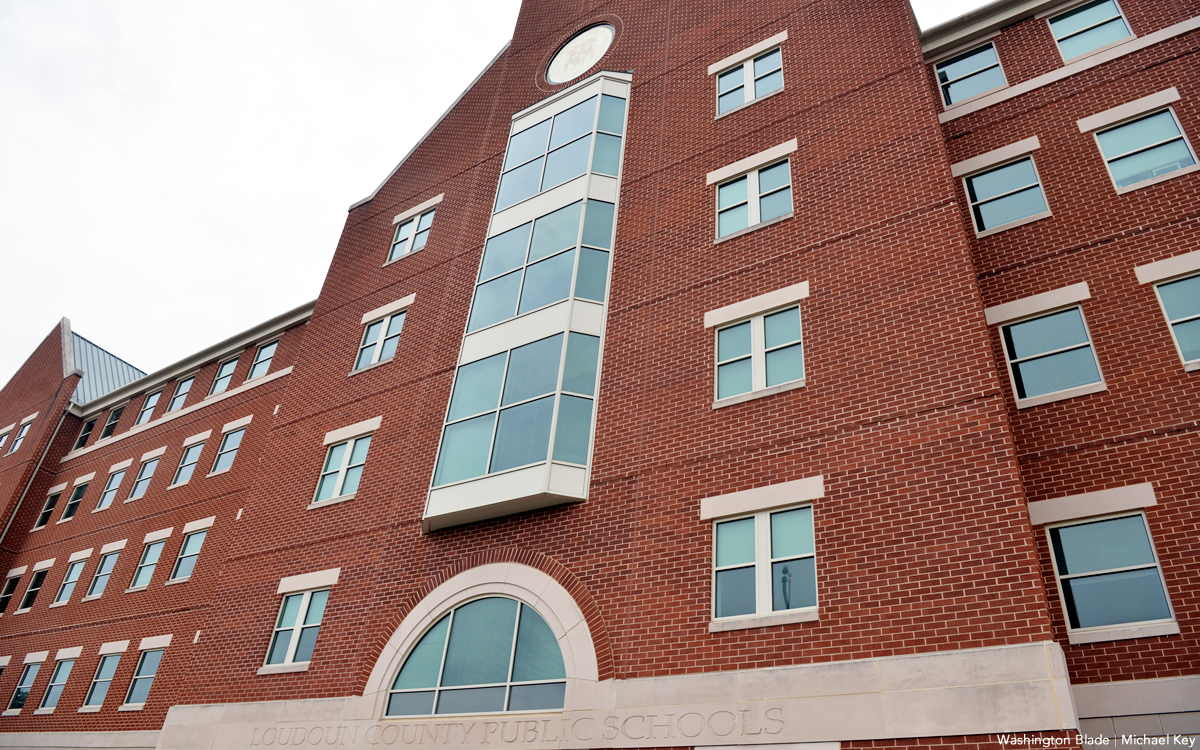
The Justice Department has asked to join a federal lawsuit against Loudoun County Public Schools over the way it handled the case of three male high school students who complained about a transgender student in a boys’ locker room.
The Washington Blade earlier this year reported Loudoun County public schools suspended the three boys and launched a Title IX investigation into whether they sexually harassed the student after they said they felt uncomfortable with their classmate in the locker room at Stone Bridge High School in Ashburn.
The parents of two of the boys filed a lawsuit against Loudoun County public schools in U.S. District Court for the Eastern District of Virginia in Alexandria. The Richmond-based Founding Freedoms Law Center and America First Legal, which White House deputy chief of staff Stephen Miller co-founded, represent them.
The Justice Department in a Dec. 8 press release announced that “it filed legal action against the Loudoun County (Va.) School Board (Loudoun County) for its denial of equal protection based on religion.”
“The suit alleges that Loudoun County applied Policy 8040, which requires students and faculty to accept and promote gender ideology, to two Christian, male students in violation of the Equal Protection Clause of the 14th Amendment to the U.S. Constitution,” reads the press release.
Assistant Attorney General Harmeet K. Dhillon of the Justice Department’s Civil Rights Division in the press release said “students do not shed their First Amendment rights at the schoolhouse gate.”
“Loudoun County’s decision to advance and promote gender ideology tramples on the rights of religious students who cannot embrace ideas that deny biological reality,” said Dhillon.
Outgoing Virginia Gov. Glenn Youngkin and outgoing Virginia Attorney General Jason Miyares in May announced an investigation into the case.
The Virginia Department of Education in 2023 announced the new guidelines for trans and nonbinary students for which Youngkin asked. Equality Virginia and other advocacy groups claim they, among other things, forcibly out trans and nonbinary students.
The U.S. Department of Education’s Office of Civil Rights in February launched an investigation into whether Loudoun County and four other Northern Virginia school districts’ policies in support of trans and nonbinary students violate Title IX and President Donald Trump’s executive order that prohibits federally funded educational institutions from promoting “gender ideology.”
District of Columbia
Capital Pride announces change in date for 2026 D.C. Pride parade and festival
Events related to U.S. 250th anniversary and Trump birthday cited as reasons for change

The Capital Pride Alliance, the D.C. based group that organizes the city’s annual LGBTQ Pride events, has announced it is changing the dates for the 2026 Capital Pride Parade and Festival from the second weekend in June to the third weekend.
“For over a decade, Capital Pride has taken place during the second weekend in June, but in 2026, we are shifting our dates in response to the city’s capacity due to major events and preparations for the 250th anniversary of the United States,” according to a Dec. 9 statement released by Capital Pride Alliance.
The statement says the parade will take place on Saturday, June 20, 2026, with the festival and related concert taking place on June 21.
“This change ensures our community can gather safely and without unnecessary barriers,” the statement says. “By moving the celebration, we are protecting our space and preserving Pride as a powerful act of visibility, solidarity, and resistance,” it says.
Ryan Bos, the Capital Pride Alliance CEO and President, told the Washington Blade the change in dates came after the group conferred with D.C. government officials regarding plans for a number of events in the city on the second weekend in June. Among them, he noted, is a planned White House celebration of President Donald Trump’s 80th birthday and other events related to the U.S. 250th anniversary, which are expected to take place from early June through Independence Day on July 4.
The White House has announced plans for a large June 14, 2026 celebration on the White House south lawn of Trump’s 80th birthday that will include a large-scale Ultimate Fighting Championship (UFC) event involving boxing and wrestling competition.
Bos said the Capital Pride Parade will take place along the same route it has in the past number of years, starting at 14th and T Streets, N.W. and traveling along 14th Street to Pennsylvania Ave., where it will end. He said the festival set for the following day will also take place at its usual location on Pennsylvania Avenue, N.W., between 2nd Street near the U.S. Capitol, to around 7th Street, N.W.
“Our Pride events thrive because of the passion and support of the community,” Capital Pride Board Chair Anna Jinkerson said in the statement. “In 2026, your involvement is more important than ever,” she said.
District of Columbia
Three women elected leaders of Capital Pride Alliance board
Restructured body includes chair rather than president as top leader
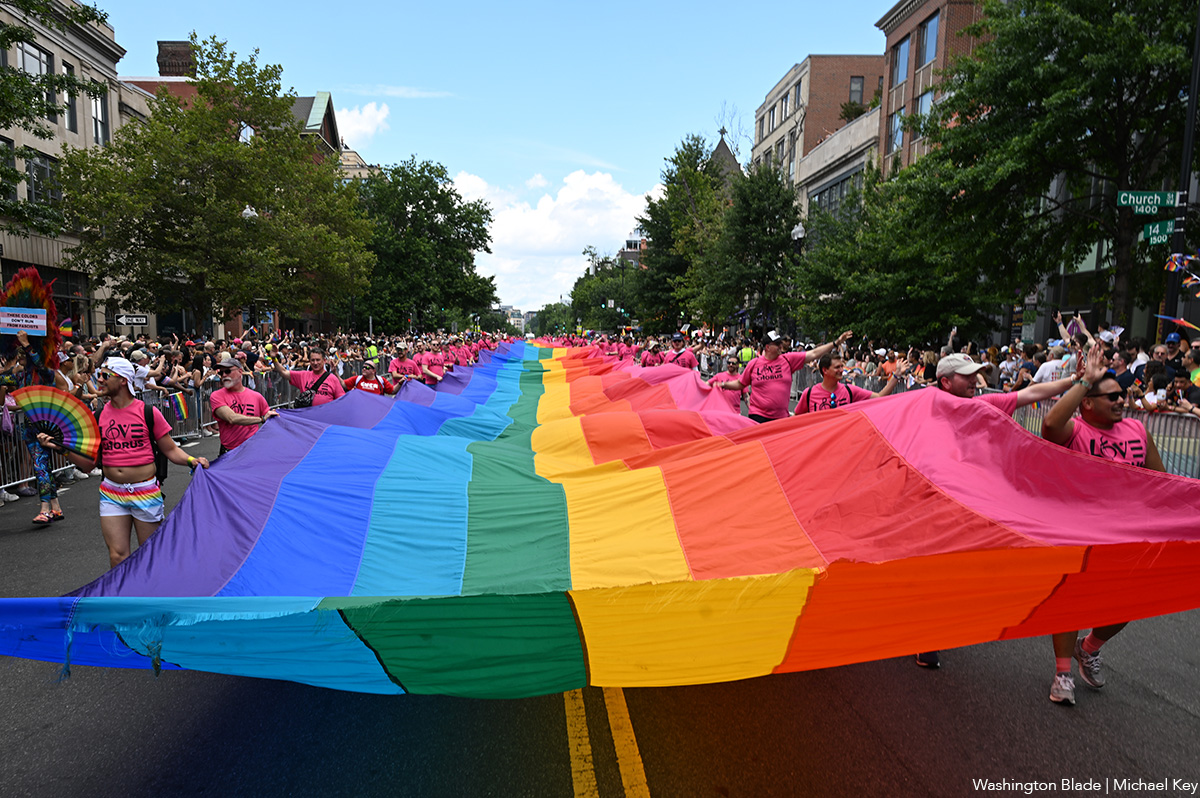
The Capital Pride Alliance, the D.C.-based group that organizes the city’s annual LGBTQ Pride events, announced it has restructured its board of directors and elected for the first time three women to serve as leaders of the board’s Executive Committee.
“Congratulations to our newly elected Executive Officers, making history as Capital Pride Alliance’s first all-women Board leadership,” the group said in a statement.
“As we head into 2026 with a bold new leadership structure, we’re proud to welcome Anna Jinkerson as Board Chair, Kim Baker as Board Treasurer, and Taylor Lianne Chandler as Board Secretary,” the statement says.
In a separate statement released on Nov. 20, Capital Pride Alliance says the restructured Board now includes the top leadership posts of Chair, Treasurer, and Secretary, replacing the previous structure of President and Vice President as the top board leaders.
It says an additional update to the leadership structure includes a change in title for longtime Capital Pride official Ryan Bos from executive director to chief executive officer and president.
According to the statement, June Crenshaw, who served as acting deputy director during the time the group organized WorldPride 2025 in D.C., will now continue in that role as permanent deputy director.
The statement provides background information on the three newly elected women Board leaders.
• Anna Jinkerson (chair), who joined the Capital Pride Alliance board in 2022, previously served as the group’s vice president for operations and acting president. “A seasoned non-profit executive, she currently serves as Assistant to the President and CEO and Chief of Staff at Living Cities, a national member collaborative of leading philanthropic foundations and financial institutions committed to closing income and wealth gaps in the United States and building an economy that works for everyone.”
• Kim Baker (treasurer) is a “biracial Filipino American and queer leader,” a “retired, disabled U.S. Army veteran with more than 20 years of service and extensive experience in finance, security, and risk management.” She has served on the Capital Pride Board since 2018, “bringing a proven track record of steady, principled leadership and unwavering dedication to the LGBTQ+ community.”
• Taylor Lianne Chandler (Secretary) is a former sign language interpreter and crisis management consultant. She “takes office as the first intersex and trans-identifying member of the Executive Committee.” She joined the Capital Pride Board in 2019 and previously served as executive producer from 2016 to 2018.
Bos told the Washington Blade in a Dec. 2 interview that the Capital Pride board currently has 12 members, and is in the process of interviewing additional potential board members.
“In January we will be announcing in another likely press release the full board,” Bos said. “We are finishing the interview process of new board members this month,” he said. “And they will take office to join the board in January.”
Bos said the organization’s rules set a cap of 25 total board members, but the board, which elects its members, has not yet decided how many additional members it will select and a full 25-member board is not required.
The Nov. 20 Capital Pride statement says the new board executive members will succeed the organization’s previous leadership team, which included Ashley Smith, who served as president for eight years before he resigned earlier this year; Anthony Musa, who served for seven years as vice president of board engagement; Natalie Thompson, who served eight years on the executive committee; and Vince Micone, who served for eight years as vice president of operations.
“I am grateful for the leadership, dedication, and commitment shown by our former executive officers — Ashley, Natalie, Anthony, and Vince — who have been instrumental in CPA’s growth and the exceptional success of WorldPride 2025,” Bos said in the statement.
“I look forward to collaborating with Anna in her new role, as well as Kim and Taylor in theirs, as we take on the important work ahead, prepare for Capital Pride 2026, and expand our platform and voice through Pride365,” Bos said.

PHOTOS: The Holiday Show

The best books to give this holiday season

Studio’s ‘Mother Play’ draws from lesbian playwright’s past

Choose U ambassadors share lived experiences with HIV, personal reflections, and insights

DOJ seeks to join lawsuit against Loudoun County over trans student in locker room

EXCLUSIVE: George Santos speaks out on prison, Trump pardon, and more

Victory Institute honors transgender Spanish senator in D.C.

The beginning of the fall of Trump

Markey reintroduces International Human Rights Act in Senate