Connect with us

Arts & Entertainment

Shifting ‘Shape’

World premier depdicts married Vaudevillians on tour
Published

on

Dane Figueroa Edidi, force/collision production, Shape, gay news, Washington Blade

‘Shape’
force/collision
Atlas Performing Arts Center
1333 H Street, NE
$10-$25
202-399-7993, ext. 2
Dane Figueroa Edidi, force/collision production, Shape, gay news, Washington Blade

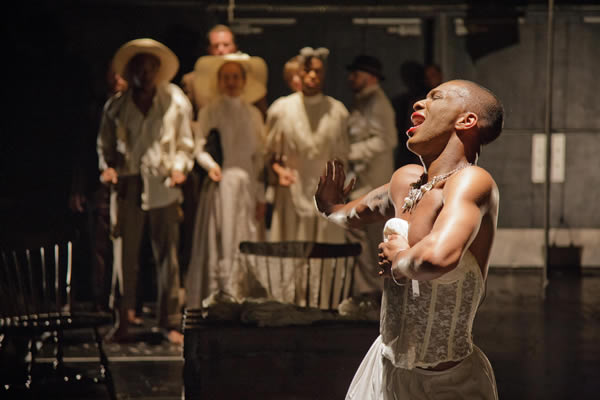
Dane Figueroa Edidi in ‘Shape,’ a force/collision production. If you want to see it, act fast — it closes Saturday. (Photo by C. Stanley Photography)

Young local company force/collision isn’t afraid to take on tough material.

Their last production was a site-specific project inspired by the Washington Navy Yard performed over a nippy spring weekend in outdoor fountains at a park on the Southwest Waterfront. Now, the ensemble is tackling very different-but-equally challenging work by experimental dramatist Erik Ehn titled “Shape” (currently nearing the end of a world premiere run at Atlas Performing Arts Center). In both cases, the productions have proved intriguing and visually compelling.

Roughly based on the lives African-American vaudevillians Billy and Cordelia McClain, “Shape” follows the married couple’s experiences over time as they move from place to place.

As the lights come up, the scene is set by Survivor (the excellent Dexter Hamlett), a narrator who’s big on lyricism but short on concrete detail (thank goodness for program notes). It’s turn-of-the-century Ambrose Park, Brooklyn where Billy (Frank Britton) and Cordelia (Dane Figuero Edidi) are headlining in “Black America,” a true life spectacle in which about 500 black entertainers glorified plantation life in the Old South.

After the Brooklyn show closes, the couple sojourns to Europe where they eschew their usual daily dose of minstrelsy for racier entertainments — Cordelia introduces a new sexy Jazz Age act while Billy finds adventure in the arms of myriad other women. The marriage crumbles and they return to the states where Billy is on hand for the Tulsa Race Riots of 1921, a hideous episode in American history that left thousands of black families homeless and scores dead.

Director John Moletress, who is gay, leads a talented design team in admirably presenting Ehn’s sometimes puzzling play.

Collin Ranney (also gay) transforms Atlas’ black box theater into an enchanted place.  Above a lawn of excelsior hang tiny glowing fairy houses that rise and fall like the vaudevillians fortunes. In the center sits a stump; nearby there’s an old steamer trunk. At either end of the space are billowy sails, bookending a small world both redolent of the past, of suggestive voyage and escape.

Ariel J. Benjamin’s dramatic lighting and Derek V. Knoderer’s equally evocative soundscape add to the overall effect.

And while the production is visually appealing, and boasts inventive staging (random chairs and a few actors magically morph into a railroad passenger car) and a strong cast, its lack of linear narrative can be frustrating at times, especially since Ehn is tying historical facts to larger themes. (“Shape” is part of Ehn’s “Soulographie,” a series of 17 plays about genocide and reconciliation.)

Mostly, it’s best to sit back and let Ehn’s dreamlike prose wash over you; enjoy the production’s haunting songs, stirring, avian-inspired movement and the dedicated cast. Figueroa Edidi’s Cordelia is sublime: a diva with a sense of humor. She’s resilient but not wholly inured to life’s hardships. In one of his stronger performances, Britton captures Billy as the charming philanderer. Other standouts include Karin Rosnizek’s clueless French reporter and Luci Murphy as a soulful, singing vaudevillian.

The parts of Cordelia and her maid (S. Lewis Feemster) have been cast with male actors, heightening theatricality and a focus on identity. The choice also pays homage to black vaudevillians of the early 20th century who often played cross-gendered roles.

With “Shape,” force/collision strikingly fulfills its mission to create new performance works. And while “Shape” is sometimes hard to follow, it’s always beautiful to watch.

Advertisement
FUND LGBTQ JOURNALISM
SIGN UP FOR E-BLAST

Movies

A ‘Battle’ we can’t avoid

Critical darling is part action thriller, part political allegory, part satire

Published

on

Leonardo DiCaprio stars in ‘One Battle After Another.’ (Photo courtesy of Warner Bros.)

When Paul Thomas Anderson’s “One Battle After Another” debuted on American movie screens last September, it had a lot of things going for it: an acclaimed Hollywood auteur working with a cast that included three Oscar-winning actors, on an ambitious blockbuster with his biggest budget to date, and a $70 million advertising campaign to draw in the crowds. It was even released in IMAX. 

It was still a box office disappointment, failing to achieve its “break-even” threshold before making the jump from big screen to small via VOD rentals and streaming on HBO Max. Whatever the reason – an ambivalence toward its stars, a lack of clarity around what it was about, divisive pushback from both progressive and conservative camps over perceived messaging, or a general sense of fatigue over real-world events that had pushed potential moviegoers to their saturation point for politically charged material – audiences failed to show up for it. 

The story did not end there, of course; most critics, unconcerned with box office receipts, embraced Anderson’s grand-scale opus, and it’s now a top contender in this year’s awards race, already securing top prizes at the Golden Globe and Critics’ Choice Awards, nominated for a record number of SAG’s Actor Awards, and almost certain to be a front runner in multiple categories at the Academy Awards on March 15.

For cinema buffs who care about such things, that means the time has come: get over all those misgivings and hesitations, whatever reasons might be behind them, and see for yourself why it’s at the top of so many “Best Of” lists.

Adapted by Anderson from the 1990 Thomas Pynchon novel “Vineland,” “One Battle” is part action thriller, part political allegory, part jet-black satire, and – as the first feature film shot primarily in the “VistaVision” format since the early 1960s – all gloriously cinematic. It unspools a near-mythic saga of oppression, resistance, and family bonds, set in an authoritarian America of unspecified date, in which a former revolutionary (Leonardo DiCaprio) is attempting to raise his teenage daughter (Chase Infiniti) under the radar after her mother (Teyana Taylor) betrayed the movement and fled the country. Now living under a fake identity and consumed by paranoia and a weed habit, he has grown soft and unprepared when a corrupt military officer (Sean Penn) – who may be his daughter’s real biological father – tracks them down and apprehends her. Determined to rescue her, he reconnects with his old revolutionary network and enlists the aid of her karate teacher (Benicio Del Toro), embarking on a desperate rescue mission while her captor plots to erase all traces of his former “indiscretion” with her mother.

It’s a plot straight out of a mainstream action melodrama, top-heavy with opportunities for old-school action, sensationalistic violence, and epic car chases (all of which it delivers), but in the hands of Anderson – whose sensibilities always strike a provocative balance between introspection, nostalgia, and a sense of apt-but-irreverent destiny – it becomes much more intriguing than the generic tropes with which he invokes to cover his own absurdist leanings.

Indeed, it’s that absurdity which infuses “One Battle” with a bemusedly observational tone and emerges to distinguish it from the “action movie” format it uses to relay its narrative. From DiCaprio (whose performance highlights his subtle comedic gifts as much as his “serious” acting chops) as a bathrobe-clad underdog hero with shades of The Dude from the Coen Brothers’ “The Big Liebowski,” to the uncomfortably hilarious creepy secret society of financially elite white supremacists that lurks in the margins of the action, Anderson gives us plenty of satirical fodder to chuckle about, even if we cringe as we do it; like that masterpiece of too-close-to-home political comedy, Stanley Kubrick’s 1964 nuclear holocaust farce “Dr. Strangelove,” it offers us ridiculousness and buffoonery which rings so perfectly true in a terrifying reality that we can’t really laugh at it.

That, perhaps, is why Anderson’s film has had a hard time drawing viewers; though it’s based on a book from nearly four decades ago and it was conceived, written, and created well before our current political reality, the world it creates hits a little too close to home. It imagines a roughly contemporary America ruled by a draconian regime, where immigration enforcement, police, and the military all seem wrapped into one oppressive force, and where unapologetic racism dictates an entire ideology that works in the shadows to impose its twisted values on the world. When it was conceived and written, it must have felt like an exaggeration; now, watching the final product in 2026, it feels almost like an inevitability. Let’s face it, none of us wants to accept the reality of fascism imposing itself on our daily lives; a movie that forces us to confront it is, unfortunately, bound to feel like a downer. We get enough “doomscrolling” on social media; we can’t be faulted for not wanting more of it when we sit down to watch a movie.

In truth, however, “One Battle” is anything but a downer. Full of comedic flourish, it maintains a rigorous distance that makes it impossible to make snap judgments about its characters, and that makes all the difference – especially with characters like DiCaprio’s protective dad, whose behavior sometimes feels toxic from a certain point of view. And though it’s a movie which has no qualms about showing us terrifying things we would rather not see, it somehow comes off better in the end than it might have done by making everything feel safe.

“Safe” is something we are never allowed to feel in Anderson’s outlandish action adventure, even at an intellectual level; even if we can laugh at some of its over-the-top flourishes or find emotional (or ideological) satisfaction in the way things ultimately play out, we can’t walk away from it without feeling the dread that comes from recognizing the ugly truths behind its satirical absurdities. In the end, it’s all too real, too familiar, too dire for us not to be unsettled. After all, it’s only a movie, but the things it shows us are not far removed from the world outside our doors. Indeed, they’re getting closer every day.

Visually masterful, superbly performed, and flawlessly delivered by a cinematic master, it’s a movie that, like it or not, confronts us with the discomforting reality we face, and there’s nobody to save it from us but ourselves.

Continue Reading

Sports

‘Heated Rivalry’ stars to participate in Olympic torch relay

Games to take place next month in Italy

Published

on

(Photo courtesy of Crave HBO Max)

“Heated Rivalry” stars Hudson Williams and Connor Storrie will participate in the Olympic torch relay ahead of the 2026 Winter Olympics that will take place next month in Italy.

HBO Max, which distributes “Heated Rivalry” in the U.S., made the announcement on Thursday in a press release.

The games will take place in Milan and Cortina from Feb. 6-22. The HBO Max announcement did not specifically say when Williams and Storrie will participate in the torch relay.

Continue Reading

Bars & Parties

Here’s where to watch ‘RuPaul’s Drag Race’ with fellow fans

Entertainers TrevHER and Grey host event with live performance

Published

on

(Photo by New Africa/Bigstock)

Spark Social Events will host “Ru Paul’s Drag Race S18 Watch Party Hosted by Local Drag Queens” on Friday, Jan. 23 at 8 p.m.

Drag entertainers TrevHER and Grey will provide commentary and make live predictions on who’s staying and who’s going home. Stick around after the show for a live drag performance. The watch party will take place on a heated outdoor patio and cozy indoor space.

This event is free and more details are available on Eventbrite.

Continue Reading

Popular