Local
Same-sex couples seek Va. marriage licenses
Campaign for Southern Equality’s “We Do” campaign ended with march to D.C.
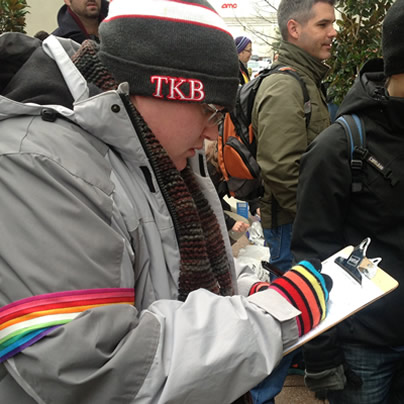
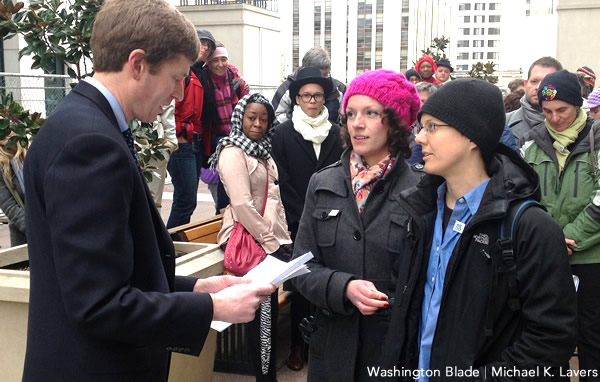
From left; D.C. residents Alyssa Weaver and Mike McVicker, who are from South Carolina, apply for a marriage license outside the Arlington County Courthouse on Jan. 17. (Washington Blade photo by Michael K. Lavers)
More than a dozen same-sex couples from across the South gathered outside the Arlington County Courthouse on Thursday to apply for marriage licenses.
Gays and lesbians from Alabama, Georgia, Mississippi, Tennessee and North and South Carolina submitted applications to Arlington Circuit Court Clerk Paul Ferguson in the complex’s plaza. A constitutional amendment that Virginia voters approved in 2006 defines marriage as between a man and a woman in the commonwealth, but those who participated in the action described their decision to take part as symbolic.
“We’re here to resist the unjust laws that label us as second class citizens and to call for full equality on the federal level,” Ivy Hill of Piedmont, S.C., told the Washington Blade after she filled out a marriage license in the complex plaza.
She and her partner of more than two years, Misha Gibson, recently became engaged.
“I’m here today to request a marriage license and knowingly being denied, but doing that to make sure that people know that we’re equal,” Gibson said. “I’m doing it to fight for my civil rights.”
Beth Schissel and Sally White of Atlanta joined four other same-sex couples who tried to apply for marriage licenses in Decatur, Ga., earlier this month.
White, who lived in Richmond for 30 years, joked with the Blade after Ferguson declined to issue them a marriage license she traveled to Virginia with her partner as a way to celebrate her birthday on Saturday.
“I’m a pediatric ER doctor,” Schissel said with tears in her eyes. “I take care of your children and take care of the sick and injured and I served my country. I went to the Air Force Academy and I served my country on active duty and yet I can’t have all the rights that are afforded me under that word marriage under federal law. So it’s a slap in the face type of feeling and it hits you deep in your core.”
The Arlington protest was the last in a series of actions organized by the Campaign for Southern Equality to highlight a lack of marriage rights for same-sex couples in the South and to urge the federal government to extend full equality to LGBT Americans.
The “We Do” campaign kicked-off in Hattiesburg, Miss., on Jan. 2 when five gay and lesbian couples applied for marriage licenses. Others followed suit in Mobile, Ala., Morristown, Tenn., Greenville, S.C., and three North Carolina cities before traveling to Virginia.
“We all live here in the South and we’re Southern folks,” Rev. Jasmine Beach-Ferrara, executive director of the Campaign for Southern Equality, who is also an ordained minister with the United Church of Christ in Asheville, N.C., told the Blade in an interview earlier this month. “This is where we live and we’re working with LGBT folks in small towns and cities across the region who are ready to stand up for equality — federal equality in new ways.”
She stressed her group’s approach to highlight the lack of marriage rights for same-sex couples below the Mason-Dixon Line reflects a broader strategy.
“We do feel like because this is the region where discriminatory laws are most deeply enshrined in state law, it creates a really powerful and unique opportunity to revisit those laws by using peaceful, direct action,” Beach-Ferrara said. “What we’re doing with the ‘We Do’ campaign is folks are taking action in their local communities to resist these state laws, to show what happens when they’re actually enforced. They’re typically invisible because they’re so rarely enforced, if at all. And so the general public is sort of insulated from the reality that we live with day in and day out as LGBT folks in the South, which is these laws exist, but when they’re actually enacted and enforced there’s an opportunity to talk about what that actually means and how that hurts real people and real families.”
Matt Griffin and Raymie Wolfe of Morristown, Tenn., who have been together for more than seven years, sought a marriage license in their hometown on Jan. 9.
Wolfe told the Blade before he and his partner tried to obtain a Virginia marriage license that they were “met with good humor” when they tried to do the same in Tennessee. He noted the clerk said it was the first time a gay couple had ever applied for a marriage license in the town — she did reaffirm the Tennessee does not recognize nuptials for gays and lesbians.
“What we wanted to do was kind of illustrate for people and ourselves what happens when we do that,” Wolfe said. “That’s kind of unprecedented. That was my hometown. It’s where I grew up and as a gay kid there, I kind never imagined that i would be going to a courthouse with a partner and applying for a marriage license.”
Same-sex couples gathered in Arlington three days after a Virginia House of Delegates subcommittee voted against a proposal that would have repealed the state’s constitutional ban on same-sex marriage.
Neighboring Maryland is among the nine states and D.C. that allow gays and lesbians to tie the knot. North Carolina voters last May approved a constitutional amendment that defined marriage as between a man and a woman by a 61-39 percent margin, while Minnesota voters on Election Day rejected a similar proposal.
The upcoming oral arguments before the U.S. Supreme Court in cases challenging the constitutionality of the Defense of Marriage Act and California’s Proposition 8 also weighed on the minds of the same-sex couples who applied for marriage licenses and those who witnessed them do so.
“I’m very sympathetic to what the people who came before me today are trying to do and I am happy that there’s other jurisdictions where they can go to have their marriage licenses processed,” Ferguson, who is a former member of the Arlington Board of Supervisors, told the Blade. “There’s a Supreme Court decision coming up and so that will add some clarity to a lot of these peoples’ marriages, which is what they were looking for.”
Tim Young and Mark Maxwell of Winston-Salem, N.C., legally married at the Jefferson Memorial after they and other same-sex couples who had sought Virginia marriage licenses marched from Arlington to the nation’s capital.
“We live our lives in a way where we are not denied anything and we are open to being prosperous and successful,” Young, who has been with Maxwell for 20 years and raised four boys with him, said. “We’ve educated ourselves. We run a business so we pay taxes in that state and we give our money to that state, but we don’t have the same rights as other people and we believe in equity and equality.”
Beach-Ferrara noted her group made a deliberate decision to end their latest campaign in D.C.
“It’s in a lot of ways a small, intimate group, but of folks who traveled on a journey that’s symbolic in a lot of ways in the sense that if you live in the South, you need to travel to Washington, D.C., before you can be recognized as an equal citizen,” she said. “The journey folks have taken sort of helps to illustrate the legal realities that LGBT folks live with, which is you are a second class citizen until you reach the Washington border.”
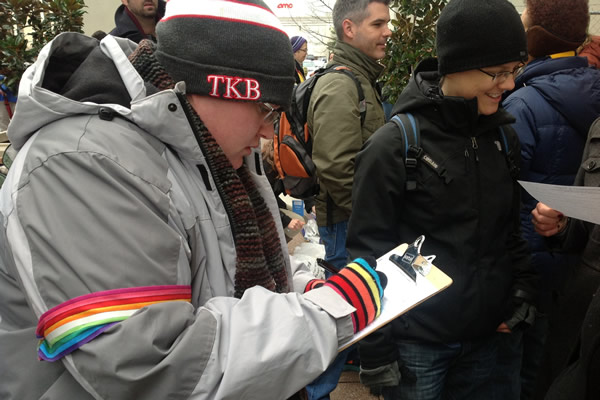
Ivy Hill of Piedmont, S.C., fills out a marriage license outside the Arlington County Courthouse on Jan. 17. (Washington Blade photo by Michael K. Lavers)


District of Columbia
Brian Footer suspends campaign for Ward 1 D.C. Council seat
Race’s third LGBTQ candidate cites family reasons for ‘stepping back’
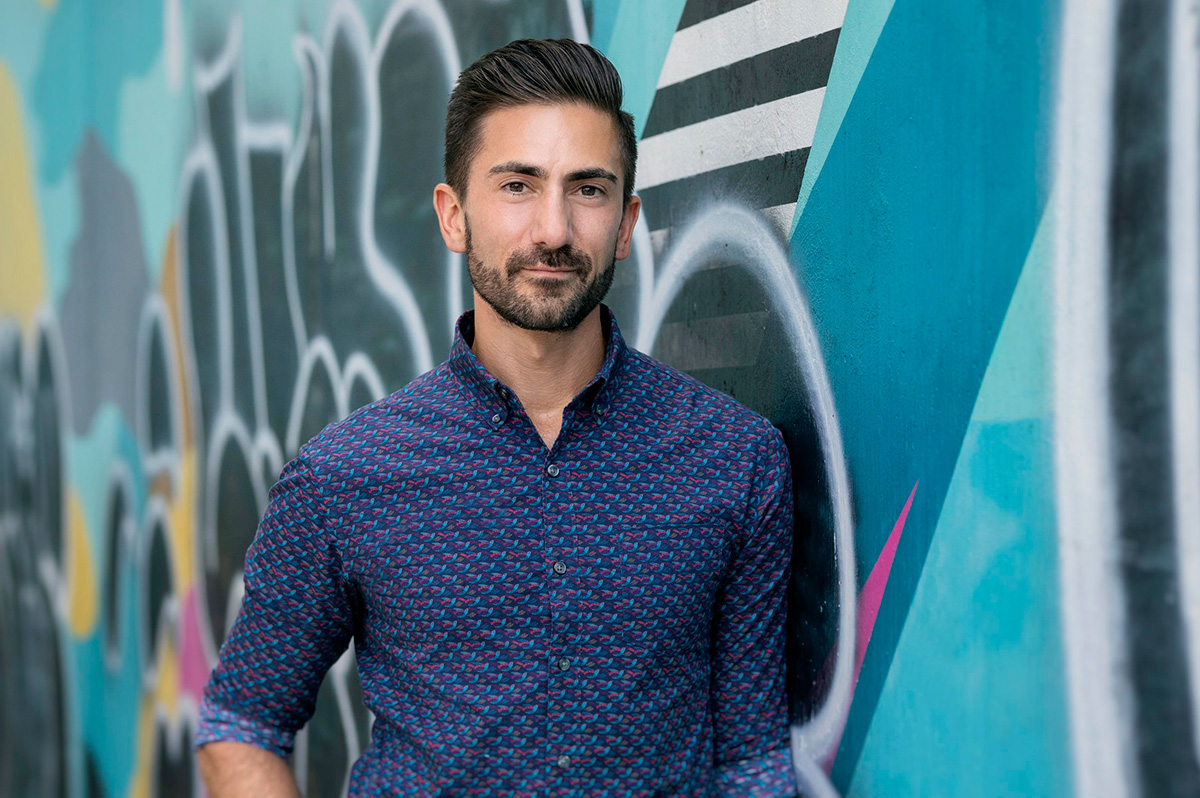
Gay Advisory Neighborhood Commissioner Brian Footer, who was one of three out LGBTQ candidates running for the open Ward 1 D.C. Council seat in the city’s June 16, 2026, Democratic primary, announced on Dec. 17 he has decided to “suspend” his campaign to focus on his family.
“After deep reflection and honest conversations with my family, I have decided to suspend my campaign for the D.C. Council,” he said in a statement. “This moment in my life requires me to be present with the people I love most and honor the responsibilities I carry both at home and in the community,” he states. “This was not an easy decision, but it is the right one for me and my family at this time.”
Footer, a longtime Ward 1 community activist and LGBTQ rights advocate, announced his candidacy for the Ward 1 Council seat in July, one month before bisexual Ward 1 community activist Aparna Raj announced her candidacy for the Council seat on Aug. 12.
Gay Ward 1 Advisory Neighborhood Commissioner Miguel Trindade Deramo announced his candidacy for the Ward 1 Council seat on Nov. 18, becoming the third out LGBTQ candidate in what appeared to be an unprecedented development for a race for a single D.C. Council seat.
At least three other candidates who are not LGBTQ are running for the Ward 1 Council seat. They include Ward 1 ANC member Rashida Brown, longtime Ward 1 community activist Terry Lynch, and Jackie Reyes-Yanes, the former director of the Mayor’s Office of Community Affairs.
In his statement announcing the suspension of his candidacy, Footer said he would continue to be involved in community affairs and advocate for the issues he discussed during his campaign.
“I want to be clear: I am stepping back from the race, not the work,” he says in his statement. “Public service has always been my calling. I will continue advocating for affordability, for safer streets, for stability for small businesses, and for a government that responds to people with urgency and respect,” he wrote. “And I will continue showing up as a partner in the work of building a stronger Ward 1.”
Footer concluded by thanking and praising his campaign supporters and calling his campaign suspension a “transition,” suggesting he is not likely to resume his candidacy.
His campaign press spokesperson did not immediately respond to a question from the Washington Blade asking if Footer might later resume his campaign or if his latest action was in effect an end to his candidacy.
“To everyone who knocked on doors, hosted conversations, donated, shared encouragement, and believed in this campaign, thank you,” he says in his statement. “I am deeply grateful for every person who helped this campaign take root,” he added. “This isn’t an ending, it’s a transition. And I’m excited for the work ahead, both in Ward 1 and at home with my family.”
Longtime gay D.C. Democratic Party activist Peter Rosenstein said in a statement to the Blade, “I respect Brian Footer’s decision to end his campaign for Council. It is not easy to run a campaign in D.C. and there are many others running in Ward 1.” He added, “While not living in Ward 1, I thank Brian for all he has done and clearly will continue to do for the people in the ward.”
Local
LGBTQ, LGBTQ-friendly congregations to hold holiday services
Bet Mishpachah’s Hanukkah service to take place on Friday
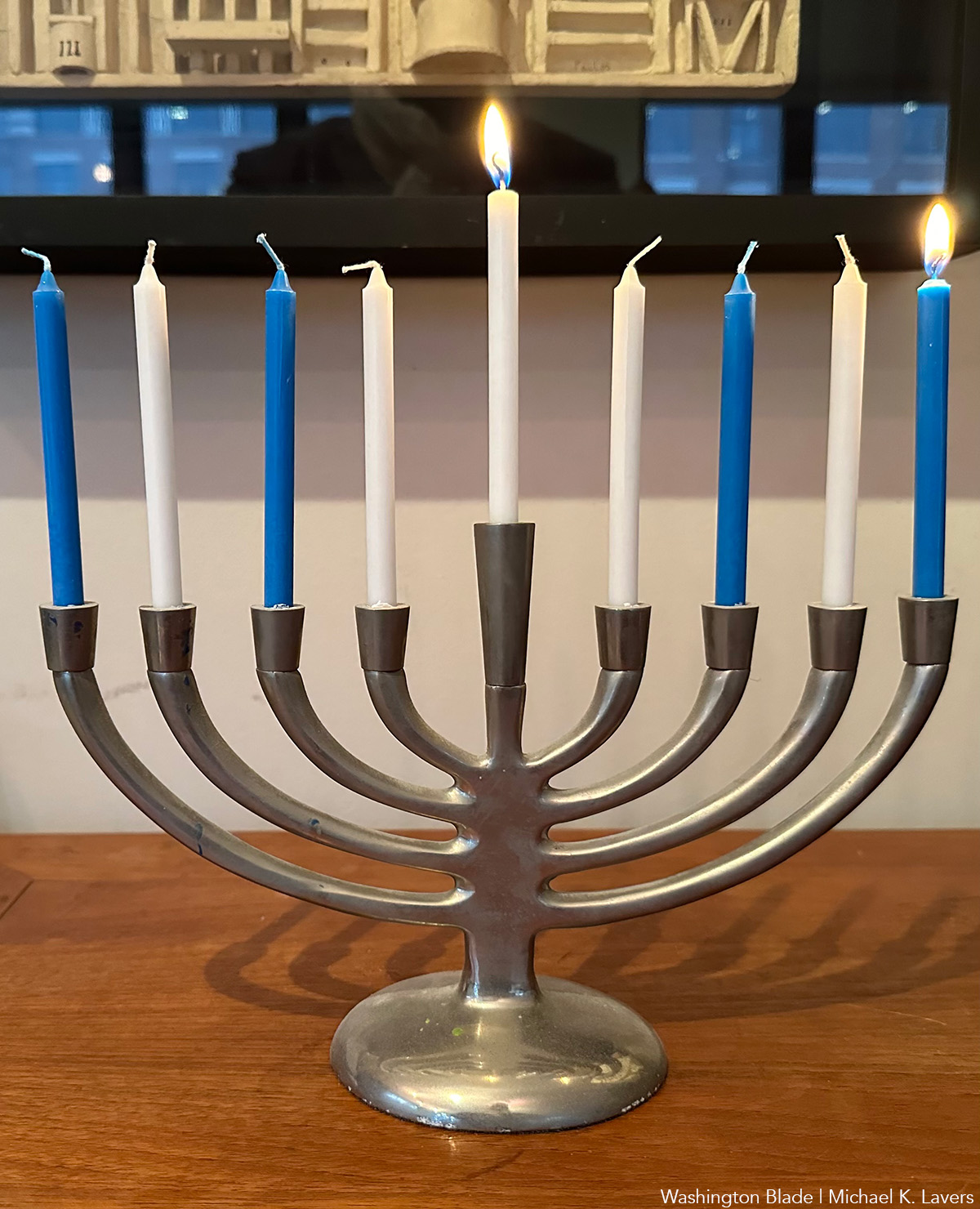
LGBTQ and LGBTQ-friendly congregations in D.C. will hold services and other events throughout the holiday season.
Bet Mishpachah on Friday will hold its Sparks in the Dark Happy Hour at Spark Social on 14th Street from 5:30-7:30 p.m. It’s Chanuka Shabbat Service will begin at the Edlavitch DC Jewish Community Center (1529 16th St., N.W.) at 8 p.m.
Hanukkah began on Sunday and will end on Dec. 22.
Two gunmen on Sunday killed 15 people and injured more than two dozen others when they opened fire at a Hanukkah celebration on Sydney’s Bondi Beach.
Jake Singer-Beilin, Bet Mishpachah’s chief rabbi, in a Facebook post mourned the victims.
“We grieve for the victims and send heartfelt prayers of healing for those who were wounded,” he wrote.
“This Chanuka, our lights will shine brightly in the darkness, but our hearts will be heavy with mourning for those who were murdered on Bondi Beach while observing what should have been a joyous day,” added Singer-Beilin. “We will still celebrate our Festival of Lights and we will commit ourselves to illuminating and repairing our broken world. Let us channel the bravery of the Maccabees who found hope where there seemed to be none, and who fought to create a better future. We must do the same.”
LGBTQ Catholic group to hold annual Christmas Day Mass
Dignity Washington’s Christmas Day Mass will take place at St. Margaret’s Episcopal Church (1820 Connecticut Ave., N.W.) on Dec. 25 from 6-7 p.m. Parishioners can attend in person or watch it online via Facebook.
The Metropolitan Community Church of Washington D.C.’s Christmas Eve service will take place at the church (474 Ridge St., N.W., on Dec. 24 at 6 p.m.
St. Thomas Episcopal Church (1517 18th St., N.W.) in Dupont Circle will hold its Christmas Eve Festival Eucharist from 5-6 p.m. A Christmas Eve dinner will take place in the Parish Hall from 6-8:30 p.m. The church’s Christmas Eve Festival Eucharist will occur on Dec. 25 from 10-11 a.m.
Washington National Cathedral throughout the holiday season has a number of services and events scheduled. These include the virtual Gospel Christmas Service on Dec. 21 from 6-7:30 p.m., the Family Christmas Service on Dec. 23 from 11 a.m. to noon, the Christmas Eve Festival Holy Eucharist on Dec. 24 from 10-11:45 p.m., and the Christmas Day Festival Holy Eucharist on Dec. 25 from 11:15 a.m. to 12:45 p.m.
The Foundry United Methodist Church (1500 16th St., N.W.) in Dupont Circle will hold its Christmas Eve Family Service on Dec. 24 at 4:30 p.m. Its Carols and Candlelight Service will take place at 8 p.m.
Smithsonian Anacostia Community Museum to celebrate Kwanzaa
The Smithsonian Anacostia Community Museum (1901 Fort Place S.E.) in Anacostia will mark the first day of Kwanzaa on Dec. 26 with storytelling and drumming with Mama Ayo and Baba Ras D from noon to 2 p.m. The museum will hold a series of other events through the 6-day celebration of African American culture that ends on Jan. 1.
The Creative Suitland Arts Center (4719 Silver Hill Road) in Suitland, Md., on Friday will hold their Almost Kwanzaa: A Creative Kind of Holiday event from 6-8:30 p.m.
Maryland
Joseline Peña-Melnyk elected Md. House speaker
Family immigrated to New York City from the Dominican Republic
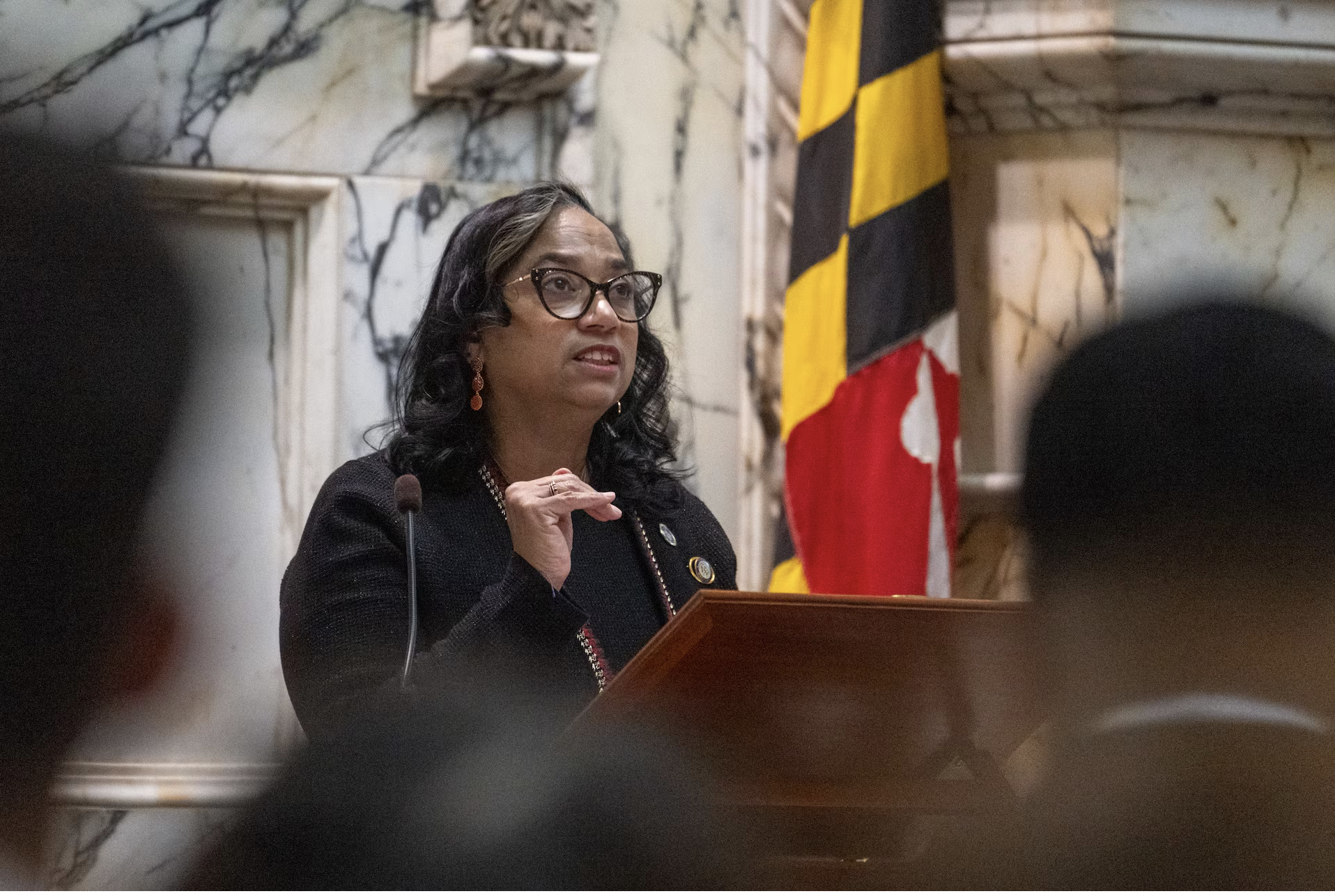
By PAMELA WOOD | Moments after being elected speaker of the Maryland House of Delegates Tuesday, state Del. Joseline Peña-Melnyk stood before the chamber and contemplated her unlikely journey to that moment.
Born in the Dominican Republic, the Peña family lived in a small wooden house with a leaky tin roof and no indoor plumbing. Some days, she said, there was no food to eat.
When she was 8 years old, the family immigrated to New York City, where Peña-Melnyk was dubbed “abogadito” or “little lawyer” for helping her mother and others by translating at social services offices.
The rest of this article can be read on the Baltimore Banner’s website.

Candidates should pledge to nominate LGBTQ judge to Supreme Court

Kazakh Senate approves anti-LGBTQ propaganda bill

Local, last-minute holiday gift ideas

2026 elections will bring major changes to D.C. government

Brian Footer suspends campaign for Ward 1 D.C. Council seat

PHOTOS: The Holiday Show

Choose U ambassadors share lived experiences with HIV, personal reflections, and insights

The best books to give this holiday season

Studio’s ‘Mother Play’ draws from lesbian playwright’s past