Opinions
14th St. venues fuel LGBT scholar soirée
May 9 benefit features a ‘taste of 14th’ and rooftop cocktails

Trailblazing mid-19th century American newspaper columnist, novelist and children’s book author Fanny Fern is credited with coining the phrase. Updating the New York Ledger writer’s adage, she penned the notion that “the way to a person’s heart is through their stomach.”
The restaurant portion of D.C.’s hospitality industry will this year generate $2.7 billion in annual sales. The combined contribution of bars and restaurants to the local economy in revenue generation, taxes, tourism, employment and a lively culture make the signature business segment a critical core component of the District’s financial stability and vitality.
While contributing to the fiscal health and collective soul of a city, the ever-volatile tight profit margins in operating a dining or drinking establishment make it difficult for businesses to commit to many of the multitude of solicitations for donations, sponsorships, product or participation. It’s hard enough managing the workload and paying the bills – especially in a city notorious for its high cost of conducting business and costly regulatory hoop-jumping processes.
When a distinguished assortment of popular hospitality businesses join together to generously assist in creating an enticing and distinctive charitable function funding a worthy community cause, it becomes calendar planning time.
So it is with an upcoming Point Foundation benefit event on 14th Street, N.W. – an illustration of the community “give-back” common to the industry.
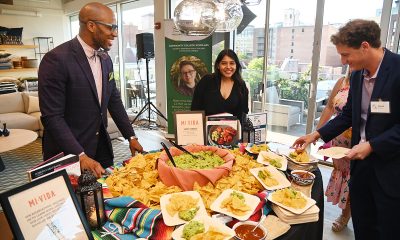
Seven prominent Logan Circle-U Street restaurants and bars will be serving unique culinary dishes and mixing specialty seasonal cocktails on Thursday, May 9, at home furnishing retailer Room & Board, located at 1840 14th St., from 6:30-8:30 p.m.
The event is an opportunity to sample concoctions from the eagerly awaited Black Whiskey, the two-story hybrid bar/restaurant and art gallery preparing to debut this Saturday with small-batch cocktails and traditional Scottish bar food only steps south of 14th and P streets.
Popular landmark neighborhood hospitality pioneer Café Saint-Ex restaurant/bar and the adjacent Bar Pilar will be joined by award-winning and always-a-wait-to-be-seated contemporary Spanish restaurant Estadio, along with Black Restaurant Group standout Pearl Dive Oyster Palace with its street-facing open-air bar.
Rounding out the eclectic and dynamic assembly of chefs and mixologists will be Marvin Bistro and Bar, noted for its third-floor lounge and year-round rooftop Belgian beer garden, and companion Hilton Brothers enterprise and cocktail-focused speakeasy-style lounge The Gibson, offering some of the most interesting drinks in D.C. in an intimate environment also featuring a rooftop patio.
Local community leader, elected D.C. State Board of Education member and Point Foundation D.C. Regional Trustee Jack Jacobson describes the event as “an amazing opportunity to sample fare from a number of the best restaurants and bars on 14th Street while supporting a worthy cause.” Describing the generosity of the donor establishments, he adds that the group is “absolutely thrilled to have so many notable area venues coming together in tandem. It shows that when the community supports small businesses, they’re eager to return the favor.”
Hosted in Room & Board’s glass-enclosed rooftop event space and terrace with views of the avenue, this “taste of 14th” gathering benefits the organization’s “Point Scholars” program.
Funds underwrite scholarships and support professional guidance and mentoring for LGBT college and graduate school students with demonstrated leadership skills, scholastic achievement and involvement in the community, with financial need to continue their studies. Current scholars and program alumni will be in attendance to share their experiences. Newly expanded BodySmith Gym has donated a membership and training package for giveaway. The Blade is also a sponsor.
Tickets for the foundation’s annual Washington “Cornerstone” event, including inspired food and drink offerings, are $75 and available on the foundation website or contributed at the event.
Mark Lee is a long-time entrepreneur and community business advocate. Follow on Twitter: @MarkLeeDC. Reach him at [email protected].





Opinions
Lighting candles in a time of exhaustion
Gunmen killed 15 people at Sydney Hanukkah celebration

In the wake of the shooting at Bondi Beach that targeted Jews, many of us are sitting with a familiar feeling: exhaustion. Not shock or surprise, but the deep weariness that comes from knowing this violence continues. It is yet another reminder that antisemitism remains persistent.
Bondi Beach is far from Washington, D.C., but antisemitism does not respect geography. When Jews are attacked anywhere, Jews everywhere feel it. We check on family and friends, absorb the headlines, and brace ourselves for the quiet, numbing normalization that has followed acts of mass violence.
Many of us live at an intersection where threats can come from multiple directions. As a community, we have embraced the concept of intersectional identity, and yet in queer spaces, many LGBTQ+ Jews are being implicitly or explicitly asked to play down our Jewishness. Jews hesitate before wearing a Magen David or a kippah. Some of us have learned to compartmentalize our identities, deciding which part of ourselves feels safest to lead with. Are we welcome as queer people only if we mute our Jewishness? Are those around us able to acknowledge that our fear is not abstract, but rooted in a lived reality, one in which our friends and family are directly affected by the rise in antisemitic violence, globally and here at home?
As a result of these experiences, many LGBTQ+ Jews feel a growing fatigue. We are told, implicitly or explicitly, that our fear is inconvenient; that Jewish trauma must be contextualized, minimized, or deferred in favor of other injustices. Certainly, the world is full of horror. And yet, we long for a world in which all lives are cherished and safe, where solidarity is not conditional on political purity or on which parts of ourselves are deemed acceptable to love.
We are now in the season of Chanuka. The story of this holiday is not one of darkness vanishing overnight. It is the story of a fragile light that should not have lasted. Chanuka teaches us that hope does not require certainty; it requires persistence and the courage to kindle a flame even when the darkness feels overwhelming.
For LGBTQ+ Jews, this lesson resonates deeply. We have survived by refusing to disappear across multiple dimensions of our identities. We have built communities, created rituals, and embraced chosen families that affirm the fullness of who we are.
To our LGBTQ+ siblings who are not Jewish: this is a moment to listen, to stand with us, and to make space for our grief. Solidarity means showing up not only when it is easy or popular, but especially when it is uncomfortable.
To our fellow Jews: your exhaustion is valid. Your fear is understandable, and so is your hope. Every candle lit this Chanuka is an act of resilience. Every refusal to hide, every moment of joy, is a declaration that hatred will not have the final word.
Light does not deny darkness. It confronts it.
As we light our candles this Chanuka season, may we protect one another and bring light to one another, even as the world too often responds to difference with violence and hate.
Joshua Maxey is the executive director of Bet Mishpachah, D.C.’s LGBTQ synagogue.
Opinions
Holidays not always bright for transgender people
‘Home’ often doesn’t feel like home for trans folks

Christmas is family time, isn’t it? It seems like every TV ad, every rom-com with a Christmas tree and fairy lights, every festive novel in your local bookshop is trying to persuade you of this. To push it on you — and what’s wrong with it, you may ask? Well, just think about the thousands of people who cannot spend this holiday season with their loved ones. Think about the transgender community specifically.
Even without the increasingly hostile political climate against trans people in modern-day America, many of them are not welcome in their own families. It is not something that started with MAGA, although MAGA certainly made it worse. “Home Alone” is not a comedy when your family does not accept you, and you are stuck all alone on Christmas. I’ve never been alone at holidays, but I know — as a trans person who has always loved family stories but estranged from their family — how the season can be tough.
Let’s make it clear: I like the holiday season, and I would never ask you to cancel it. I just want you to support your trans friends, and the trans community in general.
According to recent data from the Williams Institute at UCLA, more than 2.8 million people in the U.S. now identify as trans, including roughly 724,000 youth aged 13–17. And not all of them are out or accepted at home. That means many thousands are navigating teenage years — the years when so many family traditions, holidays, and emotional expectations are formed — while being invisible to their own families, or abused by them.
But for a large proportion of trans people, “home” doesn’t feel like home.
In the landmark 2015 U.S. Transgender Survey, many of respondents who were out to their immediate family reported some form of rejection: relationships ending, being kicked out, being denied the ability to express their gender, or being sent away.
Among those who did experience family rejection, 45 percent had experienced homelessness.
Other research shows how deeply rejection affects health: trans youth without family support face far higher rates of psychological distress, suicidality, and substance misuse.
So when you hear “Christmas is family time,” for many trans adults that message comes with flashbacks and pain. For trans kids it may be worse.
Also, intersectionality made everything even hard. Take trans people of color. A report on Black trans Americans found:
- 42 percent had experienced homelessness
- 38 percent lived in poverty
- Rates of sexual violence, mistrust of authorities, and fear of asking for help were also significantly higher
And if a trans person is also disabled, autistic, or living with chronic health conditions, the barriers become even bigger. Just imagine what it is like when your parents try to change you for being autistic all your childhood, and then kick you up for being trans. Ableism often goes hand in hand with transphobia; support systems become less accessible; and acceptance becomes harder to find. Holidays meant not just that you sometimes couldn’t share fun because of lack of inclusion now, but also because of mental health issues triggered by the past.
So yes — when you talk about Christmas stories of family, warmth, fairy lights and acceptance, it’s important to remember that for many trans people, Christmas is not something nice and cozy. Many trans people are suffering from PTSD, and for people with PTSD holidays are often a trigger.
So what can you do, as a trans ally or another trans person who wants to help their trans siblings? What does a “trans-friendly Christmas” look like for those estranged from their families?
Supporting a trans person at Christmas doesn’t have to be perfect. It doesn’t demand huge gestures, it doesn’t mean that you should stop celebrating or play Grinch. Just remember that not everyone is celebrating. And even people like me, who are celebrating, sometimes feel too triggered by all the perfect family pictures.
But there is some way to help your trans friends.
Give them space. Not everyone wants to talk about Christmas. Not everyone wants to explain their estrangement. They may withdraw, or avoid festive events entirely. Respect that. As an expert working with mental health services, I can say that sometimes the best gift is the room to breathe.
Say: “I know this time of year can be difficult. I’m here if you want to speak, and I’m here if you don’t.” Or share your own bad experience, especially if you are speaking with autistic person.
Or just ready to support them in a way they need.
Acknowledge the pain, without feeling guilty if it’s not your fault, and provide some support.
This might mean:
- Inviting them to your home for a meal
- Checking in with a simple, trans-friendly message (“thinking of you today — hope you’re doing whatever feels right for you”) — especially if they like this kind of messages
- Suggesting a walk, a film night, or anything that doesn’t revolve around “family”
- Bringing them into chosen family traditions if they’re open to it
- Support trans community online
- Just share photos of your pets
Be prepared for triggers. Really. I often have a relapse in my mental health on holidays despite liking them. Or, because I have Dissociative Identity Disorder, I struggle with my child’s personality. Your friends who have PTSD or DID can have similar problems. Respect them even if they behave “childishly” — even when a person is mentally falling into their child state, remember that they still have agency. Listen to their stories. Help them create their own holiday traditions if they need to, or ask for professional help. Be patient. Depression, anxiety, or OCD can also be triggered during holidays even if a person with those conditions is in remission.
And, most important of all: listen.
Some trans people want community on Christmas. Some want silence. Some want to escape. Some want a tiny piece of normality. Some want their own queer or geeky Christmas. Some prefer to celebrate the new year. There is no universal script. Let them decide. And remember: support is the most important thing.
Not the holiday decorations. Not the perfectly curated “inclusive holiday.” Not expensive parties.
Because for many trans people who have lost their family, especially at Christmas, it is important to know that someone sees them, someone calls them by their chosen name, someone cares, someone wants them here even if their parents don’t.
And sometimes, that’s enough to make the season not just survivable, but enjoyable. This, by the way, is true for all holidays, whether it’s Hanukkah or New Year’s Eve.
Opinions
Reflecting on six years on the CAMP Rehoboth board
Purpose, people, and the power of community

Some people let life happen; I prefer to plan it—meticulously, intentionally, and yes, sometimes overboard. After losing many loved ones and navigating my own setbacks, I learned not to let life drift by; instead, I live it with intention—curating the people, commitments, and actions that bring joy and meaning, even if others mistake that intentionality for control.
True to form, I close each year with an annual life audit reflecting to see if my personal goals were achieved and, if not, why did I fall short. This habit reflects a simple philosophy: fulfillment doesn’t happen by accident. It comes from daring to imagine the life you want and living deliberately at work, in service to others, and in the everyday moments that make life meaningful.
This year’s assessment is a bit more complicated because on Dec. 31 I will conclude six years on the board of CAMP Rehoboth Community Center — two full three-year terms, including three years as board president. When putting pen to paper, I quickly realized the lessons from the last 12 months were six years in the making.
For those who may not know, CAMP Rehoboth (CAMP is an acronym for Create A More Positive) is widely recognized as the leading provider of life-affirming programs and services in support of LGBTQ people in Rehoboth Beach, Del., and the greater Sussex County area. Since its founding 34 years ago, CAMP’s work has enabled LGBTQ people to thrive. In fact, it is the reason my husband Greg and I (along with thousands of other LGBTQ people) decided to make this part of Delaware our home.
If the past few years have taught me anything, it is that leadership is not a position—it is a practice. It is a daily decision to show up with clarity, steadiness, and a willingness to hold space for others as we navigate change together.
Purpose is the compass. Purpose gives direction when circumstances shift, resources tighten, and competing demands threaten to pull us off course. At CAMP Rehoboth, our purpose has always been to ensure LGBTQ people have access to life-affirming programs, culturally competent services, and a place where they feel seen, valued, and supported. Purpose guided our leadership transition and executive director search, reminding us that the leader our community deserves must bring experience, emotional intelligence, and a deep understanding of what belonging means.
Values are the guardrails. They keep us aligned when opportunities, distractions, or pressures arise. Our values show up in our strategic planning, financial stewardship, and insistence that inclusion is a practice, not a slogan. They ensure that when challenges—political hostility, funding uncertainty, changing community needs—emerge, we respond with integrity instead of reaction.
People are the engine. Organizations don’t create impact — people do. Staff, volunteers, board members, donors, and community members together make the mission real. Investing in their capacity, wellness, and professional development ensures they can do their best work. When we take care of our people, they take care of the community.
I am a gay man who knows how obstacles can feel insurmountable and hope can falter having lived through the AIDS epidemic and fought for civil rights like the legalization of same-sex marriage. In those moments, I chose to focus on what I could control rather than what I could not. Getting involved gave me purpose and proved that fulfillment comes from taking action to make a difference—for yourself and for the broader community.
Gratitude is the culture.
As I close this chapter, what I feel most is gratitude. Gratitude honors those who built the foundation, celebrates those who carry the work forward, and reminds us that progress is a collective effort. Thank you to our staff, especially Executive Director Kim Leisey, who serve with skill and heart; to our volunteers like former board member Chris Beagle and current board president Leslie Ledogar, who give more than anyone will ever know; to our donors, who invest in possibility; and to the community that trusts us to be there in moments of celebration, struggle, and change. Finally, none of this would have been possible without the steadfast love of my husband and the unwavering support of close friends who lifted me in the moments I needed it most.
Reflection, planning, and intentionality do not guarantee perfection — but they make fulfillment possible. Life is too short to leave it to chance. By daring to dream, acting deliberately, and giving generously, we can create lives that are both meaningful and impactful — not just for ourselves, but for the communities we touch.
Wes Combs is an outgoing board member of CAMP Rehoboth.

Brian Footer suspends campaign for Ward 1 D.C. Council seat

LGBTQ Democrats say they’re ready to fight to win in 2026

PHOTOS: 10’s Across the Board

Lighting candles in a time of exhaustion

LGBTQ, LGBTQ-friendly congregations to hold holiday services

PHOTOS: The Holiday Show

Studio’s ‘Mother Play’ draws from lesbian playwright’s past

Choose U ambassadors share lived experiences with HIV, personal reflections, and insights

The best books to give this holiday season