News
Dutch LGBT advocacy spans more than a century
Formal gay activism in the Netherlands began in 1911 over consent law
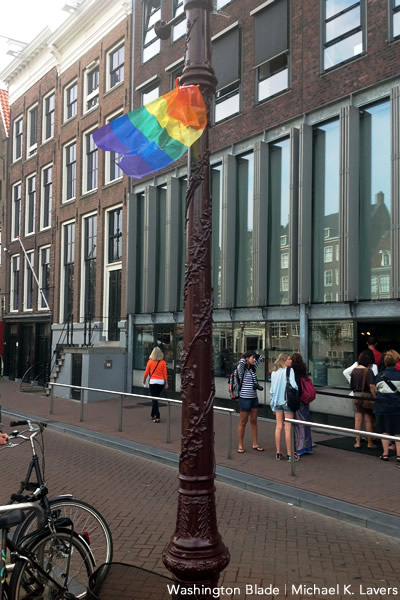
A rainbow flag outside the Anne Frank House in Amsterdam (Washington Blade photo by Michael K. Lavers)
AMSTERDAM — Formal Dutch LGBT advocacy began in 1911 when the Netherlands raised the age of consent for same-sex sexual relations from 16 to 21.
Koen van Dijk, executive director of COC Nederland, a Dutch LGBT advocacy group, told the Washington Blade during an interview in his Amsterdam office earlier this month the measure prompted gay men to respond against it.
“That spurred gay men that were insulted by this legislation, but were also offended by it to become more organized and start working on change,” he said.
COC Nederland can trace its origins back to the late 1930s when a group of gay men who primarily lived in Amsterdam begin to publish a magazine called “The Right to Live.”
Gay organizing in the Netherlands came to an abrupt halt in 1940 when Germany invaded the Netherlands. Those who published the magazine burned their archives and went underground because van Dijk said they “heard stories of what happened to gay people in Germany” under the Nazi regime.
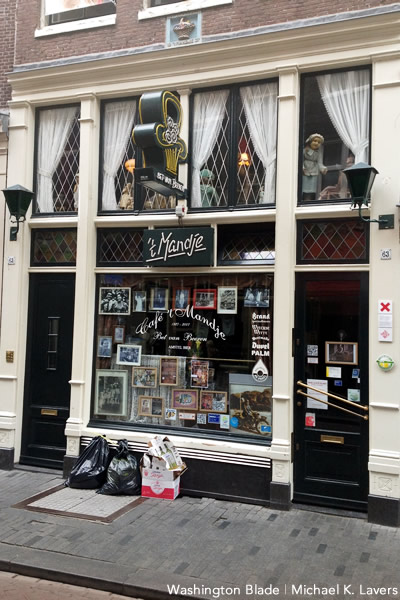
Amsterdam’s oldest gay bar, Café t’Mandje, opened in 1927. (Washington Blade photo by Michael K. Lavers)
Café t’Mandje, the country’s first gay bar that lesbian Bet van Beeren opened in what is now Amsterdam’s Chinatown in 1927, remained open during the war. Van Beeren hid Jews and smuggled weapons to the Dutch resistance in her establishment throughout the occupation. She even bribed German soldiers with alcohol.
“The Right to Live” began to publish after the war ended in 1945, and COC Nederland formally came into existence on Dec. 7, 1946. It began as a social club under the acronym Center for Relaxation and Culture or Cultuur-en Ontspanningscentrum (COC) in Dutch, and had two offices in Amsterdam and The Hague.
“It was a social club where people could meet behind closed doors,” van Dijk said. “Discrimination was still very high in the Netherlands at that time. People would actually lose their jobs if they were out at work and could lose their homes.”
LGBT equality and acceptance remain group’s objectives
COC Nederland has two broad goals: Personal emancipation of LGBT people and the promotion of greater acceptance of gay men and lesbians in the country through legislation and social acceptance.
Lawmakers in 1971 equalized the age of consent for same-sex and opposite-sex sexual relations. The Dutch government in 1973 formally recognized COC Nederland, which at that time was known as the Dutch Association for Integration of Homosexuality COC.
The Netherlands in 2001 became the first country in the world to extend marriage rights to gays and lesbians.
Van Dijk was quick to point out COC Nederland continues to work on a host of issues in spite of the country’s liberal and pro-gay reputation.
A 2009 report the Dutch Ministry of Justice commissioned found 70 percent of LGBT people in the Netherlands have experienced harassment because of their sexual orientation and/or gender identity and expression. A third of respondents said they experienced physical violence.
One-third of Dutch LGBT employees are not out in the workplace, while more than 30 percent of people in the Netherlands said they find gay people kissing in public shocking.
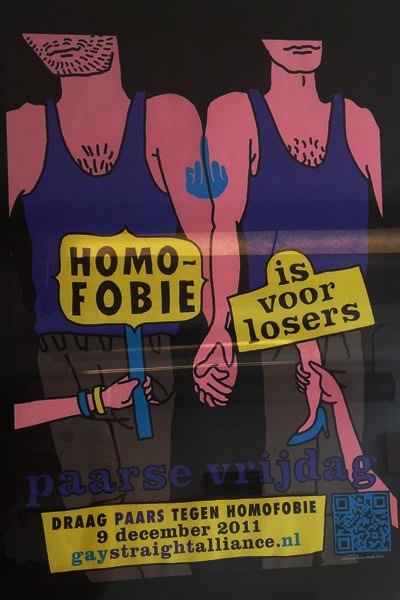
COC Nederland’s GSA program is now in two-thirds of the Netherlands’ public high schools. (Washington Blade photo by Michael K. Lavers)
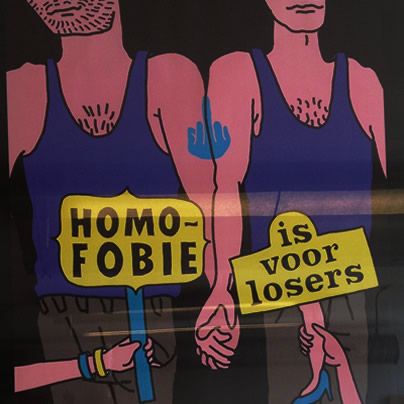
Van Dijk said anti-LGBT bullying in Dutch schools remains a problem — COC Nederland in 2008 launched a program based on Gay-Straight Alliances in the U.S. to combat homophobia and transphobia. The initiative is now in two-thirds of the country’s public high schools.
“The layer of tolerance is thinner than it looks at first glance,” van Dijk told the Blade, noting anti-LGBT attitudes remain among specific religious and ethnic groups in the Netherlands. “There’s a whole spectrum of intolerance that is still really worrying.”
COC Nederland: Dutch government is an ally
Van Dijk said lawmakers have been responsive to concerns his organization and other LGBT advocacy groups have had over specific issues.
Dutch lawmakers last September passed a law that said a resident of the Netherlands could only sponsor their partner for immigration purposes if the couple had already legally married in the foreign-born spouse’s country of origin. The Netherlands is one of only 14 countries in which gays and lesbians can legally marry.
Lawmakers quickly repealed the statute after COC Nederland and other LGBT advocates expressed concern.
“We had to go to Parliament, go to our government to say you probably don’t mean this happening, but this will make our lives more difficult,” van Dijk said. “They’ve been very responsible.”
Van Dijk said LGBT asylum seekers in the Netherlands remain particularly vulnerable because the government places them in housing with their countrymen who may subject them to anti-gay harassment and violence. He noted officials are sometimes unaware of this treatment, while others may blame the victim who experiences mistreatment because of their sexual orientation or gender identity and expression.
“For them a gay man is 40, wearing a pink boa standing on a boat at gay Pride,” van Dijk told the Blade. “They don’t recognize LGBT people and that they have a different view of how good they should be or take care of themselves in that situation. So we need to really work with organizations like them, or care organizations for the elderly.”
State Secretary for Security and Justice Fred Teeven in 2011 introduced a bill for which COC Nederland and the Transgender Network Netherlands had lobbied for years that would allow trans people to change their gender on their birth certificates, passports and other official documents without undergoing sterilization and sex-reassignment surgery before petitioning a judge to grant the request.
Argentina President Cristina Fernández de Kirchner last year signed a law that allows trans Argentinians to legally change their gender on official documents without surgery and an affidavit from a doctor or another medical provider. The Dutch measure is similar to the Argentine law, but it would still require a trans person to obtain a statement from an “expert” to legally change their gender.
The proposal would also eliminate the need to petition a judge to approve a person’s request to legally change gender.
“It’s an invasion of rights,” van Dijk said in reference to current Dutch law. “It’s the integrity of the body; it’s privacy.”
The main chamber of the Dutch Parliament earlier this year approved the bill, but the country’s Senate has yet to act upon it. Van Dijk said he remains hopeful senators will vote on the measure in the fall once they debate a bill that would allow a married lesbian to petition municipal officials – and not go before a judge as current Dutch law mandates — to receive full parental rights of her spouse’s child she conceived through artificial insemination.
“The Senate is not working very fast at the moment, but we have good hopes that within a year it will all be fixed,” van Dijk said.
COC Nederland also works with LGBT rights advocates in Eastern Europe, Africa and other areas throughout the world.
The organization in April staged a protest outside the meeting between Russian President Vladimir Putin and Dutch Prime Minister Mark Rutte over Russia’s LGBT rights record. More than 3,000 people last month protested a Russian law that bans gay propaganda to minors and other anti-LGBT measures in the country during a Kremlin-sponsored concern in Amsterdam’s Museumplein that van Dijk said was designed to “acquaint the Dutch audience with the beauty and diversity of Russian culture.”
Authorities in the Russian city of Murmansk in July arrested four Dutch LGBT rights advocates who are not affiliated with COC Nederland for violating the country’s gay propaganda law while filming a documentary about LGBT life in Russia.
Van Dijk described Russia’s LGBT rights record as a “disgrace,” but said COC Nederland does not support calls to boycott the 2014 Winter Olympics over the issue.
“What we’re doing is listening to our counterparts in Russia and [they’ve asked] us to come over instead of to boycott,” van Dijk said. “We’re not going to explain to them what’s best for them. They should explain to us what is best for them.”






Kazakhstan
Kazakh Senate approves anti-LGBTQ propaganda bill
Measure ‘would undermine fundamental rights guaranteed under’ constitution

The Kazakh Senate on Thursday approved a bill that would ban so-called LGBTQ propaganda in the country.
Members of Kazakhstan’s lower house of parliament last month unanimously approved the measure that would ban “‘LGBT propaganda’ online or in the media” with “fines for violators and up to 10 days in jail for repeat offenders.” Senators earlier this month delayed a vote on the bill.
President Kassym-Jomart Tokayev has indicated he would sign it.
“If enacted, these provisions would undermine fundamental rights guaranteed under Kazakhstan’s Constitution, particularly the principle of equality and non-discrimination, by directly targeting and stigmatizing LGBTI people and anyone perceived to support them,” said ILGA-Europe in a statement after Thursday’s vote.
Kazakhstan is a predominantly Muslim former Soviet republic in Central Asia that borders Russia, Turkmenistan, Uzbekistan, Kyrgyzstan, and China. Russia, Georgia, and Hungary are among the other countries with anti-LGBTQ propaganda laws.
District of Columbia
Brian Footer suspends campaign for Ward 1 D.C. Council seat
Race’s third LGBTQ candidate cites family reasons for ‘stepping back’
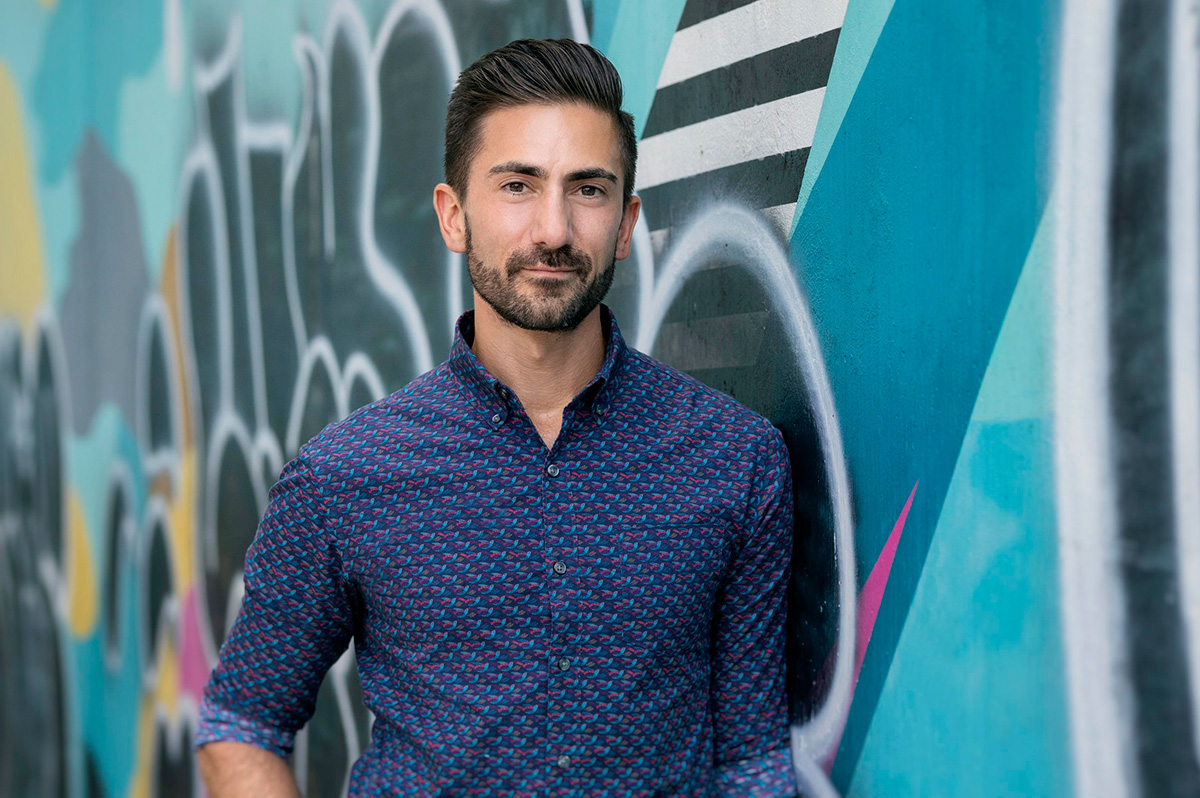
Gay Advisory Neighborhood Commissioner Brian Footer, who was one of three out LGBTQ candidates running for the open Ward 1 D.C. Council seat in the city’s June 16, 2026, Democratic primary, announced on Dec. 17 he has decided to “suspend” his campaign to focus on his family.
“After deep reflection and honest conversations with my family, I have decided to suspend my campaign for the D.C. Council,” he said in a statement. “This moment in my life requires me to be present with the people I love most and honor the responsibilities I carry both at home and in the community,” he states. “This was not an easy decision, but it is the right one for me and my family at this time.”
Footer, a longtime Ward 1 community activist and LGBTQ rights advocate, announced his candidacy for the Ward 1 Council seat in July, one month before bisexual Ward 1 community activist Aparna Raj announced her candidacy for the Council seat on Aug. 12.
Gay Ward 1 Advisory Neighborhood Commissioner Miguel Trindade Deramo announced his candidacy for the Ward 1 Council seat on Nov. 18, becoming the third out LGBTQ candidate in what appeared to be an unprecedented development for a race for a single D.C. Council seat.
At least three other candidates who are not LGBTQ are running for the Ward 1 Council seat. They include Ward 1 ANC member Rashida Brown, longtime Ward 1 community activist Terry Lynch, and Jackie Reyes-Yanes, the former director of the Mayor’s Office of Community Affairs.
In his statement announcing the suspension of his candidacy, Footer said he would continue to be involved in community affairs and advocate for the issues he discussed during his campaign.
“I want to be clear: I am stepping back from the race, not the work,” he says in his statement. “Public service has always been my calling. I will continue advocating for affordability, for safer streets, for stability for small businesses, and for a government that responds to people with urgency and respect,” he wrote. “And I will continue showing up as a partner in the work of building a stronger Ward 1.”
Footer concluded by thanking and praising his campaign supporters and calling his campaign suspension a “transition,” suggesting he is not likely to resume his candidacy.
His campaign press spokesperson did not immediately respond to a question from the Washington Blade asking if Footer might later resume his campaign or if his latest action was in effect an end to his candidacy.
“To everyone who knocked on doors, hosted conversations, donated, shared encouragement, and believed in this campaign, thank you,” he says in his statement. “I am deeply grateful for every person who helped this campaign take root,” he added. “This isn’t an ending, it’s a transition. And I’m excited for the work ahead, both in Ward 1 and at home with my family.”
Longtime gay D.C. Democratic Party activist Peter Rosenstein said in a statement to the Blade, “I respect Brian Footer’s decision to end his campaign for Council. It is not easy to run a campaign in D.C. and there are many others running in Ward 1.” He added, “While not living in Ward 1, I thank Brian for all he has done and clearly will continue to do for the people in the ward.”
Politics
LGBTQ Democrats say they’re ready to fight to win in 2026
DNC winter meetings took place last weekend in Los Angeles

The Democratic National Committee held its annual winter meetings in Downtown Los Angeles over the weekend, and queer Democrats showed up with a clear message for the national organization: don’t abandon queer and transgender people.
Following last year’s disastrous presidential and congressional elections, many influential pundits and some powerful lawmakers called on Democrats to distance the party from unpopular positions on trans rights, in order to win swing districts by wooing more conservative voters.
But members of the DNC’s LGBTQ Caucus say that’s actually a losing strategy.
“There are still parts of our party saying we need to abandon trans people in order to win elections, which is just not provable, actually. It’s just some feelings from some old consultants in DC,” LGBTQ Caucus Chair Sean Meloy says.
Some national Democrats are already backtracking from suggestions that they walk back on trans rights.
California Gov. Gavin Newsom grabbed national attention in March when he suggested that it was “deeply unfair” for trans girls to play in women’s sports. But last week, he doubled down on support for trans rights, claiming to have signed more trans-rights legislation than any governor in the country, and entering into feuds on X with Elon Musk and Nicki Minaj over his support for trans kids.
Democrats are also clearly feeling the wind in their sails recently after major election victories in Virginia and New Jersey last month, as well as victories in dozens of local and state legislative elections across the country in 2025.
“[Abigail] Spanberger in Virginia didn’t win by dodging the trans question. She won by attacking it, confronting it, and that’s how she got ahead,” says Vivian Smotherman, a trans activist and at-large member of the DNC’s LGBTQ Caucus.
“Trans people are not a problem. We are a resource,” Smotherman says. “For my community, surviving into adulthood is not a guarantee, it’s an accomplishment. You don’t walk through a survival gauntlet without learning things … I’m not begging the DNC to protect my community. I’m here to remind you that we are the warriors tempered by fire, and we are fully capable of helping this party win.”
At its own meeting on Friday, the LGBTQ Caucus announced several new initiatives to ensure that queer and trans issues stay top of mind for the DNC as it gears up for the midterm elections next year.
One plan is to formalize the DNC’s Trans Advisory Board as distinct from the LGBTQ Caucus, to help introduce candidates across the country to trans people and trans issues.
“One in three people in this country know a trans person. Two-thirds of Americans don’t think they do,” Smotherman says. “So the real problem is not being trans, it’s that you don’t know us. You cannot authentically support a trans person if you’ve never met one.
“That’s why my first goal with this Trans Advisory Board is to host a monthly Meet a Trans Person webinar. Not as a spectacle, as a debate, but as a human connection, and I will be charging every state chair with asking every one of their candidates up and down the board if they know a trans person. And if that person doesn’t know a trans person, I’m gonna have that state chair put them on that webinar.”
The LGBTQ caucus is also opening up associate membership to allies who do not identify as LGBTQ, in order to broaden support and connections over queer issues.
It’s also preparing for the inevitable attacks Republicans will throw at queer candidates and supporters of LGBTQ issues.
“These attacks are going to come. You have to budget money proactively. You have to be ready to fight,” Meloy says. “There are some local party chairs who don’t want to recruit LGBTQ candidates to run because these issues might come up, right? That’s an absolutely ludicrous statement, but there are still people who need support in how to be ready and how to respond to these things that inevitably come.”
“The oldest joke is that Democrats don’t have a spine. And when they come after us, and we do not reply, we play right into that.”
Meloy also alluded to anti-LGBTQ tropes that queer people are out to harm children, and said that Democrats should be prepared to make the case that it’s actually Republicans who are protecting child abusers – for example, by suppressing the Epstein files.
“They are weak on this issue. Take the fight, empower your parties to say, ‘These people have nothing to stand on,’” Meloy says.

Candidates should pledge to nominate LGBTQ judge to Supreme Court

Kazakh Senate approves anti-LGBTQ propaganda bill

Local, last-minute holiday gift ideas

2026 elections will bring major changes to D.C. government

Brian Footer suspends campaign for Ward 1 D.C. Council seat

PHOTOS: The Holiday Show

Choose U ambassadors share lived experiences with HIV, personal reflections, and insights

The best books to give this holiday season

Studio’s ‘Mother Play’ draws from lesbian playwright’s past