National
WHAT A YEAR!
Our picks for the top national and international stories of 2013


(Washington Blade file photo by Michael Key)
It was perhaps the biggest year yet for the LGBT rights movement in the United States, as the Supreme Court made history by striking down Prop 8 and part of the Defense of Marriage Act. More states legalized marriage in its wake. Elsewhere in the world, the Catholic Church got a new pope who seemed to break with his predecessor over gay rights, among other issues.
Here are the Blade staff’s picks for the year’s top 10 national and international stories.
#1 Supreme Court strikes down DOMA, Prop 8
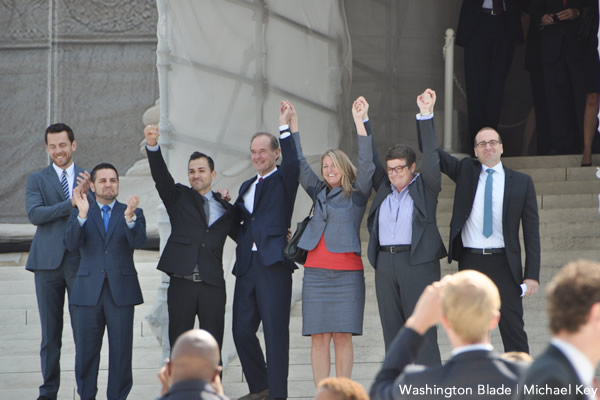
The plaintiffs in the Proposition 8 case at the Supreme Court emerge victorious with lawyer David Boies, Human Rights Campaign President Chad Griffin and American Foundation for Equal Rights Executive Director Adam Umhoefer. (Washington Blade file photo by Michael Key)
The U.S. Supreme Court issued a pair of historic decisions against the Defense of Marriage Act and California’s Proposition 8 in a news event we have dubbed the story of the year.
In a 5-4 decision, the court struck down Section 3 of DOMA, the 1996 Clinton-era law that prohibited the federal government from recognizing same-sex marriage. In a separate 5-4 decision issued at the same time, the court ruled the proponents of Prop 8 couldn’t defend the initiative in court, allowing a district court ruling to stand that determined the 2008 amendment was unconstitutional.
Writing for the majority in the decision against DOMA, U.S. Associate Justice Anthony Kennedy emphasized the harm the anti-gay law causes married same-sex couples.
“The federal statute is invalid, for no legitimate purpose overcomes the purpose and effect to disparage and to injure those whom the State, by its marriage laws, sought to protect in personhood and dignity,” Kennedy wrote. “By seeking to displace this protection and treating those persons as living in marriages less respected than others, the federal statute is in violation of the Fifth Amendment.”
The DOMA lawsuit was brought by New York widow Edith Windsor as a result of having to pay $363,000 in estate taxes in 2009 upon the death of her spouse, Thea Spyer. Windsor became a symbol of the marriage equality movement and was named by Time magazine as its No. 3 pick for “Person of the Year” after her victory at the Supreme Court.
The ruling against Prop 8 restored marriage equality to California. Thousands of same-sex couples — beginning with plaintiffs Kris Perry and Sandra Stier, who were wed by California Attorney General Kamala Harris at San Francisco City Hall — began to marry after the U.S. Ninth Circuit Court of Appeals gave the go-ahead weeks after the decision.
Immediately after the ruling against DOMA, the Obama administration pledged to work toward implementing the decision to allow for the recognition of same-sex marriage by the federal government. At a news conference during a trip to Africa, President Obama pledged to make the federal benefits of marriage as widely available as possible.
“It’s my personal belief — but I’m speaking now as a president as opposed to as a lawyer — that if you’ve been married in Massachusetts and you move someplace else, you’re still married, and that under federal law you should be able to obtain the benefits of any lawfully married couple,” Obama said.
Then-Secretary of Homeland Security Janet Napolitano issued guidance saying bi-national same-sex couples would be able to apply for marriage-based green cards to enable them to stay in the United States. The U.S. Office of Personnel Management announced that spousal benefits, including health and pension benefits, would begin to flow to gay federal employees. Perhaps most significantly, the Internal Revenue Service announced it would recognize the marriages of same-sex couples for tax purposes — even if they file tax returns while living in a non-marriage equality state.
Defense Secretary Chuck Hagel also announced that service members in same-sex marriages would be able to receive spousal benefits, including health, pension and housing benefits. Several national guards with state constitutional amendments banning same-sex marriage said they would be unable to process these benefits, but after a second edict from Hagel saying they must comply, each of those states fell in line.
Within a few short months, the ruling against DOMA also helped accelerate the path toward marriage equality throughout individual states. In Ohio, a federal judge recognized the marriage of a same-sex couple that married at BWI airport because one of the partners in the relationship was dying of Lou Gehrig’s disease. Later, a New Jersey superior court ruled the state’s civil union law was insufficient — a decision the State Supreme Court let stand upon appeal from New Jersey Gov. Chris Christie, who later the dropped the lawsuit.
Doug NeJaime, a gay law professor at the University of California, Irvine, said this movement so soon after the Windsor ruling “was anticipated” given the language that Associate Justice Anthony Kennedy used in his opinion.
“Given the flurry of activity, and the quick decisions coming out of places like Ohio, this may mean that the Supreme Court may not be able to avoid the question regarding the constitutionality of state marriage bans as long as some of the justices may hope,” NeJaime said.
#2 States, countries extend marriage rights
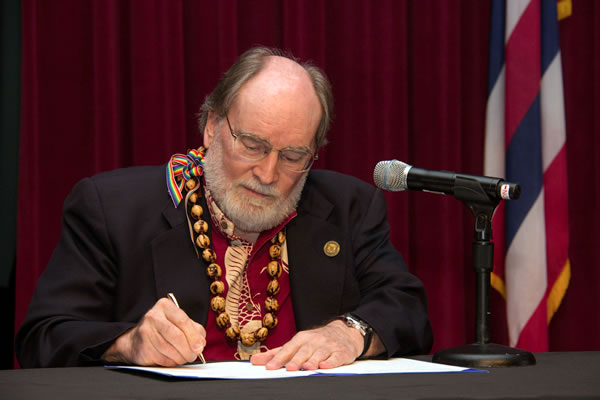
Hawaii Gov. Neil Abercrombie on Nov. 13, 2013, signed his state’s same-sex marriage bill into law. (Photo courtesy of State of Hawaii/Office of the Governor)
The movement for marriage rights for same-sex couples made significant advances in the U.S. and around the world in 2013.
In addition to Maryland and Delaware, gays and lesbians began to legally marry in California, Rhode Island, New Jersey, Minnesota and Hawaii. Illinois’s same-sex marriage law that Gov. Pat Quinn signed last month will take effect in June.
New Zealand and Uruguay also extended marriage rights to same-sex couples in 2013.
Brazil’s National Council of Justice in May nearly unanimously ruled that registrars in the South American country cannot deny marriage licenses to same-sex couples.
Gays and lesbians in England and Wales on March 29 will begin to exchange vows after the British Parliament over the summer approved a same-sex marriage bill. An identical measure cleared its first hurdle in the Scottish Parliament last month.
The legal process to extend marriage rights to same-sex couples in Mexico continued to gain ground in Baja California, Guanajuato, Jalisco and other states in 2013. A handful of gays and lesbians have exchanged vows in Colombia, but the country’s attorney general has challenged some of them.
Croatian voters on Dec. 1 approved a constitutional amendment that defines marriage as between a man and a woman. The Australia High Court on Dec. 11 ruled a law that extended marriage rights to same-sex couples in the country’s capital is unconstitutional.
#3 Senate passes ENDA; House version stalls
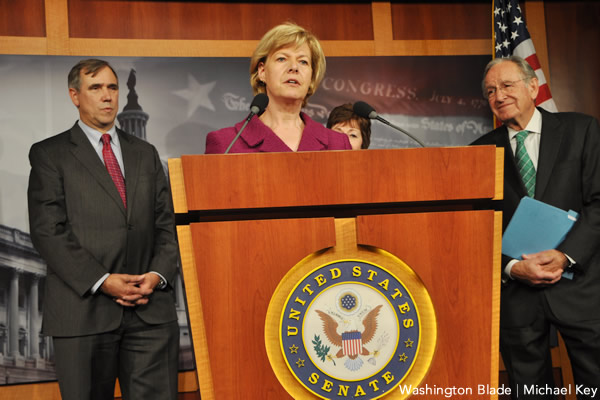
Sen. Tammy Baldwin (D-Wis.) spoke in a press conference following the passage of the Employment Non-Discrimination Act in the U.S. Senate. (Washington Blade photo by Michael Key).
For the first time in history, the U.S. Senate approved with bipartisan support this year a long sought piece of legislation that would bar employers from discriminating against or firing workers based on their sexual orientation or gender identity.
By a vote of 64-32, the Employment Non-Discrimination Act passed the Senate, marking the first time that either chamber of Congress has passed a version of the bill with protections for transgender workers. A total of 10 Republicans joined the entire Democratic caucus present in voting for the bill.
Prior to the vote, Sen. Jeff Merkley (D-Ore.), ENDA’s chief sponsor, delivered a speech on the Senate floor recognizing the historic nature of the moment.
“I look forward to this vote, this vote for liberty, this vote for freedom, this vote for opportunity, this vote for a fair and just America,” Merkley said.
Despite a push to bring up the legislation in the House, momentum on ENDA seems to have stalled as the legislation has capped out at 201 sponsors and House Speaker John Boehner (R-Ohio) has continually said he opposes it.
“I understand people have differing opinions on this issue, and I respect those opinions,” Boehner said in response to a question from the Washington Blade. “But as someone who’s worked in the employment law area for all my years in the State House and all my years here, I see no basis or no need for this legislation.”
#4 Russia’s LGBT crackdown sparks outrage
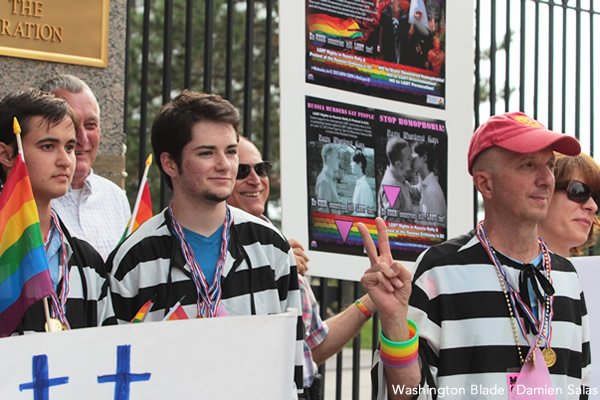
Activists protested in front of the Russian embassy several times throughout the year following the passage of anti-gay laws in the country. (Washington Blade photo by Damien Salas)
The Kremlin’s LGBT rights crackdown sparked widespread outrage this past year amid preparations for the 2014 Winter Olympics that will take place in Sochi, Russia, in February.
Russian President Vladimir Putin in June signed a broadly worded bill into law that bans gay propaganda to minors. A second statute that bans foreign same-sex couples and any couple from a country in which gays and lesbians can marry from adopting Russian children took effect in July.
LGBT rights groups and other organizations that receive funding from outside Russia could face a fine if they don’t register as a “foreign agent.”
“These laws are aimed at driving LGBT people back into silence, back underground, back to the invisibility,” Polina Andrianova of Coming Out, a St. Petersburg-based LGBT advocacy group, told the Washington Blade during an August interview.
Playwright Harvey Fierstein is among those who have called for a boycott of the Sochi games in response to Russia’s LGBT rights crackdown. The International Olympic Committee and the U.S. Olympic Committee have also faced criticism from those who feel they have not done enough to publicly criticize the Kremlin over the gay propaganda law.
“The U.S. Olympic Committee has been complicit in this act of aggression because they say we respect Russia’s right to do this,” U.S. Rep. Ileana Ros-Lehtinen (R-Fla.) told the Washington Blade in late September before the USOC added sexual orientation to its anti-discrimination policy. “That is not worthy of Olympic standards.”
Retired Olympic diver Greg Louganis on Dec. 13 told the Blade that gay MSNBC anchor Thomas Roberts should not have co-hosted the Miss Universe 2013 pageant in November in Moscow. The four-time gold medalist also said gay singer Elton John should not have performed in Russia earlier this month.
“It just seems like all they’re doing is lending credibility to what’s going on there,” said Louganis.
#5 LGBT Catholics welcome Pope Francis

‘If a person is gay and seeks the Lord and is of good will, who am I to judge him,’ said Pope Francis. (Photo by Agência Brasil; courtesy Wikimedia Commons)
LGBT Catholics in 2013 welcomed Pope Francis’ more moderate tone toward gays.
The College of Cardinals on March 16 elected the former archbishop of Buenos Aires to succeed Pope Benedict XVI who abruptly resigned in February.
The Argentine pontiff said during a September interview with an Italian Jesuit newspaper that the Roman Catholic church has grown “obsessed” with nuptials for gays and lesbians, abortion and contraception. These comments came roughly two months after he told reporters as he returned to Rome after a weeklong trip to Brazil that gays and lesbians should not be judged or marginalized.
“If a person is gay and seeks the Lord and is of good will, who am I to judge him?” said Francis in response to a question about gay priests.
LGBT rights advocates in Argentina noted to the Washington Blade the pontiff categorized the same-sex marriage bill the country’s president, Cristina Fernández de Kirchner, signed in 2010 as “the work of the devil” that would “spark God’s war.”
Dignity USA Executive Director Marianne Duddy-Burke acknowledged Francis’ anti-LGBT statements after his election. She remains optimistic the new pontiff will welcome LGBT Catholics back into the church.
“We find much to be hopeful about, particularly in the Pope’s firm desire that the church be a ‘home for all people,’ and his belief that God looks on lesbian, gay, bisexual and transgender people with love rather than condemnation,” said Duddy-Burke in a September statement.
#6 Obama names gay ambassadors, judges
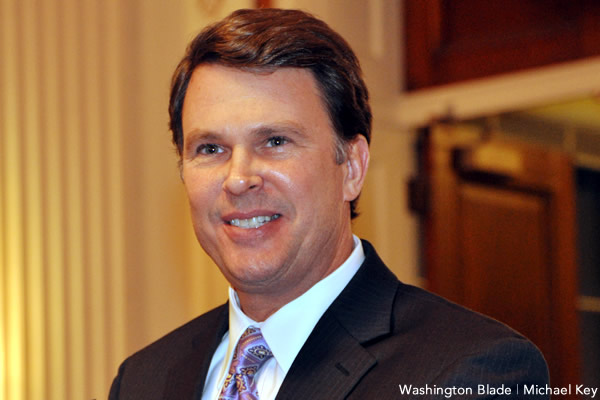
John Berry was named U.S. Ambassador to Australia. (Washington Blade file photo by Michael Key)
The U.S. Senate approved this year several openly gay appointees — including the first openly gay federal appeals judge — in confirmations that were historic both in number and significance.
Among the confirmed appointees were five openly gay ambassadors, including former U.S. Office of Personnel Management Director John Berry as U.S. ambassador to Australia. The confirmation made him the first openly gay U.S. ambassador to a G-20 country.
Also among the gay confirmations were Daniel Baer as U.S. ambassador to Organization for Security & Cooperation in Europe; Rufus Gifford as U.S. ambassador to Denmark; James Costos as U.S. ambassador to Spain; and James “Wally” Brewster as U.S. ambassador to the Dominican Republic.
Additionally, the Senate confirmed Eric Fanning as under secretary of the Air Force. After the departure of his immediate boss shortly after the confirmation, Fanning became acting secretary of the Air Force, making him the highest-ranking openly gay civilian in the U.S. military.
Chai Feldblum, the lesbian member of the U.S. Equal Employment Opportunity Commission, was confirmed for a second term after leading the way for a ruling instituting transgender workplace non-discrimination protections.
The Senate also confirmed openly gay judicial nominees. The highest-ranking among them was Todd Hughes, who was confirmed as circuit judge for the U.S. Court of Appeals for the Federal Circuit. He’s the first openly gay person to serve a federal appeals court.
The other confirmations were Pamela Ki Mai Chen as U.S. District Judge for the Eastern District of New York; Michael McShane as U.S. District Judge for the District of Oregon; and Nitza Quiñones Alejandro as U.S. District Judge for the Eastern District of Pennsylvania.
#7 Trans protections recognized under Title IX
The Obama administration made a historic ruling for transgender rights this year by applying existing law to protect students in school on the basis of their gender identity.
The Departments of Education and Justice announced the resolution as a result of a complaint filed by the National Center for Lesbian Rights on behalf of a transgender student in California’s Arcadia Unified School District. The resolution requires the school district to treat the student as male in all respects and keep his transgender status private.
NCLR Staff Attorney Asaf Orr commended the Obama administration for taking the step “to ensure that schools are safe and supportive environments where all students can thrive, including transgender students.”
The resolution represents a growing legal and administrative trend to interpret existing law — in this case, Title IX of the Education Act of 1972 — to ban discrimination against trans people.
Prior to the ruling, the student was required to sleep in a cabin by himself on an overnight field trip instead of being allowed to room with his male peers. The school district also excluded the student from the boys’ restroom and locker room, insisting that he use the nurse’s office.
The student, who remained anonymous, said he’s glad his school district agreed to put in place the resolution proposed by the Obama administration.
“Knowing that I have the school district’s support, I can focus on learning and being a typical high school student, like my friends,” the student said.
#8 Obama references Stonewall in inaugural speech
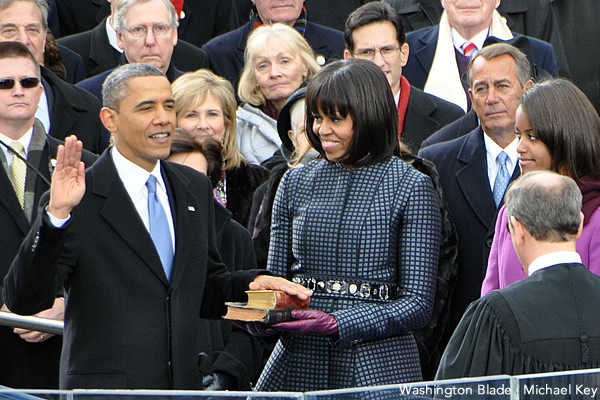
In a first, President Obama made two references to gay rights during his inaugural address in January. (Washington Blade file photo by Michael Key)
President Obama stirred passions in the LGBT community by making an unprecedented reference to LGBT rights during his second-term inaugural address and saying he believes gay people deserve equal treatment under the law.
“Our journey is not complete until our gay brothers and sisters are treated like anyone else under the law – for if we are truly created equal, then surely the love we commit to one another must be equal as well,” Obama said.
The words marked the first time that any U.S. president mentioned gay rights during an inaugural address and sent shockwaves through the LGBT community.
Also during the speech, Obama made a reference to the 1969 Stonewall riots, which are considered the start of the modern LGBT rights movement.
“We, the people, declare today that the most evident of truths – that all of us are created equal – is the star that guides us still; just as it guided our forebears through Seneca Falls, and Selma, and Stonewall; just as it guided all those men and women, sung and unsung, who left footprints along this great Mall, to hear a preacher say that we cannot walk alone; to hear a King proclaim that our individual freedom is inextricably bound to the freedom of every soul on Earth,” Obama said.
#9: Gay mayors in Seattle, Houston; Quinn loses in New York
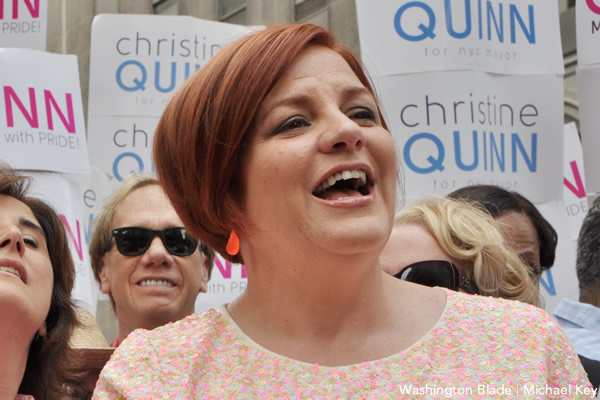
Lesbian Christine Quinn started her mayoral campaign a heavy favorite but ultimately lost in New York’s primary. (Washington Blade photo by Michael Key)
Lesbian Annise Parker won election to her third and final term as mayor of Houston, on Nov. 5, receiving a decisive 57 percent of the vote in a nine-candidate race.
In Seattle, Washington State Sen. Ed Murray defeated incumbent Mayor Mike McGinn by a margin of 56 percent to 43 percent to become that city’s first openly gay mayor.
And in Atlantic City, N.J., gay Republican Don Guardian shook up the political establishment by winning an upset victory over incumbent Mayor Lorenzo Langford, a Democrat, in a city where Democrats outnumber Republicans among registered voters by a nine to one margin. Guardian ran as a socially progressive reform candidate with a record as a highly competent administrator of services for the city’s tourist district.
Meanwhile, New York City Council Speaker Christine Quinn lost her race to become New York’s first openly gay and first female mayor, finishing third in a hotly contested Democratic primary in September. A New York Times exit poll showed pro-LGBT candidate Bill deBlasio, who won the primary and the general election in November, beat Quinn among LGBT voters by a margin of 47 percent to 34 percent in a four candidate race.
Most political observers said LGBT voters joined the majority of their straight counterparts in backing deBlasio, who emerged as more progressive on economic issues than Quinn and who was perceived as an outspoken critic of incumbent Mayor Michael Bloomberg, who is highly unpopular among Democratic voters. Quinn had long been viewed as a Bloomberg ally.
# 10 Manning gets 35 years, comes out as trans

Manning announced she is transitioning one day after being sentenced for leaking classified documents. (Public domain photo)
One day after a military judge sentenced former U.S. Army Private Bradley Manning to 35 years in prison for leaking classified documents to Wikileaks, the 25-year-old soldier released a statement through her attorney coming out as transgender.
“As I transition into this next phase of my life, I want everyone to know the real me,” Manning said. “I am Chelsea Manning. I am a female.”
Manning’s dramatic announcement shifted the media focus from that of her conviction in an Army court martial proceeding of violating the U.S. Espionage Act for leaking an unprecedented amount of classified information to the issue of who transgender people are and whether they should be entitled to equal rights.
Some transgender rights advocates said Manning’s case would hurt efforts to lift the military’s ban on transgender service members by casting transgender people in a negative light. Transgender activists Brynn Tannehill and Autumn Sandeen, who served in the military before transitioning, said they were especially troubled by arguments by Manning’s attorney that Manning’s struggle over her gender identity created stress that played some role in her decision to leak classified information.
“In my last four years in the Navy I was grappling with gender identity yet I did my job” and didn’t release classified information,” Sandeen said.
By Lou Chibbaro Jr., Chris Johnson and Michael Lavers



U.S. Federal Courts
Renee Good’s family files two federal lawsuits
ICE officer killed lesbian mother of three in Minneapolis in January

The family of lesbian woman who a U.S. Immigration and Customs Enforcement killed in Minneapolis in January have filed two federal lawsuits.
The Associated Press notes Renee Good’s partner, Becca Good, and her brother, Brent Ganger, in the lawsuits accuse the Trump-Vance administration and ICE officer Jonathan Ross of “unjustified and excessive use of force.”
Renee Good was a 37-year-old mother of three.
Ross on Jan. 7 shot and killed her in Minneapolis.
The shooting took place during the Trump-Vance administration’s so-called Operation Metro Surge that targeted Somalis and other immigrant groups in Minneapolis. U.S. Customs and Border Protection agents on Jan. 24 shot and killed Alex Pretti, a 37-year-old nurse who worked for the U.S. Department of Veterans Affairs, in Minneapolis.
Both shooting sparked outrage across the U.S. and around the world.
“Every morning, she is my first thought. I think about how the kids are growing up without their mama, and how I will grow old without the love of my life. I think about how we should have had 40 more years together. But I also think about what she would have wanted after all of this,” said Becca Good in a statement the Human Rights Campaign released after she and her partner’s family announced the lawsuits.
“As we have tried to navigate our own massive loss, I am also devastated by how many other lives have been destroyed in this darkest of times. So many other families are dealing with the loss of their loved ones; to everyone who has had to witness it — the pain of this moment extends far beyond our family,” added Becca Good. “What happened to us should never happen to any family. No child should grow up without a parent because of it. No one should lose their sister or their daughter. No one should have to live without their soulmate. Accountability — real accountability — is the only way to make sure that no other family has to go through what we have.”
HRC President Kelley Robinson in her own statement said the Good family “is one of our own — and today, the Human Rights Campaign joins them in demanding justice.”
“It has been eight months and 24 days since Renee was shot and killed by an ICE agent, and the United States government has failed to take responsibility for its actions,” said Robinson. “Her partner, Becca, and brother Brent, have made the brave and bold decision to hold the government accountable, and we stand with them. Like every person murdered by ICE, Renee should be alive today. The Goods were robbed of what every American family deserves: to be together.”
Federal Government
988 restores crisis services for LGBTQ youth

The lifesaving 988 call-in number to help people experiencing mental health crises or suicidal thoughts has once again restored its specialized services for LGBTQ youth.
The lifeline, which used to have the option to “press 3” to be directly sent to specialized services for LGBTQ youth facing mental health crises or suicidal thoughts, was returned on Wednesday following an over-year-long battle with the Trump-Vance administration, which removed the service in May 2025.
The Press 3 option rolled out as a pilot program in 2022 through a government contract with the Trevor Project, a suicide prevention and crisis intervention organization for LGBTQ people.
Then, in June 2025, the federal government announced that the lifeline would be eliminated within a month. By July 2025, 988 Lifeline’s “Press 3” services were terminated.
Openly gay U.S. Sen. Tammy Baldwin (D-Wis.) helped lead Congress in reversing the removal of the lifesaving resource from American phones. As a member of the Senatw Labor-HHS Appropriations Subcommittee, she started the process of securing $535 million for 988 — a $15 million increase — as well as dedicated funding for LGBTQ youth specialized services.
Then, in September 2025, Baldwin, along with U.S. Sen. Lisa Murkowski (R-Alaska), introduced bipartisan legislation in the Senate, the 988 LGBTQ+ Youth Access Act, to codify the 988 Lifeline’s specialized services for LGBTQ young people.
At the same time, U.S. Rep Raja Krishnamoorthi (D-Ill.) introduced the legislation in the House of Representatives alongside U.S. Reps. Michael Lawler (R-N.Y.) Sharice Davids (D-Kan.) Brian Fitzpatrick (R-Pa.) and Seth Moulton (D-Mass.)
The Senate passed Baldwin’s bipartisan funding bill in January 2026, funding the Department of Health and Human Services with explicit language mandating the return of 988’s LGBTQ youth specialized services.
In February 2026, Congress passed legislation mandating that the previously eliminated “Press 3” specialized services be restored and funded with $33,100,000 — but it was unclear if the Press 3 option would still be allowed under current executive orders, namely Executive Order 14168, or “Defending Women From Gender Ideology Extremism and Restoring Biological Truth to the Federal Government.”
Despite the securing of federal funding for the Press 3 resource, the battle to get the 988 LGBTQ+ Youth Access Act through Congress is ongoing — and would provide codafied protection from this removal ever happening again.
According to data on the Trevor Project’s website, LGBTQ young people are more than four times as likely to attempt suicide than their peers.
Baldwin’s office touts the immense help the lifeline provides to LGBTQ people in their moments of greatest need. The press release on the reinstatement of Press 3 highlighted the continued demand for the service:
“The volume of calls, texts, and chats 15 percent higher than a year earlier and nearly 50 percent higher than two years ago. Since the lifeline launched, it has received over 27 million contacts, including over 18 million calls, 4 million texts, and 3 million chats.”
Advocates for LGBTQ rights and mental health awareness have agreed with the increasing numbers and hailed the return as a win for everyone.
“Suicide and mental health struggles touch every community across our state, and that’s why creating the 988 crisis lifeline to make sure help is there for everyone is one of my proudest accomplishments,” said Baldwin said in a statement. “But, last year, the Trump administration decided to make these real struggles a political football and ripped away the specialized line that helped LGBTQ children. This was a deliberate choice. The Trump administration chose to put children’s lives on the line to score some political points.
“I’ve fought tooth and nail to restore this lifesaving resource. When I realized the Trump administration was not going to do it on their own, I wrote it into federal law to require them to restore the Press 3 option,” the Wisconsin senator said. “This lifesaving resource never should have gone away in the first place, but I am glad the lifesaving support Press 3 provides is once again there for people who need it.”
“I’m proud that we secured the funding to restore this lifesaving LGBTQ+ crisis line and successfully pressured the Trump administration to bring the program back,” Krishnamoorthi said. “When an LGBTQ+ young person reaches out for help in a moment of crisis, they deserve to reach a counselor trained to understand and support them. This program should never have been taken away, and now we need to make sure it stays available for every young person who needs it. I’m grateful to the Trevor Project, NAMI Chicago, Equality Illinois, the American Foundation for Suicide Prevention, and all the advocates and young people who worked alongside us to bring these services back.”
Jaymes Black, CEO of The Trevor Project who works with the SAMHSA, in their press three operations celebrated the return of the resource.
“We are grateful to see that the 988 Suicide & Crisis Lifeline’s ‘Press 3’ specialized services for LGBTQ+ youth have been restored. Resuming this national resource will be critical in addressing the public health crisis of suicide among LGBTQ+ young people, and supporting the estimated more than 1.8 million LGBTQ+ youth who seriously consider attempting suicide in the U.S. each year,” Black said via a statement. “We are thankful for the large coalition of bipartisan lawmakers, mental health advocates, allies, and supporters who fought tirelessly for this restoration. We will monitor the launch and usage of these important services to ensure all LGBTQ+ youth are supported with clinically best standards.”
If you or someone you know needs mental health resources and support, please call, text, or chat with the 988 Suicide & Crisis Lifeline or visit 988lifeline.org for 24/7 access to free and confidential services. Trans Lifeline, designed for transgender or gender-nonconforming people, can be reached at (877) 565-8860. The lifeline also provides resources to help with other crises, such as domestic violence situations. The Trevor Project Lifeline, for LGBTQ+ youth (ages 24 and younger), can be reached at (866) 488-7386. Users can also access chat services at TheTrevorProject.org/Help or text START to 678678.
California
Calif. governor signs 6 pro-LGBTQ bills, vetoes 1
Gavin Newsom rejected measure he claimed is legislative overreach

Last week, California Gov. Gavin Newsom signed and vetoed a slew of bills into state law. Among them were seven pertaining to California’s LGBTQ community. Newsom signed six while vetoing one. His actions drew applause and scorn from advocacy groups in the state.
The six signed bills:
Assembly Bill 1775 allows transgender veterans, who were banned from service last year by the Trump-Vance administration, to access housing assistance, use California’s discharge upgrade assistance program, and get support for gaining employment.
Assembly Bill 1930 strengthens privacy protections for healthcare patients and providers by creating clear guidelines for California agencies, individuals, and corporations to respond to out-of-state subpoena requests relating to abortion or gender-affirming care. This includes a requirement to contact the California Attorney General at least seven days prior to responding to the subpoena or providing legal documents. This should add additional protection to those residing in California from investigations in states where abortion or gender-affirming care has more restrictions.
Senate Bill 934 targets conversion therapy in California and increases the amount of time a patient has to bring a medical malpractice lawsuit against a provider for attempting to change the patient’s sexual orientation or gender identity. The bill takes aim at the widely debunked practice that treats queerness as a mental disorder that could be cured through psychotherapeutic methods. Conversion therapy has been illegal in California since 2012; however, a recent Supreme Court decision threw the ban into question, prompting lawmakers to write this new bill that legally defines it as medical malpractice.
Senate Bill 1023 expands access to PrEP, a medication that protects people from contracting HIV. The bill requires insurers to cover the drug through the medical benefit and the pharmacy benefit pathways, allowing for more providers to give patients PrEP.
Senate Bill 1114 strengthens privacy protections for voluntary self-identification data about sexual orientation and gender identity. The bill limits when California government agencies can share this data and bars it from being disclosed outside of the state government, with few exceptions.
Senate Bill 1328 expands support for LGBTQ students and staff in California colleges. The bill requires any institution of higher education to designate an employee at any campus, satellite campus, branch campus, or outreach center to support the needs of LGBTQ individuals.
Equality California, the largest statewide LGBTQ civil rights group in the country, commended the governor for his support of legislation that protects and supports the queer community amid escalating threats, attacks, and rollbacks from the federal government.
Executive Director Tony Hoang said in a written statement, “California is once again demonstrating that when LGBTQ+ people are targeted, our state will respond with action,” adding, “We are grateful to Gov. Newsom for signing these measures.”
The vetoed bill:
Assembly Bill 2164 would have banned California from extraditing anyone residing in California for providing abortions or gender-affirming care in another state. Newsom vetoed this bill despite agreeing with its principles, claiming in a written statement that “extradition is an exclusively executive function” and that he did not want to limit the “executive authority of an incoming governor.”
This bill was created in response to Louisiana’s attempt to extradite a California physician for allegedly sending abortion pills in the mail to a Louisiana woman. Newsom responded forcefully to the extradition request, publicly denying it and stating, “We will not allow extremist politicians from other states to reach into California and try to punish doctors based on allegations that they provided reproductive health care services.”
In a written statement responding to the veto, Lizzy Hinkley, the legal director of the bill’s lead sponsor, Abortion Coalition for Telemedicine, criticized Newsom, stating, “[the] outgoing governor’s principled stance is cold comfort to Californians living and working in the real world post-Dobbs. A high-brow, academic justification for refusing to codify legal protections only reveals an ignorance for the lived reality of patients and providers — and does nothing to help them.”

Bowser, Office of LGBTQ Affairs announce LGBTQ+ History Month events

PHOTOS: Winchester Pride

Evan Low is not the leader the Victory Fund needs at this moment

Transgender woman elected to Brazilian Chamber of Deputies

Lula, Flávio Bolsonaro to face off in second round of Brazilian presidential election

Meet the LGBTQ candidates running for U.S. House, Senate

Vote now! Best Of LGBTQ DC readers’ choice awards

Gay Va. couple hopeful voters will enshrine marriage equality in state constitution

Victory Fund board investigates former staffers’ allegations against CEO Evan Low

LGBTQ community must vote in big numbers
-

 2026 Midterm Elections5 days ago
Meet the LGBTQ candidates running for U.S. House, Senate
-
Arts & Entertainment5 days ago
Vote now! Best Of LGBTQ DC readers’ choice awards
-
Virginia4 days ago
Gay Va. couple hopeful voters will enshrine marriage equality in state constitution
-
LGBTQ Non-Profit Organizations4 days ago
Victory Fund board investigates former staffers’ allegations against CEO Evan Low