Local
In reversal, Kameny heir says no ashes for public memorial
Dramatic shift leaves fate of cemetery plot unclear
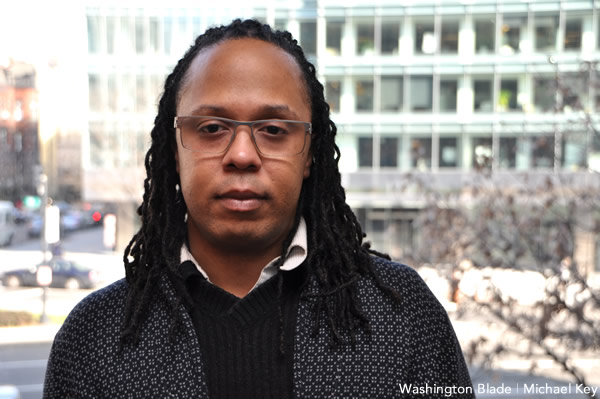
Timothy Clark, who earlier said he would release half of Frank Kameny’s ashes to be interred at Congressional Cemetery, changed his mind and now plans to inter the ashes at an undisclosed location. (Washington Blade photo by Michael Key)
Timothy Clark, the man D.C. gay rights pioneer Frank Kameny named in his will as heir to his estate, has released a statement through his lawyers saying he has decided to inter Kameny’s ashes at an undisclosed location.
The statement released Feb. 20 by the D.C. law firm Ackerman Brown represents a dramatic change from Clark’s earlier statements, including comments in an interview with the Blade in 2012, that he would release half of the ashes for burial at a memorial site in the city’s historic Congressional Cemetery. He reiterated his intent to inter ashes in D.C. in another Blade interview in July 2013.
“We reached an agreement on that so I’m going to keep the burial plot,” Clark said at that time. “I just have to decide on when I want to have something,” he said in referring to a burial ceremony at Congressional Cemetery.
Clark, 37, Kameny’s housemate and longtime friend, had said in the months following Kameny’s death on Oct. 11, 2011, that he planned to keep some but not all of the ashes for his personal reflection and possible interment elsewhere. Kameny died in his Washington home of natural causes at the age of 86.
“The decision regarding interment of Frank Kameny’s ashes rests solely with Timothy Clark, the Personal Representative of the Estate of Franklin E. Kameny,” the Ackerman Brown statement says.
“Mr. Clark has decided to inter the ashes at an undisclosed location. Mr. Clark asks the community to respect his wishes and his privacy,” the statement says.
Clark’s announcement through his attorneys comes more than two years after the local LGBT charitable group Helping Our Brothers and Sisters (HOBS) purchased a burial plot for Kameny’s ashes at Congressional Cemetery.
HOBS and some of Kameny’s gay activist friends and supporters who worked with the group to choose the location of the cemetery site said it would become a monument to Kameny’s legacy and a place where people could go to pay their respects to a nationally known figure considered a hero to the LGBT rights cause.
The site they selected is located just behind the gravesite of the late gay rights leader and U.S. Air Force Sgt. Leonard Matlovich, who, with Kameny’s assistance in 1975, became the first active duty military service member to come out of the closet and challenge the military’s ban on gay service members. Matlovich died in 1987.
A planned ceremony and burial of Kameny’s ashes scheduled for March 2012 was abruptly cancelled at the request of the estate, according to Patrick Crowley, who worked as senior manager of Congressional Cemetery at that time. Lawyers for the Kameny estate wanted HOBS to transfer ownership of the cemetery plot to the estate, Crowley said.
Although HOBS agreed to the transfer, a dispute arose over the terms of an agreement proposed by lawyers for both parties, and negotiations dragged on for nearly two years.
Last July, both sides said a tentative agreement had been reached, raising hopes among Kameny’s friends and admirers that a burial ceremony and the official opening of a Kameny memorial site at Congressional Cemetery would soon take place.
“The estate has always been, and remains willing to work with gay community representatives who knew Frank Kameny in organizing a burial service and appropriate gravesite at which members of the community could pay tribute to Kameny,” said attorney Christopher Brown of Ackerman Brown at that time.
However, no announcement of an agreement emerged since that time. When Ackerman Brown released its statement last week saying Clark decided to inter the ashes at an undisclosed location, neither Ackerman Brown nor HOBS would disclose where things stood with the cemetery plot.
“The estate has no further comment,” said Glen Ackerman, principal partner of Ackerman Brown, in a Feb. 23 email to the Blade.
Matthew Cook, an attorney with the national law firm Fried Frank, which is representing HOBS, sent the Blade a separate statement from HOBS that made no mention of whether ownership of the cemetery plot had been transferred to the estate or whether HOBS would seek to set up another memorial site for Kameny at Congressional Cemetery.
“Dr. Kameny was a true gay rights pioneer and local legend,” the HOBS statement says. “HOBS was proud to work with and for Dr. Kameny during the last years of his life. Of course, as the executor of the Kameny Estate, it is Mr. Clark’s decision where to inter Dr. Kameny’s ashes.”
Veteran D.C. gay activist Paul Kuntzler, who worked with Kameny on gay rights activities beginning in 1962, and San Francisco gay activist Michael Bedwell, a friend of Kameny’s, each told the Blade that the LGBT community should now take immediate steps to arrange for another memorial site for Kameny at Congressional Cemetery, even though the ashes won’t be interred there.
The four local activists and Kameny friends who initiated plans to inter Kameny’s ashes at Congressional Cemetery in early 2012 – Marvin Carter, CEO of HOBS and LGBT rights advocates Charles Francis, Bob Witeck and Rick Rosendall – have declined to comment on Clark’s decision to inter the ashes at another location.
They also declined to comment on what, if anything, they may do to set up a Kameny memorial site at the cemetery now that the ashes are out of the picture.
“Frank Kameny’s monumental legacy may be best remembered by laws he helped overturn, the hateful policies he defeated and the causes of equal rights he unselfishly advanced for the LGBT community,” said Witeck in an email statement on Sunday.
The relationship between the four men and the Kameny estate became strained in 2012 shortly after they announced plans for a Congressional Cemetery memorial site and burial when Clark stated through his attorneys that Clark was never given the courtesy of being consulted about those plans.
Carter, however, has said Clark was informed about the plans and invited to participate in the planned ceremony.
The relationship between the four men and the estate became further strained when the estate filed individual lawsuits against each of them, charging that they took without permission items from Kameny’s house that belonged to the estate shortly after Kameny’s death. The men disputed the allegations, saying Clark along with Clark’s lawyer at the time, Michele Zavos, gave them permission to enter the house and take an inventory of Kameny’s papers and other possessions to arrange for their safe keeping.
The lawsuits, which were filed by Ackerman Brown on Clark’s behalf, were later dropped after undisclosed settlements were reached in three of the cases. The court dismissed the case against Rosendall on grounds that no cause was shown to justify the complaint, according to Rosendall’s attorney, Mindy Daniels.
Upon learning of Clark’s decision to inter the ashes in an undisclosed location, Bedwell expressed concern that Clark, who among other things, inherited Kameny’s house that the estate sold in 2012 for $725,000, was not doing his part to promote Kameny’s legacy.
“Frank’s trust and affection made Mr. Clark a wealthy man,” Bedwell said. “His sacrifices helped make him, like all LGBTs, a freer man,” Bedwell said.
“Now that Mr. Clark has disappeared with Frank’s ashes along with any hopes of his repaying Frank’s extraordinary generous friendship by sharing them for a memorial, I trust that others will create one without them,” he said.
Clark didn’t respond to a phone message from the Blade this week.
In a 2012 interview with the Blade, Clark described himself as a private person who shunned the spotlight, saying he intentionally remained in the background during the 19 years he lived in Kameny’s house.
(Washington Blade file photo by Michael Key)
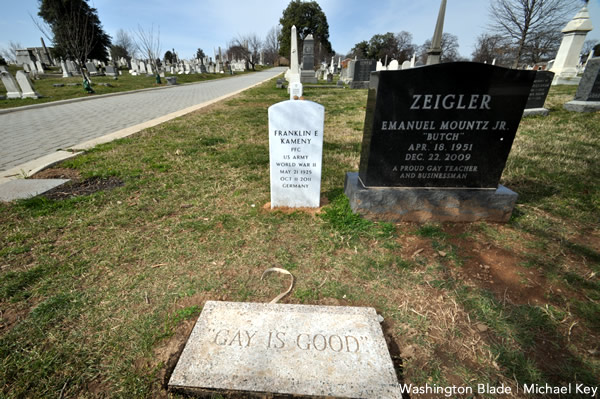
Also remaining unclear this week is what will become of a headstone and separate grave marker that HOBS and the activists working with the group installed at the cemetery site before the dispute with the estate surfaced.
Francis, the founder of the Kameny Papers Project, which arranged several years before Kameny’s death to have Kameny’s voluminous collection of letters and gay rights documents donated to the Library of Congress, obtained the headstone from the U.S. Department of Veterans Affairs.
Francis and others working on the memorial site said the military headstone would recognize Kameny’s role as a World War II combat veteran. The stone is identical to gravestones used for soldiers and veterans buried at Arlington National Cemetery, and is issued free of charge to all deceased military veterans.
HOBS purchased a separate footstone inscribed with the slogan Kameny coined in the 1960s, “Gay is Good.” Carter said HOBS paid for the footstone along with the cemetery plot through funds donated by members of the LGBT community.
HOBS had both stones installed at the gravesite in March 2012 in anticipation that plans for burial of the ashes would move forward as planned.
Cemetery officials later removed the headstone and the “Gay is Good” marker and placed them in storage, saying it was inappropriate for them to remain in place while the ownership of the gravesite was in dispute.
Bedwell, who has played a role in managing the Matlovich gravesite, said he owns a separate plot next to the Matlovich site that he offered to donate for the Kameny burial shortly after Kameny died. HOBS instead chose to buy a plot a short distance away. Now, Bedwell said he is open to donating the plot he owns for a new Kameny memorial site at the cemetery.
“Neither [Clark’s] permission or Frank’s ashes are required for anyone to create a memorial to Frank anywhere,” Bedwell said in a comment to the Blade in October. “Millions more visit Lincoln’s Memorial in Washington every year than his actual gravesite in Springfield, Ill.,” he said.
“I’m confident many would be eager to contribute to the purchase of another marker bearing Frank’s name,” Bedwell said, in the event that the Veterans Administration stone or the “Gay is Good” stone won’t be released by the estate.
Ackerman, while repeating his firm’s written statement that the Kameny estate would have no further comment on Clark’s decision to inter the ashes in a private location, said the estate would welcome inquiries “by anyone” interested in establishing a public memorial for Kameny.
“All they have to do is call us,” he said.




Virginia
DOJ seeks to join lawsuit against Loudoun County over trans student in locker room
Three male high school students suspended after complaining about classmate

The Justice Department has asked to join a federal lawsuit against Loudoun County Public Schools over the way it handled the case of three male high school students who complained about a transgender student in a boys’ locker room.
The Washington Blade earlier this year reported Loudoun County public schools suspended the three boys and launched a Title IX investigation into whether they sexually harassed the student after they said they felt uncomfortable with their classmate in the locker room at Stone Bridge High School in Ashburn.
The parents of two of the boys filed a lawsuit against Loudoun County public schools in U.S. District Court for the Eastern District of Virginia in Alexandria. The Richmond-based Founding Freedoms Law Center and America First Legal, which White House deputy chief of staff Stephen Miller co-founded, represent them.
The Justice Department in a Dec. 8 press release announced that “it filed legal action against the Loudoun County (Va.) School Board (Loudoun County) for its denial of equal protection based on religion.”
“The suit alleges that Loudoun County applied Policy 8040, which requires students and faculty to accept and promote gender ideology, to two Christian, male students in violation of the Equal Protection Clause of the 14th Amendment to the U.S. Constitution,” reads the press release.
Assistant Attorney General Harmeet K. Dhillon of the Justice Department’s Civil Rights Division in the press release said “students do not shed their First Amendment rights at the schoolhouse gate.”
“Loudoun County’s decision to advance and promote gender ideology tramples on the rights of religious students who cannot embrace ideas that deny biological reality,” said Dhillon.
Outgoing Virginia Gov. Glenn Youngkin and outgoing Virginia Attorney General Jason Miyares in May announced an investigation into the case.
The Virginia Department of Education in 2023 announced the new guidelines for trans and nonbinary students for which Youngkin asked. Equality Virginia and other advocacy groups claim they, among other things, forcibly out trans and nonbinary students.
The U.S. Department of Education’s Office of Civil Rights in February launched an investigation into whether Loudoun County and four other Northern Virginia school districts’ policies in support of trans and nonbinary students violate Title IX and President Donald Trump’s executive order that prohibits federally funded educational institutions from promoting “gender ideology.”
District of Columbia
Capital Pride announces change in date for 2026 D.C. Pride parade and festival
Events related to U.S. 250th anniversary and Trump birthday cited as reasons for change

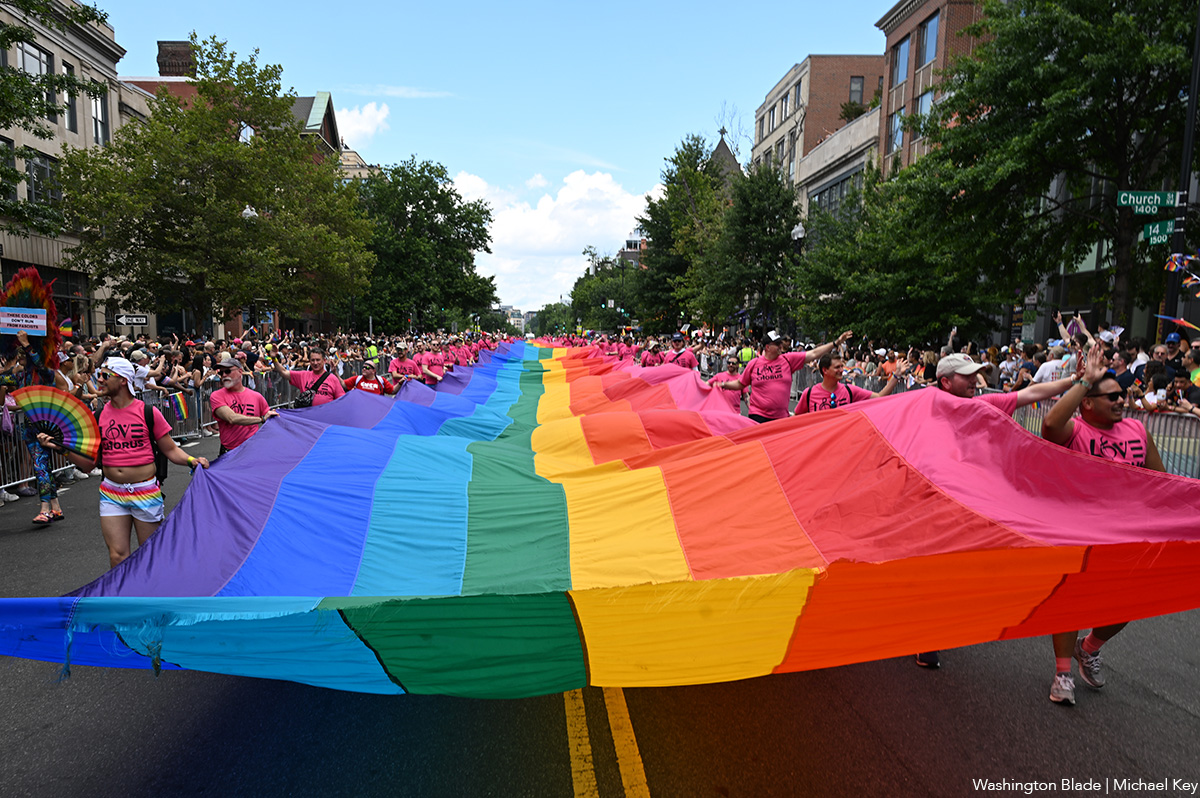
The Capital Pride Alliance, the D.C. based group that organizes the city’s annual LGBTQ Pride events, has announced it is changing the dates for the 2026 Capital Pride Parade and Festival from the second weekend in June to the third weekend.
“For over a decade, Capital Pride has taken place during the second weekend in June, but in 2026, we are shifting our dates in response to the city’s capacity due to major events and preparations for the 250th anniversary of the United States,” according to a Dec. 9 statement released by Capital Pride Alliance.
The statement says the parade will take place on Saturday, June 20, 2026, with the festival and related concert taking place on June 21.
“This change ensures our community can gather safely and without unnecessary barriers,” the statement says. “By moving the celebration, we are protecting our space and preserving Pride as a powerful act of visibility, solidarity, and resistance,” it says.
Ryan Bos, the Capital Pride Alliance CEO and President, told the Washington Blade the change in dates came after the group conferred with D.C. government officials regarding plans for a number of events in the city on the second weekend in June. Among them, he noted, is a planned White House celebration of President Donald Trump’s 80th birthday and other events related to the U.S. 250th anniversary, which are expected to take place from early June through Independence Day on July 4.
The White House has announced plans for a large June 14, 2026 celebration on the White House south lawn of Trump’s 80th birthday that will include a large-scale Ultimate Fighting Championship (UFC) event involving boxing and wrestling competition.
Bos said the Capital Pride Parade will take place along the same route it has in the past number of years, starting at 14th and T Streets, N.W. and traveling along 14th Street to Pennsylvania Ave., where it will end. He said the festival set for the following day will also take place at its usual location on Pennsylvania Avenue, N.W., between 2nd Street near the U.S. Capitol, to around 7th Street, N.W.
“Our Pride events thrive because of the passion and support of the community,” Capital Pride Board Chair Anna Jinkerson said in the statement. “In 2026, your involvement is more important than ever,” she said.
District of Columbia
Three women elected leaders of Capital Pride Alliance board
Restructured body includes chair rather than president as top leader
The Capital Pride Alliance, the D.C.-based group that organizes the city’s annual LGBTQ Pride events, announced it has restructured its board of directors and elected for the first time three women to serve as leaders of the board’s Executive Committee.
“Congratulations to our newly elected Executive Officers, making history as Capital Pride Alliance’s first all-women Board leadership,” the group said in a statement.
“As we head into 2026 with a bold new leadership structure, we’re proud to welcome Anna Jinkerson as Board Chair, Kim Baker as Board Treasurer, and Taylor Lianne Chandler as Board Secretary,” the statement says.
In a separate statement released on Nov. 20, Capital Pride Alliance says the restructured Board now includes the top leadership posts of Chair, Treasurer, and Secretary, replacing the previous structure of President and Vice President as the top board leaders.
It says an additional update to the leadership structure includes a change in title for longtime Capital Pride official Ryan Bos from executive director to chief executive officer and president.
According to the statement, June Crenshaw, who served as acting deputy director during the time the group organized WorldPride 2025 in D.C., will now continue in that role as permanent deputy director.
The statement provides background information on the three newly elected women Board leaders.
• Anna Jinkerson (chair), who joined the Capital Pride Alliance board in 2022, previously served as the group’s vice president for operations and acting president. “A seasoned non-profit executive, she currently serves as Assistant to the President and CEO and Chief of Staff at Living Cities, a national member collaborative of leading philanthropic foundations and financial institutions committed to closing income and wealth gaps in the United States and building an economy that works for everyone.”
• Kim Baker (treasurer) is a “biracial Filipino American and queer leader,” a “retired, disabled U.S. Army veteran with more than 20 years of service and extensive experience in finance, security, and risk management.” She has served on the Capital Pride Board since 2018, “bringing a proven track record of steady, principled leadership and unwavering dedication to the LGBTQ+ community.”
• Taylor Lianne Chandler (Secretary) is a former sign language interpreter and crisis management consultant. She “takes office as the first intersex and trans-identifying member of the Executive Committee.” She joined the Capital Pride Board in 2019 and previously served as executive producer from 2016 to 2018.
Bos told the Washington Blade in a Dec. 2 interview that the Capital Pride board currently has 12 members, and is in the process of interviewing additional potential board members.
“In January we will be announcing in another likely press release the full board,” Bos said. “We are finishing the interview process of new board members this month,” he said. “And they will take office to join the board in January.”
Bos said the organization’s rules set a cap of 25 total board members, but the board, which elects its members, has not yet decided how many additional members it will select and a full 25-member board is not required.
The Nov. 20 Capital Pride statement says the new board executive members will succeed the organization’s previous leadership team, which included Ashley Smith, who served as president for eight years before he resigned earlier this year; Anthony Musa, who served for seven years as vice president of board engagement; Natalie Thompson, who served eight years on the executive committee; and Vince Micone, who served for eight years as vice president of operations.
“I am grateful for the leadership, dedication, and commitment shown by our former executive officers — Ashley, Natalie, Anthony, and Vince — who have been instrumental in CPA’s growth and the exceptional success of WorldPride 2025,” Bos said in the statement.
“I look forward to collaborating with Anna in her new role, as well as Kim and Taylor in theirs, as we take on the important work ahead, prepare for Capital Pride 2026, and expand our platform and voice through Pride365,” Bos said.

PHOTOS: The Holiday Show

The best books to give this holiday season

Studio’s ‘Mother Play’ draws from lesbian playwright’s past

Choose U ambassadors share lived experiences with HIV, personal reflections, and insights

DOJ seeks to join lawsuit against Loudoun County over trans student in locker room

EXCLUSIVE: George Santos speaks out on prison, Trump pardon, and more

Victory Institute honors transgender Spanish senator in D.C.

The beginning of the fall of Trump

Markey reintroduces International Human Rights Act in Senate