a&e features
Gay Holocaust survivor shares life lessons
Alfred Munzer laments ongoing religious, racial hatred
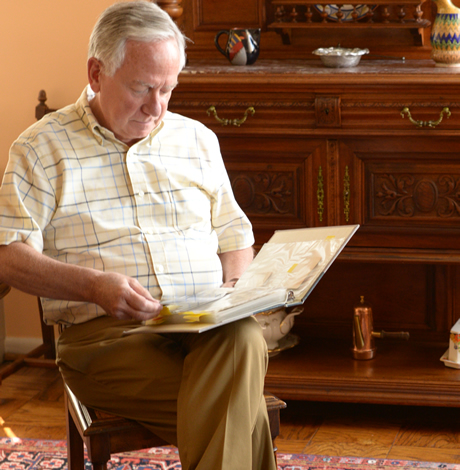
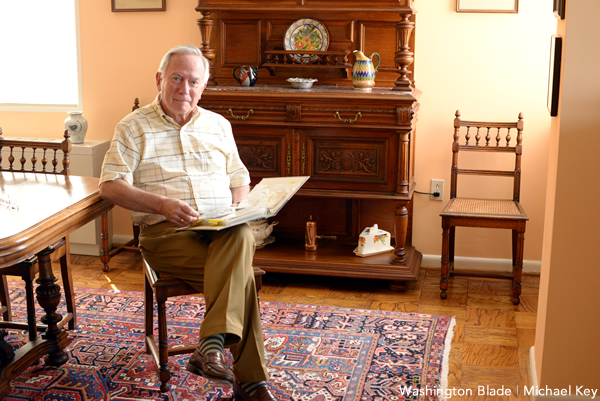
Alfred Munzer in his Van Ness apartment. Now retired from his medical career, Munzer devotes much of his time to the Holocaust Museum. (Washington Blade photo by Michael Key)
First Person 2015 Series: Al Munzer
Conversation with a Holocaust Survivor
Wednesday, July 29
11 a.m.
U.S. Holocaust Memorial Museum
100 Raoul Wallenberg Place, S.W.
Free
No registration required
Although the odds were not favorable for Alfred Munzer in the circumstances surrounding his birth, in many ways, he ended up being the luckiest member of his family.
He’s the youngest of three children of Simcha and Gisele Munzer, a family of Jewish immigrants from what is now Poland. His parents were childhood sweethearts and were raising two daughters, Eva (born in July 1936) and Leah (born in November 1938) in the Hague, Netherlands. After World War I, anti-Semitism was rampant in their native land and opportunities were limited, so they moved to Holland where there was a substantial population of Jews, some of whom were from families that had been there since the 15th century. Simcha ran a men’s tailoring business.
When Gisele discovered she was expecting a third child — the pregnancy was unplanned — an abortion was advised and, as Munzer tells it today, his mother was told that, “it would be immoral to bring another Jewish life into the world.” Although not especially religious, she was inspired by the Old Testament story of Hannah, the childless woman who vows to God that if she is given a son, she will give him back to God. Her wish is granted with the birth of Samuel.
Munzer, now 73, was born on Nov. 23, 1941. Before he reached his first birthday, in July of 1942, Germans began mass deportations of nearly 100,000 Jews from the occupied Netherlands to the east, primarily Auschwitz, a network of Nazi concentration camps in German-annexed regions that had previously been part of Poland. It marked the beginning of a harrowing season for his family.
Munzer says growing up, he was often reminded of the circumstances around which he was born.
“Any time I was bad growing up, my mother would remind me of this, how she had prayed to God and requested a son,” Munzer says. “She indoctrinated me with this. It was made very clear that she had made the same pledge as Hannah and that I was here in service of God ultimately.”
It’s one of many biographical stories Munzer will share on Wednesday, July 29 when he does another installment of the Holocaust Museum’s First Person program in which survivors are interviewed about their life experiences. Since retiring from his career as an internist and pulmonologist last year, Munzer has become increasingly active as a volunteer at the museum. The program is free.
Having shared his life story many times over the years, first at an artistic event in Woodstock, N.Y., in the early 1980s, Munzer says it’s important that his story and those of other Holocaust survivors continue to be told.
“The angle I usually take is that even in a sea of evil, it is possible for people to do the right thing and stand up for what is right,” he says.
Unlike, for instance, the Anne Frank family, the Munzers thought they’d fare better if they went into hiding separately. Munzer’s two sisters went to live with a Catholic family. Simcha Munzer had received a notice to report for so-called labor duty, essentially a one-way ticket to a concentration camp, but was able to delay it by first having a hernia operation he’d been putting off and later faking a suicide attempt. Joined by Gisele at a Jewish psychiatric hospital where she was pretending to be a nurse’s aide, the two were eventually deported, in early 1943, to Vught Concentration Camp and then a year later to Auschwitz where they were separated.
Gisele had sold the family’s possessions. Neighbors kept some items such as a silver candelabra and fire dragon puppet that are now in Munzer’s Van Ness apartment where he’s lived for about 25 years with his husband, Joel Wind. Though only married for a year and a half, the two have been together since they met at Bet Mishpachah, a local LGBT-affirming synagogue where Munzer sometimes preaches, in 1980.
Things quickly turned dark for the family. The husband of the family raising Munzer’s two older sisters turned out to be a Nazi sympathizer. He denounced his wife and the two girls and all three were arrested and sent to the Westerbork transit camp. On Feb. 8, 1944, Eva, 8, and Leah, 6, were deported to Auschwitz where they were killed three days later.
Alfred was put in the care of a family friend named Annie Madna who placed him with her sister. After about a month, she became too nervous to keep him and placed little Alfred with her ex-husband Tole, a native of Indonesia. Munzer stayed there for the next three years and was looked after by their housekeeper, Mima Saina, who went to great lengths to care for him.
“She really became my mother,” Munzer says. “She was a woman who was completely illiterate, who spoke no Dutch, couldn’t read or write, she spoke only Indonesian, but she had a heart of gold. She would walk — I was in the house illegally, so there were no ration coupons for me — she had to scrounge up milk for me however she could, sometimes walking miles just to get it. I’m told I slept in her bed. She kept a knife under the pillow to kill off any Nazis who might try to get me or even kill me rather than having me fall in their hands. She was an amazing woman who raised me from the time I was about 9 months old till I was about 3 and a half.”
Simcha spent several months in Auschwitz and was then sent to three different camps in Austria. Although eventually freed from one in Ebensee in the Austrian Alps by the U.S. Army, he was so weakened by the ordeal that he died under the care of nuns at a convent just two months later, on July 25, 1945, 70 years ago this weekend. Munzer was told his father had contracted tuberculosis.
Gisele fared better and worked on electronics equipment in a series of camps before she was freed at the Danish border through the intervention of the Swedish Red Cross in early 1945. Although fussy from having been awoken from a nap, being reunited with her is one of Munzer’s earliest memories.
“I was cranky and crying so the whole Matna family was passing me around, like you do with a crying baby, and the only lap I wouldn’t sit on was my own mother’s,” Munzer says. “She was a stranger to me by that point.”
It was decided that his de facto surrogate mother Mima would continue to care for him while Gisele looked for work but Mima had a cerebral hemorrhage about two months later and died. Gisele eventually found work in the garment industry. Although deeply traumatized by the Holocaust, Munzer remembers her as a stoic, matter-of-fact woman. He had no sense growing up that his life was any different from anyone else’s.
“I was surrounded by kids who had lost their parents, who had lost siblings, there really was nothing unusual about that,” he says. “I did not understand as a very young kid what had happened to my sisters. All I knew was that there were these beautiful pictures on the wall of these beautiful girls. Everybody would tell me how wonderful they were. One of my mother’s neighbors would tell me that my older sister could write so perfectly when she was just 6. I was a little bit jealous of them in a sense. I had no comprehension of the fact that they had been killed. I just did not understand why they were missing or just didn’t really think about it.”
Neither, too, did the bombed-out landscape of the Hague, strike young Munzer as unusual.
“My mother had a very good friend who was in a concentration camp with her and she and her husband, well, there was very little housing available there. After my mother closed her store, she had acquired a little cosmetics store, we’d go to visit the Van Der Pols in these few little rooms they had in an attic and we’d walk across these huge fields of rubble to get there. I thought walking through rubble was just a normal thing. Or playing hide and seek in bunkers on the beach. It wasn’t until much later that I came to grips with the Holocaust as such.”
In July 1958, Gisele and then-16-year-old Alfred came to the United States where he became a bit of an overachiever. Located in Brooklyn, he finished high school, college, medical school and advance training at Johns Hopkins. He first came to Washington in 1972 during a two-year tour of duty with the Air Force and an assignment at Andrews Air Force Base.
He has many happy memories of his later years with his mother and says the two enjoyed many trips, including a few to visit his father’s grave, in her later years. A pivotal turning point in his understanding of the Holocaust came in 1978 when the miniseries “The Holocaust” aired on CBS.
“Before, I would hear her in conversations with friends and it was always, ‘so-and-so came back’ or ‘so-and-so did not come back.’ They never used the term survived. She had told me little bits and pieces here and there, actually humorous things mostly. She told me once very late in the game, she was actually cast as Adolf Hitler in a play, that type of thing. But she always had an incredibly positive attitude, which I think is really what kept her alive. She even spoke of being in one of those cattle cars and being able to look out and see the beautiful countryside. She said, ‘After the war, we may not have much money, but at least that was not a bad way to travel around and see nature. … After the ‘Holocaust’ miniseries, I took out a map and had her trace the 12 concentration camps she had been through and she told me the approximate dates and things that had happened at each place.”
Munzer says she was “very matter of fact about it.”
She eventually embraced Wind and on later trips introduced he and Alfred as “her two sons.” She settled in Rockville and enjoyed painting and was “not especially anti-German,” Munzer says. “She judged people individually and felt that was important.” Several of her landscapes hang above Munzer’s sofa now. She died at age 95 about 12 years ago.
Munzer started volunteering at the museum about eight years ago. He conducts tours, helps with Dutch-to-English translation work, gives talks to student groups and more. He says he’s delighted that the museum has remained popular and, although a challenge, is often overwhelmed by the number of people who visit, crowds having far surpassed estimates since its 1993 opening.
Museum staff say the stories from survivors are hugely important and valuable.
“One of the most powerful ways people (understand history) is to engage with someone who witnessed it,” says Diane Saltzman, director of survivor affairs. “Holocaust survivors who volunteer at the museum provide that personal connection for our visitors and bring an incomprehensible past alive and add a unique and powerful dimension to the visitors’ experience.”
Munzer is thrilled the staff — he’s the only LGBT survivor volunteer he knows of — has not raised the slightest issue with him being gay. He also says being out during his medical career was also pleasantly uneventful in that regard.
Last week’s conviction of 94-year-old SS sergeant Oskar Groening, an Auschwitz bookkeeper sentenced to four years imprisonment for his role as an accessory to murder in 300,000 deaths, is “awfully late” in Munzer’s opinion.
“Although I do think it’s important for people to be brought to justice.”
Equally important, Munzer says, is that the Holocaust is not forgotten.
“To me one of the greatest tragedies of the Holocaust is not even what happened but the fact that violence continues and especially genocide continues. The world really did not learn its lesson and the slogan ‘never again’ has really not been upheld. The fact that there is still religious hatred and racial hatred is just really, really sad. The re-emergence of anti-Semitism but even more in general, just not recognizing people as part of the common human race.”

Joel Wind (standing) and Alfred Munzer married in 2013 after more than 30 years together. (Washington Blade photo by Michael Key)





a&e features
Have yourself a merry John Waters Christmas
Annual holiday show returns to Alexandria and Baltimore
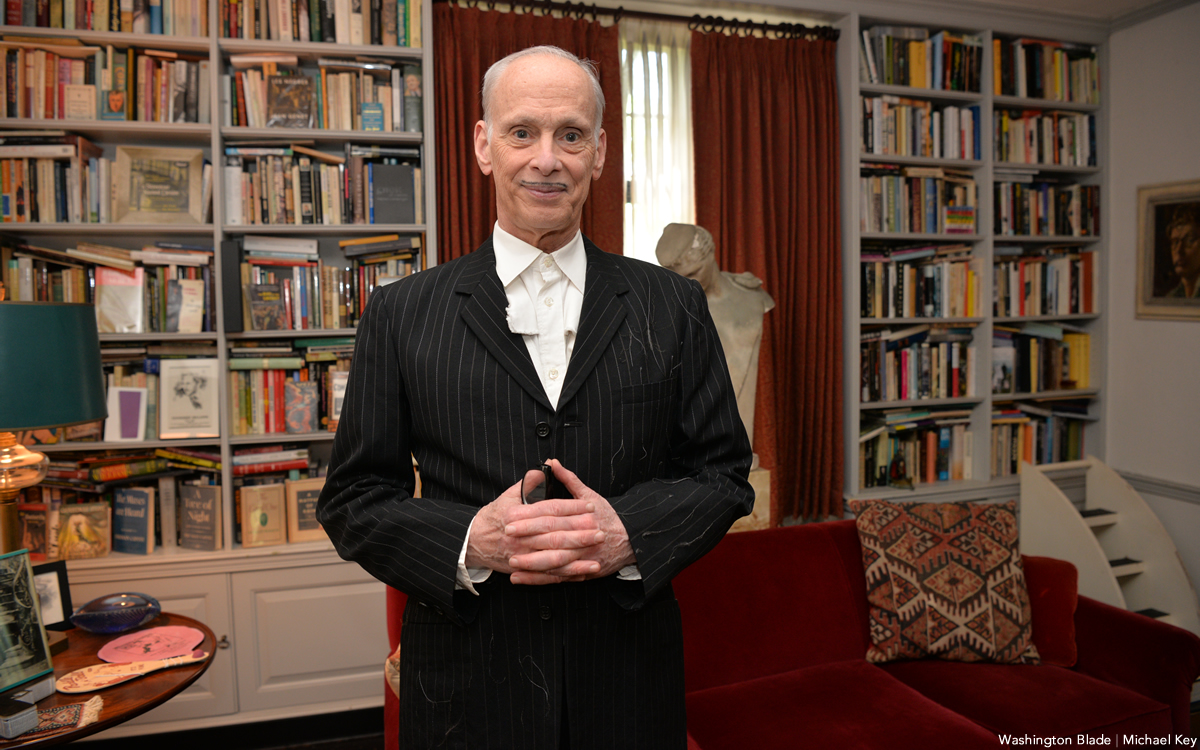
When it comes to iconic Christmas scenes in movies, none can top the tree-toppling tantrum thrown by cha-cha heels-deprived Dawn Davenport in John Waters’s fifth full-length feature “Female Trouble” from 1974. Therefore, it’s not surprising that Waters continues to make art out of Christmas, performing his spoken word Christmas tour in cities across the country. Waters has even more reason to celebrate with the release of his new red vinyl 7” single, a cover of Little Cindy’s “Happy Birthday Jesus (A Child’s Prayer)” on the A-side, and “A Pig Latin Visit From St. Nicholas” on the B-side. If you’re still looking for unique Christmas gifts, consider this record. As always, John was kind enough to make time for an interview in advance of his tour dates.
BLADE: John, in preparation for this interview with you, I went back and listened to Little Cindy’s original rendition of “Happy Birthday Jesus (A Child’s Prayer)” on your “A John Waters Christmas” CD.
JOHN WATERS: One thing I did, if you notice, I make the same stumble in my recording that she did in the original.
BLADE: It sounded to me like she got choked up.
WATERS: No, I think she just stumbles over a word, so I stumbled over the same word. It’s appropriation, insanely.
BLADE: Is this a song you first became aware of in your youth or when you were an adult?
WATERS: When I was doing the Christmas album, I had this friend named Larry Benicewicz. He was kind of my idea man with music. He knew every single old record. I would say to him, “Weird Christmas songs,” when we were doing a soundtrack, or a song about bears, or a song about this, and he would give me all these tapes. It was one of the ones he played for me. A lot of the songs I put in my movies and on my records, I did know as a kid. I did not know this one, but I immediately embraced it. I don’t think it’s campy. I think it really is spiritual in a weird way. My doing it makes it a novelty record. I am really for novelty records, and there aren’t any anymore. Why was there not a COVID novelty record? That’s insane. The dance “The Bug” that’s on the “Hairspray” soundtrack would be perfect for COVID.
BLADE: The thing that struck me was that for a Christmas song in the voice of a child, a kind of death pall hangs over it, with lines like, “If I was good you’d let me live with you” and “they nailed you to the cross, they wanted you to die.”
WATERS: All of it! When I see children at midnight mass kneeling in front of a nude man nailed to a cross, I feel like I’m at The Eagle! It is S&M, it’s creepy. I took the same cover (photo) from her record to parody and put my face on it. The same thing I did with The Singing Dogs last year when I covered (their version of) “Jingle Bells.” I’m really into novelty records. I love them and I’m trying to bring them back. I don’t expect anybody to ever play these records. Even The Singing Dogs one said on it, “Please do not play this record” [laughs]. And the flipside, the Pig Latin version, is almost impossible to listen to.
BLADE: I’m so glad you mentioned that. “A Pig Latin Visit From St. Nicholas” reminded me of the lost art of speaking in Pig Latin. I also recall watching the PBS series “Zoom” as an adolescent and learning to speak “ubbi dubbi,” a distant relative of Pig Latin. Do you think that the time is right for a Pig Latin or ubbi dubbi revival?
WATERS: Here’s the thing, I never could pick up any language, except Pig Latin. I’ve been in every foreign country. Foreign countries have given me money to learn to speak the language. I can never do it! But Pig Latin…my parents and other parents in the ‘50s spoke Pig Latin so kids couldn’t understand what they were saying. Then my mother taught it to me, and I used it. The hardest take to shoot in “Pink Flamingos” was not eating the dog shit. It was when the cast skipped, in one take, saying “E-way, are-yay e-they ilthiest-fay eople-pay in-hay e-they ole-hay ide-way orld-way.” We’re the filthiest people in the whole wide world in Pig Latin. We had to do so many takes so they could do it once without screwing it up. In “Polyester,” Edith (Massey) answers the phone, “ello-hay.” I did a photo piece where it was all subtitled in Pig Latin. Like “osebud-Ray” (from “Citizen Kane”) or in “Streetcar,” “ella-Stay!” [Laughs] All the iconic dialogue translated into Pig Latin. My assistant who helped me do it, had never heard of Pig Latin. She really got good at it because she lived in many foreign countries and can pick up languages. But it’s not that easy to do it correctly and read it. Your computer will translate into Pig Latin.
BLADE: AI understands Pig Latin?
WATERS: I guess that’s AI. It wasn’t 100% right, but it was close. I can speak it if I look at it, but just do a bit at a time. It was a challenge that no one would possibly care about or want to do.
BLADE: I think you pulled it off very well.
WATERS: If you want people to leave on Christmas morning, you put it on. That’s how you get your guests to leave. It’s time to go.
BLADE: Ood-gay i-bay! How did your relationship with record label Sub Pop, which released 2021, 2022, 2024, and new 2025 holiday singles, come about?
WATERS: I believe the first thing I did for them was “Prayer to Pasolini.” They came to me through Ian Brennan. He’s won a couple Grammys for World Music, but he is also is one of my agents who does the Christmas tour and a lot of my shows, anything with music. He helped me arrange each one of the songs. He had a relationship with Sub Pop. It was perfect. My friends in Baltimore, (the band) Beach House, have had huge success.
BLADE: That’s right, they’re on Sub Pop!
WATERS: Yes! I’m happy to be on it. I’ve even been to the warehouse and posed for pictures like Jackie Suzanne used to do.
BLADE: Is there any chance that “A John Waters Christmas” might be reissued on vinyl by Sub Pop?
WATERS: No. It’s such a nightmare to get the rights and to renew them. You have to find the publisher and the writer, and they usually hate each other. It doesn’t matter if it’s obscure or famous, it’s hard to get. You have to make the deal. The singer doesn’t get anything unless they play it on the radio. It would be so complicated legally, and there would be such a [laughs] tiny audience for it. I hope it will come out again. The same thing with the one for Valentine’s Day. I had two of them that did quite well when they came out; “A Date With John Waters and “A John Waters Christmas.” The “John Waters Christmas” album is still the soundtrack that plays whenever I’m doing my spoken word Christmas show as people are entering the theater.
BLADE: Aside from your annual Christmas show tour, what else do you do for the holidays now, and are there any traditions that you’ve carried over from your family?
WATERS: Certainly! I have two sisters, my brother’s widow, and me, so there are four and we take turns each year to have the Christmas dinner. Mine was last year. An entire sit-down dinner. Mom’s China, the silverware, the entire full dinner. It’s pretty traditional. I don’t have a Christmas tree, but I do decorate the electric chair from “Female Trouble.” That is a tradition in my family. We do have Christmas decorations, but they’re usually weird ones that fans sent me. I have one with Divine knocking over the Christmas tree, and the Christmas tree lights up, all sorts of amazing things. There is definitely a tradition here that might be a little altered, but it is definitely a tradition. I used to have a giant party every year, but COVID ended that. I still wouldn’t want 200 people in my house breathing right now.
BLADE: I was looking at your tour schedule and wondered if there are any new cities in which you’ve never performed the John Waters Christmas show that have been added to this year’s schedule?
WATERS: I don’t think there’s a city in America in which I haven’t done one show! The only places I haven’t been to are Hawaii and Alaska. I could do it there, but it’s too long on a tour. I can’t think of a city I haven’t played in in America over the last 50 years. The Christmas show is completely different every year. It doesn’t matter if you saw it last year.

Some gifts scream practical, others whisper luxury, and a few flat-out blur the lines. From cocoa that feels ceremonial to a cologne that linger like a suggestive smirk, this year’s ultimate gift picks prove that thoughtful (and occasionally naughty) presents don’t have to be prosaic. Welcome to your holiday cheat sheet for festive tangibles that get noticed, remembered, and maybe even result in a peck of gratitude planted under the mistletoe. Consensually, of course.
Amber Glass Champagne Flutes
Pop the champs – but make it vintage. These tulip-shaped stunners in amber-tinted glass bring all the Gatsby vibes without the Jazz-age drama. Whether you’re toasting a milestone or celebrating a Tuesday, their seven-ounce capacities and hand-wash-only care make ‘em as practical as they are pretty. Pair with a thoughtful bottle of bubs and gift with a glittering wink. $18, NantucketLooms.com
Disaster Playbook by Here Comes the Apocalypse
Because the end of the world shouldn’t be a solo act, this spiral-bound guide is your step-by-step roadmap to surviving and thriving when everything else goes sideways, which might be sooner than you think. Packed with checklists, drills, and a healthy dose of humor, it’s like a survival manual written by your most prepared (and slightly snarky) friend. Whether you’re prepping for a zombie apocalypse or, more realistically, REVOLUTION!, this playbook’s got your back. $40, HereComesTheApocalypse.com

Wickless Vulva Candles
Bold, luxurious, and completely flame-free, CTOAN’s wickless candles melt from beneath on a warmer, releasing subtle, sophisticated fragrances, like sandalwood or lavender. The vulva-shaped wax adds a playful, provocative element to any space –perfect for a bedroom, living room, or anywhere you want elegance with an edge. A gift that celebrates form, intimacy and self-expression, no fire required. $39, CTOANCO.com
Villeroy & Boch Royal Classic Christmas Collection
Every meal is a mini celebration – with whimsy at every place setting – in Villeroy & Boch’s Royal Classic festive dinnerware collection that hits all the right notes. Made from premium German porcelain, it features nostalgic little toys, nutcrackers, and rocking horses in delicate relief, giving your holiday spread a playful but refined twist. Dishwasher- and microwave-safe, it’s luxe without the fuss. Gift a piece to a special someone, or start a collection they’ll use (and show off) for years to come. $22-$363, Villeroy-Boch.com
Greenworks Electric Lawnmower
You a ’hood queen who considers lawn care performance art – or just wants to rule the cul-de-sac in quiet, emission-free glory? Greenworks’ zero-turn electric mower has the muscle of a 24-horsepower gas engine but none of the fumes, drama or maintenance. Six 60V batteries and a 42-inch deck mean you can mow up to two-and-a-half acres on a single charge – then plug in, recharge, and ride again. It’s whisper-quiet, slope-ready, and smooth enough to make you wonder why you ever pushed anything besides your queer agenda. The perfect gift for the homeowner who loves sustainability, symmetry, and showing off their freshly striped yard like that fresh fade you get on Fridays. $5,000, GreenworksTools.com
Molekule Air Purifier
For the friend who treats their space like a sanctuary (or just can’t stand sneezes), the Molekule Air Pro is magic in motion. Covering up to 1,000 square feet, it doesn’t just capture allergens, VOCs, and smoke – it destroys them, leaving your air feeling luxury-clean. FDA-cleared as a Class II medical device, it’s serious science disguised as modern design. Gift it to your city-dwelling, pet-loving, candle-burning friend who likes their living room as pristine as their Instagram feed. $1,015, Molekule.com

Cipriani Prosecco Gift Set
Effervescent with stone-fruit sweetness and a touch of Italian flair, the Cipriani Bellini & Prosecco gift set brings brunch-level glamour to any day of the week. The Bellini blends rich white-peach purée with sparkling wine, while the dry ’secco keeps things crisp and celebratory. Pop a bottle, pour a flute, and suddenly winter weeknights feel like a party – even with your pants off. $36, TotalWine.com
Woo(e)d Cologne
British GQ recently crowned Woo(e)d by ALTAIA the “Best Date Night Fragrance,” and honestly, they nailed it. Confident without being cocky – smoky gaïac and Atlas cedarwood grounds the room while supple leather and spicy cardamom do all the flirting – it’s a scent that lingers like good conversation and soft candlelight. Gift it to the one who always turns heads – or keep it for yourself and let them come to (and then on) you. $255, BeautyHabit.com

Lococo Cocoa Kit
Keep the run-of-the-mill mugs in the cabinet this Christmas and pull out Lococo’s handcrafted Oaxacan versions that demand you slow down and sip like it matters. Paired with a wooden scoop, rechargeable frother, and Lococo’s signature spice hot-chocolate blend (vegan, gluten-free, with adaptogenic mushrooms), this holiday kit turns Mexi-cocoa into a mini ritual you’ll look forward to. Perfect for anyone who loves a little indulgence with a side of ¡A huevo! energy.
Manta Sleep Mask
Total blackout, zero pressure on the eyes, and Bluetooth speakers built right into the straps, this ain’t your mama’s sleep mask — but it could be. The Manta SOUND sleep mask features C-shaped eye cups that block every hint of light while ultra-thin speakers deliver your favorite white noise, meditation, or late-night playlist straight to your ears. With 24-hour battery life, breathable fabric, and easy-to-adjust sound, it turns any bed (or airplane seat) into a five-star sleep suite. Perfect for anyone who treats shut-eye like an art form (or just wants to escape their roommate’s late-night bingin’ and/or bangin’). $159, MantaSleep.com

Shacklelock Necklace
Turn the industrial-chic vibe of a shackle into a sleek statement. Mi Tesoro’s platinum-plated stainless-steel necklace sits on an 18-inch wheat chain, featuring a shackle-style latch pendant that’s waterproof, tarnish-free, and totally fuss-les. Beyond style, it nods to a classic gesture in the queer leather community: replacing a traditional Master lock with something elegant to quietly signal belonging to someone special. Wear it solo for a minimalist edge or layer it like you mean it; either way this piece locks in both your look and your intentions. $90, MiTesoroJewelry.com
Parkside Flask Mojave Edition
Wine nights get a desert glow-up with Parkside’s limited-edition 750-milliliter all-in-one flask draped in sun-washed bronze and badland hues like sage, sand, and terracotta – with magnetic stemless tumblers that snap on for effortless shareability. It keeps your vino chilled for 24 hours, pours without drips (no tears for spilled rosé, please), and even lets you laser-engrave your own mantra or inside joke. Perfect for picnics, surprise rooftop clinks, or gifting to your favorite wine (or desert) rat. $149, HighCampFlasks.com

Mikey Rox is an award-winning journalist and LGBT lifestyle expert whose work has published in more than 100 outlets across the world. Connect with him on Instagram @mikeyroxtravels.
a&e features
Meet Mr. Christmas
Hallmark’s Jonathan Bennett on telling gay love stories for mainstream audiences

Jonathan Bennett believes there are two kinds of people in the world — those who love Hallmark movies and liars. And in Season 2 of Finding Mr. Christmas, which the Mean Girls star co-created with Ben Roy, Bennett is searching for Hallmark’s next leading man.
“It’s so fun for people because everyone in their life has someone they know that they think should be in Hallmark movies, right? The UPS driver, the barista at the coffee shop, the dentist,” Bennett says. “So we’re testing their acting abilities, we’re testing who they are, but we’re also looking for that star quality — the thing that makes them shine above everyone else. It’s almost something you can’t explain, but we know it when we see it.”
Season 2’s cast includes a former NFL player for the Green Bay Packers, a few actors, and a realtor. The 10 men compete in weekly festive-themed acting challenges, one of which included having to ride a horse and act out a scene with Alison Sweeney. The contestants were chosen from a crop of 360 potential men, and Bennett gives kudos to the show’s Emmy-nominated casting director, Lindsay Liles (The Bachelor, Bachelor in Paradise).
“She has a tough job because she has to find 10 guys that are going to be good reality television, but also have the talent to act, carry a scene, and lead a Hallmark movie eventually,” he says. To be the right fit for a Hallmark leading man, Bennett singles out five key characteristics: you have to be funny, charming, kind, have a sense of humor, and you have to do it all with a big heart.
Of course, Finding Mr. Christmas wouldn’t be Finding Mr. Christmas without its signature eye candy — something Bennett describes as “part of the job” for the contestants. “I can’t believe Hallmark let me get away with this. I dressed them as sexy reindeer and put them in harnesses attached to a cable 30 feet in the air, and they had to do a sexy reindeer photo shoot challenge,” he says with a laugh. “This season is just bigger and bolder than last. People are responding to not only all the craziness that we put them through, but also comparing and contrasting the guys in their acting scenes when we do them back-to-back.”
Season 1 winner Ezra Moreland’s career has been an early testament to the show’s success at finding rising talent. On seeing the show’s first winner flourish, Bennett says, “Now to watch him out in the world, just booking commercial after commercial and shining as an actor and a model, I think the show gave him the wings to do that. He learned so much about himself, and he took all that into his future auditions and casting. He just works nonstop. I’ve never seen an actor book more commercials and modeling gigs in my life.”
Bennett has been a star of plenty of Hallmark movies himself, including the GLAAD-award-winning The Groomsmen: Second Chances, which makes him a fitting host. Among those movies are 2020’s Christmas House, which featured the first same-sex kiss on the network and had a major impact on Bennett’s career as an openly gay man. “Hallmark’s been so great about supporting me in queer storytelling. But again, I don’t make gay movies for gay audiences. I make gay love stories for a broad audience, and that’s a huge difference, right? We’re not telling stories inside baseball that only the gay community will understand.”
He continues, “The backdrop of a Hallmark Christmas movie is very familiar to these people who watch. And so when you tell a gay love story, and you tell it no differently than a straight love story in that space, they’re able to understand. It’s able to change hearts and minds for people who might not have it in their lives.”
While Hallmark has become a major staple of Bennett’s career, he started off wanting to be a Broadway actor. And before the first season of Finding Mr. Christmas aired, Bennett took a break from TV to make his Broadway debut in Spamalot, replacing Michael Urie as Sir Robin and starring alongside Ethan Slater and Alex Brightman.
“That was my dream since I was five years old – then I booked a movie called Mean Girls, and everything kind of changes in your life. You no longer become a person pursuing Broadway, you become a part of pop culture,” Bennett recalls. “And to be honest, when I hit 40, I was like, ‘I’m probably never going to get to live that dream.’ And that’s okay, because I got to do other dreams and other things that were just as cool but different. So I honestly never thought it would happen.”
Bennett is still determined to make his way back on Broadway with the right role — he calls Spamalot the “best experience” of his life, after all — but he’s got another Hallmark show lined up with Murder Mystery House, which he co-created. The show was recently greenlit for development and intends to bring the Hallmark mystery movie to life. “It’s kind of like our version of The Traitors,” Bennett admits.
Looking back on both seasons, Bennett says that what makes Finding Mr. Christmas stand out in the overcrowded reality TV landscape is that everyone involved makes it with heart: “This isn’t a show where you’re going to watch people throw drinks in each other’s faces and get into big fights. The thing that has amazed me so much about this show, the more we’ve done it, is that every season, 10 guys come in as competitors, but they leave as a family and as brothers. That’s something you don’t get on any other network.”
Finding Mr. Christmas airs every Monday on Hallmark through December 20, with episodes available to stream on Hallmark+.

PHOTOS: The Holiday Show

The best books to give this holiday season

Studio’s ‘Mother Play’ draws from lesbian playwright’s past

Choose U ambassadors share lived experiences with HIV, personal reflections, and insights

DOJ seeks to join lawsuit against Loudoun County over trans student in locker room

EXCLUSIVE: George Santos speaks out on prison, Trump pardon, and more

Victory Institute honors transgender Spanish senator in D.C.

The beginning of the fall of Trump

Markey reintroduces International Human Rights Act in Senate