Arts & Entertainment
‘Teen Wolf’ actor Charlie Carver comes out
‘The Leftovers’ cast member opened up about his sexuality
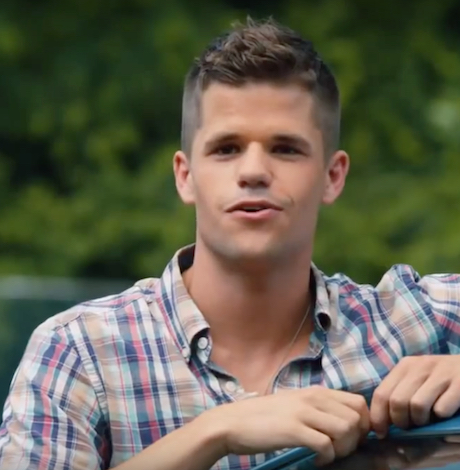
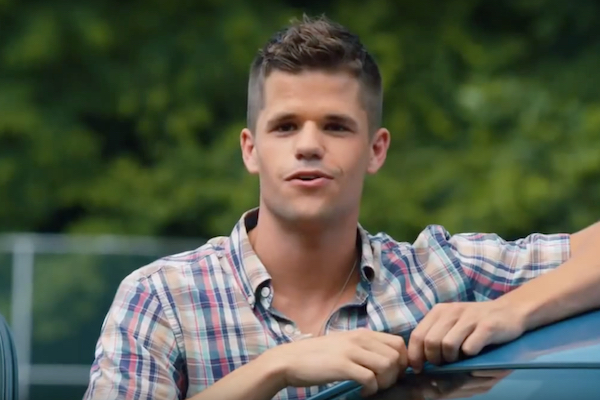
(Screenshot courtesy of YouTube)
“Teen Wolf” and “The Leftovers” actor Charlie Carver came out in a five-part post on Instagram on Monday.
The 27-year-old posted a photo of the quote “Be Who You Needed When You Were Younger” and then added a five-part written caption to the photo.
“As a young boy, I knew I wanted to be an actor. I knew I wanted to be a lot of things… It was around that age that I also knew, however abstractly, that I was different from some of the other boys in my grade,” Carver writes. “Over time, this abstract ‘knowing’ grew and articulated itself through a painful gestation marked by feelings of despair and alienation, ending in a climax of saying three words out loud: ‘I am gay.'”
Carver went on to say that he was fearful to come out because of his acting career.
“As an actor, I believed that my responsibility to the craft and the business was to remain benevolently neutral – I was a canvas, a chameleon, the next character. For the most part I had a duty to stay a possibility in the eye of casting, directors, and the public,” Carver writes. “If I came out, I feared I would be limiting myself to a type, to a perception with limits that I was not professionally comfortable with.”
Eventually Carver realized that this didn’t have to be the case and is grateful to those people who helped him realize that.
“So now, let the record show this – I self-identify as gay… I owe it to myself, more than anything, to be who I needed when I was younger,” Carver writes.
The actor has played gay characters, such as in “I Am Michael” where he shared a threesome with James Franco and Zachary Quinto, but this is the first time he has come out publicly.
Carver also noted that his twin brother and fellow actor Max Carver is “just as cool for being straight.”



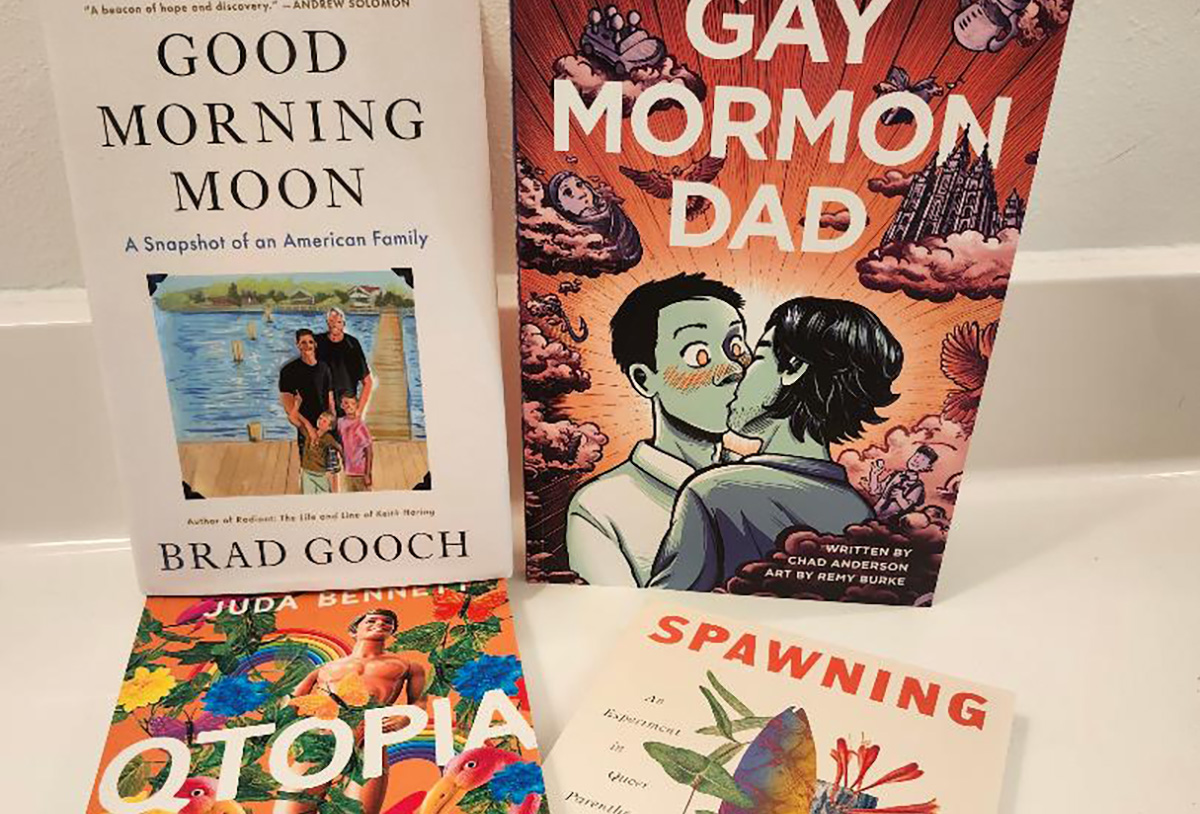
Books for Pride by various authors
c.2026, various publishers
$18.95 – $29.00
How many times have you marched so far this month? Seems like there’s always a reason to gather and walk during Pride, but save some time for yourself, too. You’ll want to reflect, rest, and read these great books about living your best Pride month.
No doubt, you’ve thought once or twice about stepping away from society as it is, and moving somewhere more accepting. So read “Qtopia: A Memoir of Love, Land, and Liberation” by Juda Bennett (University of Wisconsin Press, $18.95), the story of doing exactly that, and how it turned out.
Back in the ‘70s, Bennett fled the suburbs and all it represented, and went “back to the land,” to a commune named Lavender Hill. Some of the places he’d lived before then had promised way more than they delivered, but Lavender Hill was different – more rural, more open, more queer, much better. But you know all good things must end, and that includes “queer utopia.” The only thing left was to re-enter the mainstream, a journey unto itself, and one worth reading.
Speaking of memoirs, in “Gay Mormon Dad” by Chad Anderson, art by Remy Burke (Graphic Mundi, $21.99), you’ll read about Anderson’s life as a husband (to a woman), a father, and a man who seemingly had it all but it wasn’t right, and he wasn’t happy. He was gay, but acknowledging it, telling his family and his church family, could mean the loss of everything he loved. It’s a story that may be familiar to you, in some way, and it’s a quick read.
For most of his life, Joseph Osmundson dreamed about getting pregnant and having a family. The former didn’t happen and, as for the latter, as he writes in his memoir, “Spawning Season: An Experiment in Queer Parenthood” (Bloomsbury, $27.99) the journey for a gay man to become a father can have plenty of roadblocks.
When two women approach Osmundson to be a sperm donor, it appears that his ultimate dreams are about to come true. Things go swimmingly – until race enters the conversation. Are the words “donor” and “dad” the same? Read this powerful book, and think about it.
And finally, if parenthood as a gay person is something that’s a case of maybe-later, then “Good Morning Moon: A Snapshot of an American Family” by Brad Gooch (Harper, $29) is a book to find. It’s the story of late-life love, surrogacy, and identity as Gooch learns about himself as he learns to be a good Dad. This is a great book for older fathers, and anyone who’s on the parental fence, later in life.
If these great books aren’t enough for you, or if you’re looking for something different for Pride, then head to your favorite bookstore or library and ask the staff there to help you find your next best read. They’ve got a lot of books to put in your hands, a lot of sunny afternoons full of relaxing and promise, so march on out, get a new book, and happy Pride!
Out & About
Writers’ association hosts Capital Love LitFest
Inaugural literary salon scheduled for Sunday
The Washington Writers’ Publishing House (WWPH), the nation’s longest continuously operating cooperative nonprofit literary press, will present the inaugural “Capital Love LitFest” on Sunday, June 28 at 10 a.m. at The Writer’s Center in Bethesda, Md.
Designed as a full-day literary salon and cultural gathering, the event will feature more than 25 writers, nine workshops, and panel discussions, readings, and conversations centered on love, relationships, identity, healing, creativity, and connection in divisive times. Admission is pay-what-you-can, beginning at free.
The LitFest celebrates the release of “Capital Love,” WWPH’s new anthology featuring 55 writers from across the DMV, including contributors from Baltimore, D.C., Maryland, and Virginia. The pocket-sized collectible anthology explores love in its many forms through poetry and prose and serves as a literary response to today’s social and political climate.
For more details, visit Washington Writers’ website.
Television
‘Vampire Lestat’ heats up Pride month with queer action
Latest Anne Rice adaptation poised to be your next TV obsession
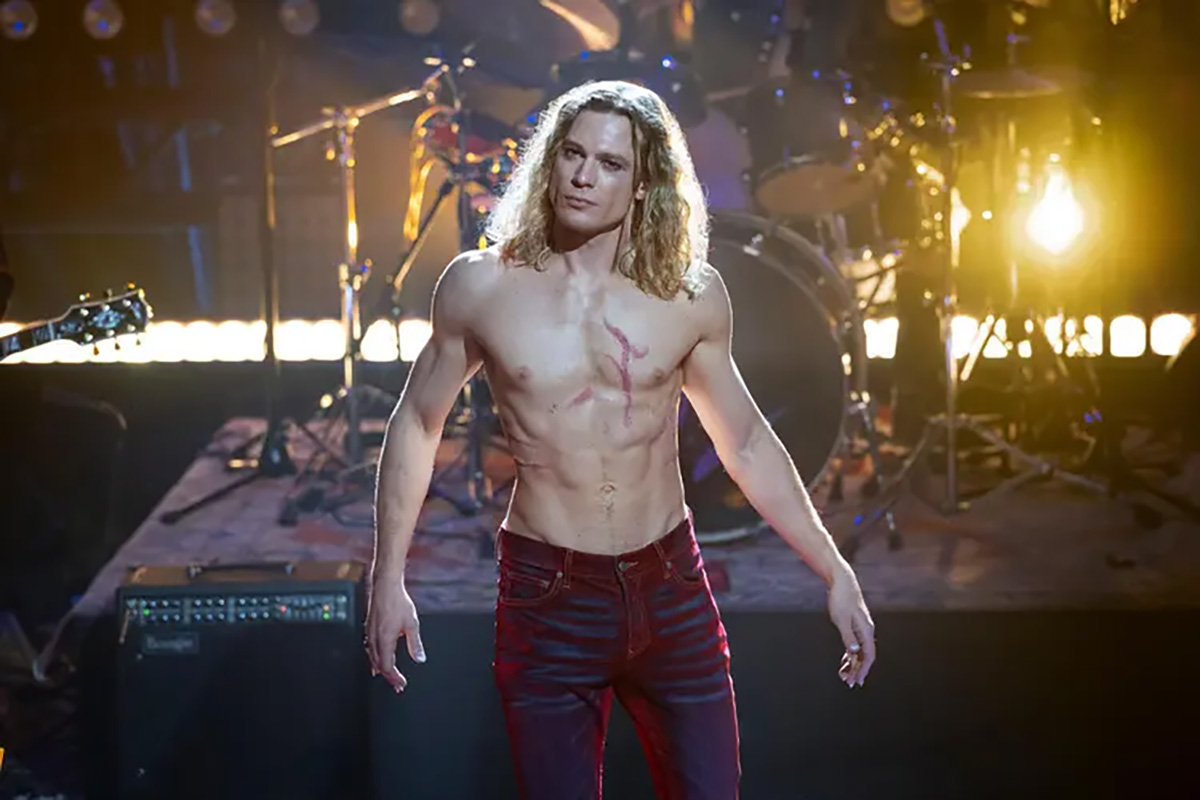
Whether you’re mourning the end of Euphoria, The Boys, or Hacks, you’re dying for another hit of Heated Rivalry or just need something new to watch, The Vampire Lestat has you covered. Whether it’s the cutting witty dialogue, supernatural action, or the maudlin adventures of problematic queer relationships, this is the show for you. This new season brings literal sex, drugs, and rock-n-roll as Lestat (Sam Reid), a multi-centennial vampire, decides to process his beef with his sexy ex Louis (Jacob Anderson) for giving the Interview With The Vampire by starting a rock band.
In 1976, Anne Rice wrote a book to process the death of her young daughter. It was the story of two vampire “roommates” and their centuries-long relationship drama. What followed was a series of 13 books and a whole world filled with vampires, witches, and more. This launched the 1994 film where Brad Pitt, Antonio Banderas, and Tom Cruise played “totally not gay” vampires who almost kissed a few times, despite having all of the hottest actors of the era, it was sanitized of all queer subplots. R&B diva Aaliyah’s last role was as Akasha, the eponymous Queen of the Damned (2002), the unoffical follow up to the first film covering Rice’s second and third book.
The AMC series version of Interview with the Vampire took all this source material and made it more gay, more current, and more PC. They shifted the story to the present day, having Louis live in a luxurious Dubai compound, and his interviewer, Daniel Molloy (Eric Bogosian), being a former addict hawking his masterclass, armed with a ton of evidence. The choice to race-swap Louis from a misanthropic emo plantation owner to a black brothel owner in New Orleans adds so much more nuance, history and richness to his character. Exploring the abusive nature of the relationship and casting the amazing Delainey Hayles as Claudia have all elevated the story to your next television obsession. The choice to turn the book into two seasons allowed the creators to take their time, play with storytelling and explore Louis as an unreliable narrator and tease at many of the storylines of later books. This was a smart choice considering these characters are all centuries old, and over the course of 13 books, all have complex backstories and inner worlds.
Sam Reid was always a standout and captured the egomania and charm of Lestat, the self-proclaimed Brat Prince. He gets to play an over-the-top bitch about everything we’ve seen and heard in Seasons 1 and 2, while even skewering the world of today, commenting on the state of fame, life, and politics.
Like in the book, he reclaims the narrative as he takes the helm of the story. Rather than write his own book, he’s nabbed the newly vamped-up Daniel Molloy as his documentarian. Also, without giving too much away, this series begins in an unnamed future. Armand (Assad Zaman) and Louis are still as hot as ever, and they’re at an auction for the complete works of the Vampire Lestat. It’s teased that some sort of world-altering event has transpired, and Lestat is missing in action. Could that be the events of The Queen of the Damned or even the sum of all of the books? Only time will tell.
The worldbuilding is really solid as we get to see the past, present and future of these characters. Prime example, Akasha, The Queen of the Damned, was name-checked in earlier seasons. Whether you’re a fan of the original source material or not, this series has something for everyone. It has action, including an epic vampire fight scene in the premiere. It has a complex world and mysteries that unfold over the course of each season. Plus, it has hotties of all genders with Reid, Anderson and Zaman holding it down from earlier seasons. Schitt’s Creek dreamboat Noah Reid joins the cast as Lestat’s band’s frontman.
The show has everything: sex, violence, drama, all with a queer and racially inclusive lens. It doesn’t pull punches in storytelling and examining history, all while maintaining a level of levity and fun. It unfolds with dramatic soap operatic reveals and confrontations while also grounding all of the fantasy in our world.
The series is poised to continue with the same characters from the first two seasons while shifting the focus to allow in a new cast of characters who will play out the events of multiple books and major arcs that are part of AMC’s new Anne Rice cinematic universe.
The series airs on AMC Plus, while the first two seasons are available on Netflix. A note to people streaming it may appear on Season 2, as the series name change might be confusing for those who haven’t seen the show.

My boyfriend is almost perfect

The boy they refused to forget

Reflect on Pride season with these engaging books

Eswatini’s government ordered to allow LGBTQ group to legally register

Does Pride decor resemble Trump’s design aesthetic?

US no longer refuge for LGBTQ refugees

Cool convertibles

Abelardo de la Espriella elected Colombia’s next president

Capital Pride draws tens of thousands to D.C.