District of Columbia
‘Behind-the-scenes’ activist Paul Kuntzler marks 62 years in D.C.
Inspired by Kennedy, Michigan native played key role in early LGBTQ movement
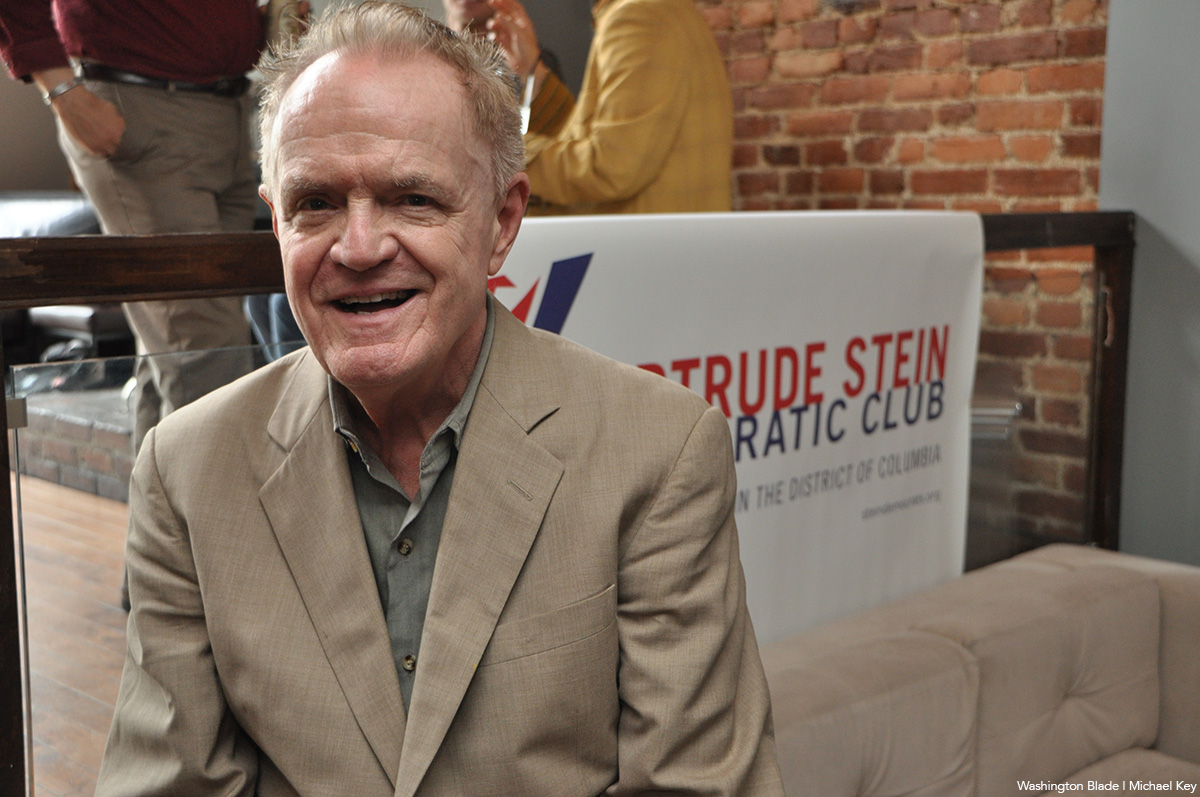
In reflecting on his many years of involvement in U.S. politics and the LGBTQ rights movement, Paul Kuntzler points out that Dec. 28 of this year will mark his 62nd year as a resident of Washington, D.C. And he also points out that two days before that, on Dec. 26, he will celebrate his 82nd birthday.
Those who have known Paul Kuntzler over the years say that while his is not a household name in politics and the LGBTQ rights movement, he has played a critical role as an everyday hero and behind-the-scenes organizer for the Democratic Party and the local and national LGBTQ rights movement.
Among other things, Kuntzler served as campaign manager for D.C. gay rights pioneer Frank Kameny’s 1971 role as the first openly gay candidate for the U.S. Congress when Kameny ran for the newly created position of non-voting Delegate to the U.S. House of Representatives for D.C.
In his role as campaign manager, Kuntzler is also credited with arranging for more than a dozen volunteers from the then-Gay Activists Alliance and Gay Youth group of New York City to come to D.C. on a bus that the Kameny campaign paid for to help gather the needed 5,000 signatures to get Kameny’s name on the ballot.
“I knew how difficult that was going to be,” Kuntzler said. “And I recognized we were not going to do this all on our own,” adding that the gay volunteers from New York, who joined forces with local D.C. volunteers, obtained a total of 7,800 signatures of registered D.C. voters to get Kameny’s name on the ballot.
Although Kameny finished in fourth place in a six-candidate race, his run as the first openly gay candidate for the U.S. Congress drew national publicity, including support from actor Paul Newman and his wife Joanne Woodward, who made a $500 contribution to the Kameny campaign while they were performing at the time at D.C.’s National Theater.
Observers of the LGBTQ rights movement at that time considered Kameny’s candidacy an important development in the effort to advance LGBTQ rights both in D.C. and nationwide.
“Looking back, that probably was one of the most significant things I did in my life,” Kuntzler said in recalling his role as Kameny’s campaign manager.
He says his involvement in politics began in the summer of 1960 in his hometown of Grosse Pointe Woods, Mich., a Detroit suburb, when he co-founded the Grosse Pointe Young Democrats and served as a volunteer on the presidential campaign of John F. Kennedy.
“I met JFK at the Detroit airport and shook his hand,” Kuntzler recalls while he joined a crowd of supporters welcoming Kennedy on his arrival for a campaign tour in Michigan. “It was Labor Day weekend – Sunday, Sept. 4, 1960,” Kuntzler said in demonstrating an amazing recall of dates and events.
Kuntzler, who traveled to D.C. to attend the Kennedy inauguration on Jan. 20, 1961, said the idealism of the Kennedy administration prompted him to move to D.C. one year later to become involved in politics and the fledgling gay rights movement.
“I met Frank Kameny at Lafayette Chicken Hut on Sunday, Feb. 25, 1962,” Kuntzler says in referring to the then-popular D.C. gay bar. “And he was then president of the Mattachine Society of Washington,” Kuntzler noted, which was the first significant gay rights group in D.C. that Kameny co-founded.
“He invited me to attend the next Mattachine Society meeting,” Kuntzler recalls. “So, on Tuesday, March 6, 1962, at Earl Aiken’s apartment on Harvard Street, I became the 17th member of the D.C. Mattachine Society.,” Kuntzler continued. “And at the age of 20, I was the only minor involved in the gay rights movement consisting of about 150 people in five American cities,” he said. “I’m the only one still living of the original 17.”
His membership in the Mattachine Society of D.C. was the start of Kuntzler’s 50-plus years of involvement in the local and national LGBTQ rights movement. He recalls that he helped make history when he joined Kameny and other members of the Mattachine Society in April of 1965 for the nation’s first gay rights protest in front of the White House.
Kuntzler said he brought with him a large poster-size sign he made reading, “15 Million Homosexuals Protest Federal Treatment.” He said Mattachine Society of D.C. co-founder Jack Nichols asked permission to carry that sign on the picket line in front of the White House. Kuntzler gave him permission to do so.
To this day, Kuntzler says, he has a large United Press International photo of Nichols carrying the sign with Kameny, lesbian activist Lilli Vincenz, and Kuntzler standing beside him with the White House as a backdrop.
In the following three decades or more, Kuntzler served as an organizer and founder of several LGBTQ organizations and projects while pursuing a work career as a manager for several organizations. He served from 1973 to 2007 as assistant executive director for advertising, exhibits and workshop sales for the D.C.-based National Science Teachers Association.
His many behind-the-scenes involvements included serving in 1975 as the first treasurer for the Gay Rights National Lobby, one of the first national LGBTQ rights organizations based in D.C. that later evolved into the Human Rights Campaign in 1980, for which he also served for a short time as treasurer. In 1979, Kuntzler became a co-founder of the Gertrude Stein Democratic Club, D.C.’s first LGBTQ Democratic organization.
Also in 1979, Kuntzler helped found the National Convention Project, an effort to elect openly gay delegates and secure a “gay rights” plank in the platform at the 1980 Democratic National Convention. The effort resulted in the election of about 100 openly LGBT delegates to the 1980 convention from states across the country, including D.C. and the adoption of an LGBT supportive plank in the Democratic Party’s platform at that time.
Kuntzler said he and the others working on the project, which he called a success, were deeply disappointed when then-Democratic President Jimmy Carter lost the November 1980 presidential election to Republican Ronald Reagan. But he said he was inspired to continue his work on behalf of the Democratic Party and LGBTQ rights issues over the next several decades.
The person most important in his life, Kuntzler said, was his domestic partner Stephen Brent Miller of 42 years who died in July 2004.
“Stephen and I met on Friday, March 30, 1962, at Lafayette Chicken Hut,” Kuntzler said. “I was sitting on the side and Stephen was sitting in the middle, and I think he sent me a beer and then came over and sat down and we talked,” Kuntzler recalls. “We had our first date on the second Sunday in April of 1962.”
The two went to brunch before going to see a movie and then took a bus to get to Frank Kameny’s house. It was a housewarming party of the house that Kameny had just secured a lease to rent for his residence and his gay rights endeavors. Miller, a professional stenographer who later started his own court reporting business, Miller Reporting, quickly took on the role of being the loving spouse to a committed activist, people who knew the couple have said.
Kuntzler said his attendance at the Human Right Campaign’s annual Washington dinner last month, which is one of the nation’s largest LGBTQ events, in which President Joe Biden and first lady Jill Biden spoke, was a further sign of progress for the LGBTQ rights movement as he sees it.
Asked if he has any advice for the LGBTQ community at this time, Kuntzler said, “I think we need to continue to be vigilant … We need to continue to be vigilant.”




District of Columbia
SMYAL receives $25,000 award for ‘courageous acts’
D.C. group provides support services for LGBTQ youth
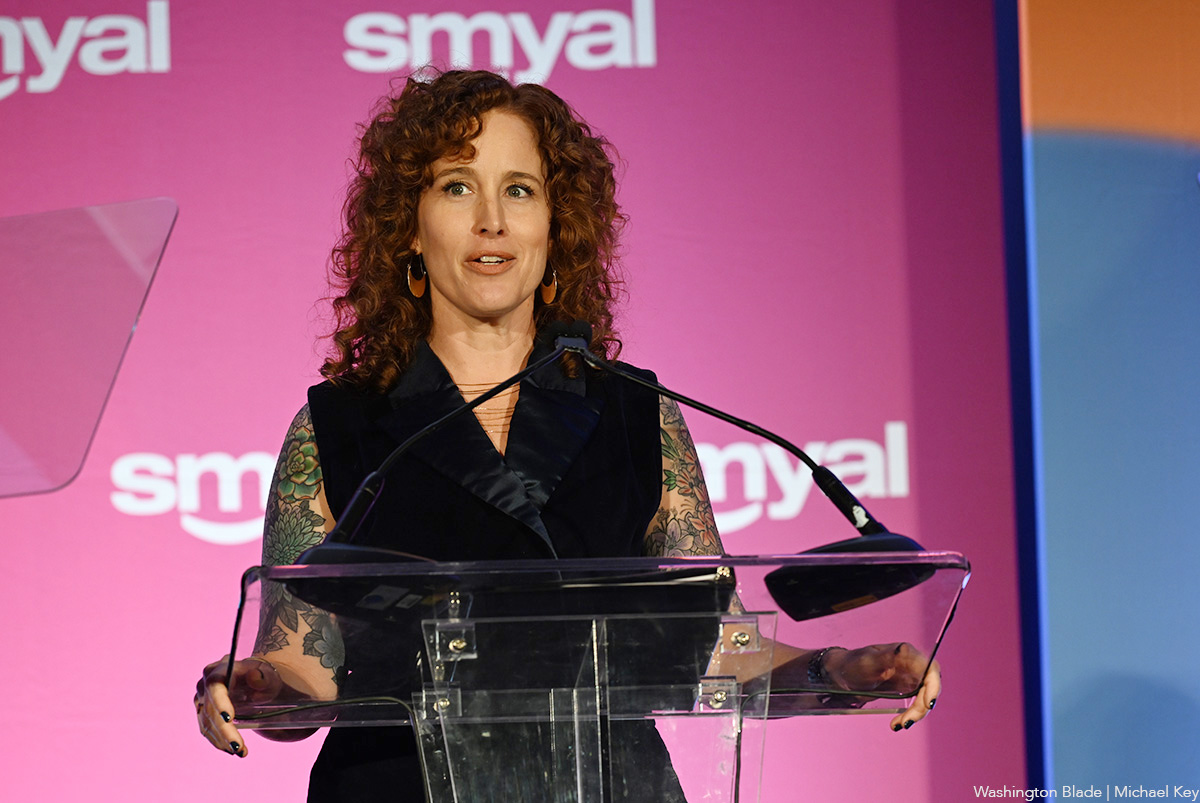
The D.C.-based organization SMYAL, which provides services for LGBTQ youth in the D.C. metro area, including housing for homeless LGBTQ youth, announced on June 30 that it received a $25,000 award for its “courageous acts” in support of the community it serves.
The award was a monetary grant from The Courage Project, which describes itself as a “national initiative investing in acts of courage and compassion that strengthens our communities and democracy.”
A statement on its website says it was launched in May 2025 and is funded and backed by leading national foundations in the U.S.
“At SMYAL, we are deeply grateful to receive support from The Courage Project and are inspired by their bold investment in LGBTQ+ youth at such a critical moment,” SMYAL CEO Erin Whelan said in a statement. “For queer and trans young people, simply showing up as themselves each day requires immense courage, and that courage is strengthened when organizations like The Courage Project stand behind them loudly, proudly, and without hesitation,” Whelan said.
In its statement announcing the award SMYAL says The Courage Project will recognize SMYAL and other awardees and their work on July 3 at the Washington National Cathedral as part of a special interfaith service marking the U.S. 250th anniversary.
“The Courage Project is a bold initiative honoring everyday acts of bravery – the quiet, often unseen acts of heroism that reflect the best of the American spirit and strengthen democracy at the community level,” the project states on its website.
District of Columbia
Longtime Blade staffer Stephen Rutgers steps down after 14 years
Plans to focus on running Crush Dance Bar, other ventures

Longtime Washington Blade employee Stephen Rutgers announced he is stepping down after 14 years to focus on other ventures, including his part ownership of the popular Crush Dance Bar.
Rutgers was hired by the Blade in 2012 to help plan Pride festivities and over the years was promoted to director of sales and marketing. In addition to his broad set of responsibilities, Rutgers planned the annual Pride on the Pier celebration at the Wharf, which has exploded in popularity over the seven years since its launch.
“Watching Pride on the Pier grow from a new community event into one of D.C.’s signature Pride celebrations has been incredibly rewarding,” Rutgers said. “Expanding Pride on the Pier into a two-day festival for WorldPride in 2025 was definitely a career highlight. Seeing thousands of people come together to celebrate our community while supporting the Blade’s mission is something I’ll always be proud of.”

Rutgers described his biggest challenge as navigating the changing media landscape.
“More than ever, we’ve had to remind our community that local journalism matters and that it needs their support,” he said.
He added that he’s most proud of helping to ensure the Washington Blade is positioned to thrive for the next 50 years.
“I was fortunate to be part of the Blade during its 50th anniversary — a milestone that reflects its incredible history and impact,” Rutgers said. “The Blade has been an important voice for the LGBTQ community for more than five decades, and knowing I played a small part in helping its future is most important to me.”
Blade Publisher Brian Pitts praised Rutgers for juggling multiple responsibilities.
“We wish Stephen all the best,” Pitts said. “For the past 14 years, Stephen has been a vital part of the Blade, handling many things — marketing and advertising, sponsorships, and Blade signature events. We will all miss him.”
Blade Editor Kevin Naff thanked Rutgers for his years of service to the community.
“After 14 years, it’s hard to imagine the Blade without Stephen and his boundless energy and creativity,” Naff said. “He’s one of the hardest working and most dedicated people I’ve ever known and he will be missed. But change is the only constant and I know Stephen will move on successfully to new challenges and the Blade will expand on Stephen’s important work.”
As for what’s next for Rutgers, he said he plans to focus on Crush as well as his real estate business.
“I’ve always been someone who likes to stay busy,” Rutgers said. “For the past 12 years, I’ve balanced my work at the Blade and in real estate. Two years ago when I opened Crush, I never realized just how much time and energy it would take. The passing of my father earlier this year also gave me a new perspective. It reminded me that life is short and that it’s important to make time for the people and experiences that matter most. Stepping away from the Blade will allow me to focus on those ventures while also creating more balance in my life. After 14 incredible years, it feels like the right time for a new chapter.”
Naff said that for now Rutgers’s responsibilities will be divided between existing staff along with several new freelance contractors.
“The Washington Blade plays a unique role in our community’s fight for equality,” Rutgers said. “It’s the only LGBTQ news organization with White House credentials, giving it direct access to the people and institutions shaping policies that affect our community. The Blade continues to hold elected officials accountable, report on the issues that matter most to LGBTQ people, and tell the stories that often go uncovered by mainstream media.
“The Blade has been my family for most of my adult life. For 14 years, it has been part of my daily routine, so it’s going to feel very strange waking up and not logging on each morning.”
District of Columbia
Nearly 6,000 turn out for Pride Night Out at the Nationals
Gay Men’s Chorus sings National Anthem

“Just shy of” 6,000 people purchased tickets for the Wednesday, June 24, 21st annual Pride Night Out at the Washington Nationals baseball stadium, which the Nationals said is the longest running LGBTQ Pride event in Major League Baseball, according to a Nationals spokesperson.
The event was organized with the Nationals by Team D.C., the local LGBTQ sports group that organizes similar Pride Nights for other professional D.C. area sports teams.
“It was a good time had by all as the Nationals celebrated the LGBTQ+ community during the Nationals 21st Pride Night Out, presented by Team D.C.” the Nationals said in a statement.
Nationals spokesperson Erica George said the overall game attendance was 27,200.
Similar to recent past years, the Gay Men’s Chorus of Washington sung the National Anthem at the start of the game, drawing loud cheers from people throughout the stadium.
The Nationals lost the game to the Philadelphia Phillies by a score of 5-4. Although most of the LGBTQ attendees of the event, held in the right-field mezzanine section of the stadium, were cheering for the Nationals, a sizeable number also cheered for the Phillies.
Miguel Ayala, one of Team D.C.’s lead organizers, said he noticed fans displaying Pride flags and recognized LGBTQ people in all parts of the stadium, indicating significantly more LGBTQ people and their supporters attended the game beyond the close to 6,000 or more who purchased the specific Pride Night Out tickets.
“It was a great excitement last night,” he told the Washington Blade on the day following the event. “I saw a lot of big crowds of our people, I saw everybody I can think of in the community. And it was really great to see the turnout.”
Also, like in previous years, Team D.C. along with the Nationals helped to organize a pre-game show on the large concourse platform area next to the stadium seating area involving a drag show led by local drag performer Shi-Queeta Lee.
“During pregame ceremonies, the Nationals Pride employee resource group was recognized on the field,” the statement released by the Nationals says. “Dr. Demetre Daskalakis, a physician and public health leader who has had a profound impact on the LGBTQ+ community and those living with or vulnerable to HIV, threw out the ceremonial first pitch as the guest of Team D.C.,” the statement says.
It adds that Team D.C.’s scholarship recipient Spencer Doll made the ceremonial call to “Play Ball.”
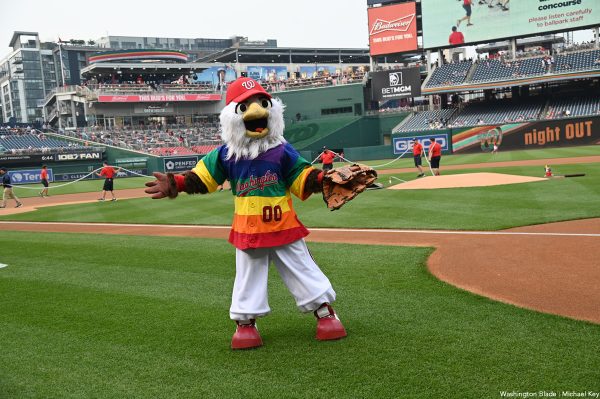
As if all that were not enough, a Nationals employee who entertains during the Nationals pre-game shows on the field dressed as a giant eagle named “Screech” wearing an eagle’s head mask appeared in the seating area where the Pride Night Out crowd was seated and mingled with the LGBTQ fans, many of whom posed for photos with Screech.

As Washington shifts right, Democratic Socialists gain ground

Susan Stewart could make history as Rehoboth’s first openly gay mayor

Silky Nutmeg Ganache talks sex and dating, gender, politics, weight loss journey

Madonna roundup: Reviews, sales, and love for ‘Danceteria’

Three overlooked court rulings limited White House anti-trans policies

‘Transcendent’ a tough but important read

Under-the-radar Delaware beach towns smart buyers are targeting

‘My Favorite Sociopath’ debuts at Shepherdstown’s CATF

In Trump’s divided America, Michael Weinstein’s AHF responds