Local
D.C. jury finds AARP Services illegally fired gay man
Former employee awarded $2.1 million in damages
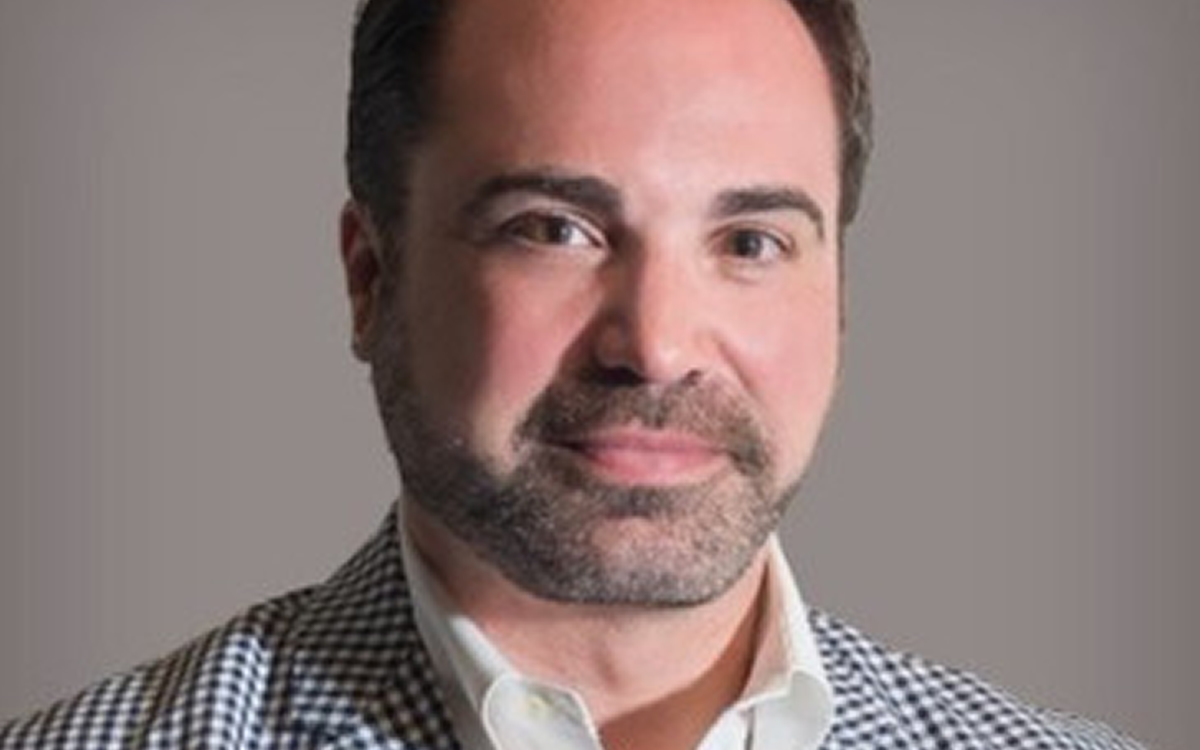
A D.C. Superior Court jury on March 15 handed down a verdict finding that the D.C.-based AARP Services, Inc., an arm of the AARP that interacts with businesses supportive of the nation’s seniors, illegally fired a gay manager because of his sexual orientation.
The jury’s verdict, which it said was based on a “preponderance of evidence,” came six years after Richard A. ‘Rick’ Deus Jr., who worked for AARP and AARP Services for 11 years, filed a lawsuit against his former employer in May 2018. The lawsuit charges that AARP Services violated the D.C. Human Rights Act by firing him after falsely accusing him of accepting gifts for travel from businesses affiliated with AARP that violated AARP employee ethics policies.
His lawsuit says he was fired in February 2018. At that time, he held the title of director of program management at AARP Services.
The lawsuit says AARP Services cited the alleged travel violations as the reason for its decision to fire him. The lawsuit named AARP Services and its then chief executive officer, Lawrence Flanagan, as the two defendants responsible for Deus’s firing.
But the jury’s verdict only named AARP Services as being at fault in the firing. It did not find Flanagan at fault and did not hold him responsible for damages, even though Flanagan testified at the trial that he made the final decision to terminate Deus on grounds that Deus violated the travel policy.
The jury also chose not to hold AARP Services responsible for paying punitive damages to Deus, whose lawsuit called for $5 million in compensatory damages and an additional $5 million in punitive damages.
In its verdict, according to online court records, the jury awarded Deus $1,612,916.18 in compensatory damages and $578,351 in damages for emotional distress that AARP Services is required to pay Deus. The court records show the jury awarded Deus another $1,118.89 to be paid by AARP Services for its alleged breach of contract with him in its decision to fire him.
An attorney representing AARP Services immediately following the verdict filed a motion requesting that Superior Court Judge Shana Frost Matini, who presided over the trial, issue a “directed verdict” overturning the jury’s verdict.
Such a motion is often filed by individuals or organizations on the losing side of a lawsuit, but such requests are rarely approved. Matini said she would schedule a hearing to consider the motion in May.
“I’m thrilled that the jury found that I was treated differently from my co-workers and discriminatorily fired,” Deus told the Washington Blade after the jury handed down its verdict. “That’s clearly what they found, and they awarded emotional pain and suffering,” he said. “But overall, I’m elated. It’s been six years of my life that I’ve been fighting and telling people that I was treated differently than anybody else and today I got my vindication.”
Laura Segal, AARP’s Senior Vice President for External Affairs, told the Blade in a statement, “AARP is pleased with the jury’s verdict that Lawrence Flanagan lawfully terminated Richard Deus’s employment.” She added, “AARP Services, Inc. (ASI) disagrees with the remainder of the verdict and is exploring all options for further legal review. We remain committed to an inclusive culture and warmth and belonging, where everyone is welcome.”
Attorneys representing AARP Services argued at the trial and presented witnesses denying Dues was fired because of his sexual orientation. They asserted that AARP Services had and still has gay and lesbian employees and managers and that the company has a longstanding policy of prohibiting discrimination on grounds of sexual orientation or marital status.
Deus’s lawsuit accused AARP Services of targeting Deus for discrimination based on his marriage to another man as well as for his sexual orientation. The jury did not find that AARP Services engaged in discrimination against Deus based on his marital status.
Flanagan was among the lead defense witnesses who testified at the nine-day-long trial. He testified that he has worked for many years with gay colleagues, has a gay relative who he admires, and would never have allowed his staff to engage in discrimination while he served as AARP Services CEO.
He noted in his testimony that his decision to fire Deus was based, in part, on the recommendation of AARP Services’ human resources or personnel director, Michael Loizzi, who is an openly gay man. Loizzi, who also testified at the trial, said that as a gay man he would never have called for Deus or anyone else to be fired because of their sexual orientation. He stated in his testimony that he recommended to Flanagan that Deus be fired because Deus violated AARP Services travel policy and lied to his supervisor about the details of the travel to get his supervisor’s approval under false pretenses.
Deus, during his own testimony, strongly disputed claims that he obtained permission for his travel by providing false information to his supervisor. His lawsuit states that both his supervisor and AARP Services’ legal counsel cleared him for the two trips that he has been accused of taking in violation of policy.
His lawsuit identifies heterosexual AARP and AARP Services employees who have taken business trips like the two taken by Deus that allegedly violated travel policy who were not fired or disciplined. A few faced disciplinary actions but were allowed to retain their jobs, the lawsuit says.
“This case is about the unequal treatment of a gay man when juxtaposed to the treatment of our heterosexual comparators,” Darrell Chambers, Deus’s lead attorney, told the Washington Blade after the verdict. “This is not a case about an organization or a group of people who hate gay people and decided that they were going to fire this man because they hate him,” Chambers said.
“Instead, it’s a case where the punishment that they consistently applied to gay employees, re Mr. Deus and Mr. Sanders, was harsher, far harsher than the punishment they applied to heterosexual employees who committed the same or similar acts.”
Chambers was referring to former AARP Services employee Jack Sanders, who is gay and who testified on video played at the trial that he was summarily fired on grounds that he allegedly sent pornographic photos or video images to another AARP Services employee, who complained about receiving the pornographic images.
Sanders has said the pornographic images in question were sent to the employee by his ex-boyfriend who wanted to portray Sanders in a negative light. Through telephone and wire transmission records Sanders was able to show that the images in question were sent from a device in Washington, D.C. at a time that Sanders was in Chicago, proving that Sanders could not have been the person who sent the images.
Deus’s attorneys brought out at the trial that AARP Services failed to give Sanders a chance to defend himself, prompting him to file his own lawsuit against AARP Services for which a settlement was reached. The terms of the settlement have not been publicly disclosed. But Deus’s attorneys cited Sanders’s case as yet another example of how AARP Services has treated gay employees differently from heterosexual employees.
AARP Services attorney Alison Davis argued during the trial that discrimination based on Deus’s sexual orientation had nothing at all to do with the decision to fire him. Davis told the jury that the two trips that Deus took that led to his firing, one to New York City and the other to New Orleans to attend the Sugar Bowl football game, were financed in part by companies that do business with AARP in violation of AARP and AARP Services policies for travel. Among other things, she said the Sugar Bowl is considered a championship game that has a value higher than smaller gifts that AARP employees are allowed to accept.
Deus testified that his reason for accepting an invitation to the Sugar Bowl game was to spend time with the new account director at the Allstate insurance company, which paid for the Sugar Bowl game ticket. “In 2019, we were going to be negotiating a new contract with Allstate and we wanted to establish a good relationship with her before the contract negotiations began,” he told the Blade. “That’s how you do business.”
Deus said he was referring to Allstate’s business relationship with AARP Services, which he said, similar to its interaction with other businesses, helps AARP provide support and services to the nation’s senior citizens.
In her cross examination of Deus on the witness stand, Davis also raised AARP Services’ claim in contesting the lawsuit that the emotional distress and depression that Deus says he suffered because of his firing could have been caused by issues unrelated to the firing. Davis asked Deus if his emotional distress was caused by stress that Deus has said he experienced years earlier when he came out as gay to his parents, who are ordained ministers, and in his interaction with his sister, who had been diagnosed as being bipolar.
Deus said that while his coming out to his conservative parents nearly 30 years ago and his sister’s mental health issues were a concern years earlier, he and his parents had long since reconciled over his sexual orientation and his sister’s mental health issues played no role whatsoever in the emotional distress he experienced after being fired by AARP Services.
In her cross examination of Deus on the witness stand, Davis also asked him if his decision to be interviewed by the Washington Blade last year for a Blade story about his lawsuit could have contributed to the difficulty, he said he encountered in finding employment after he was fired by AARP Services. Deus, who testified that he was hired by at least one other company that later laid him off, said he did not believe a Blade story about his lawsuit would have an adverse impact on him.





Maryland
Joseline Peña-Melnyk elected Md. House speaker
Family immigrated to New York City from the Dominican Republic
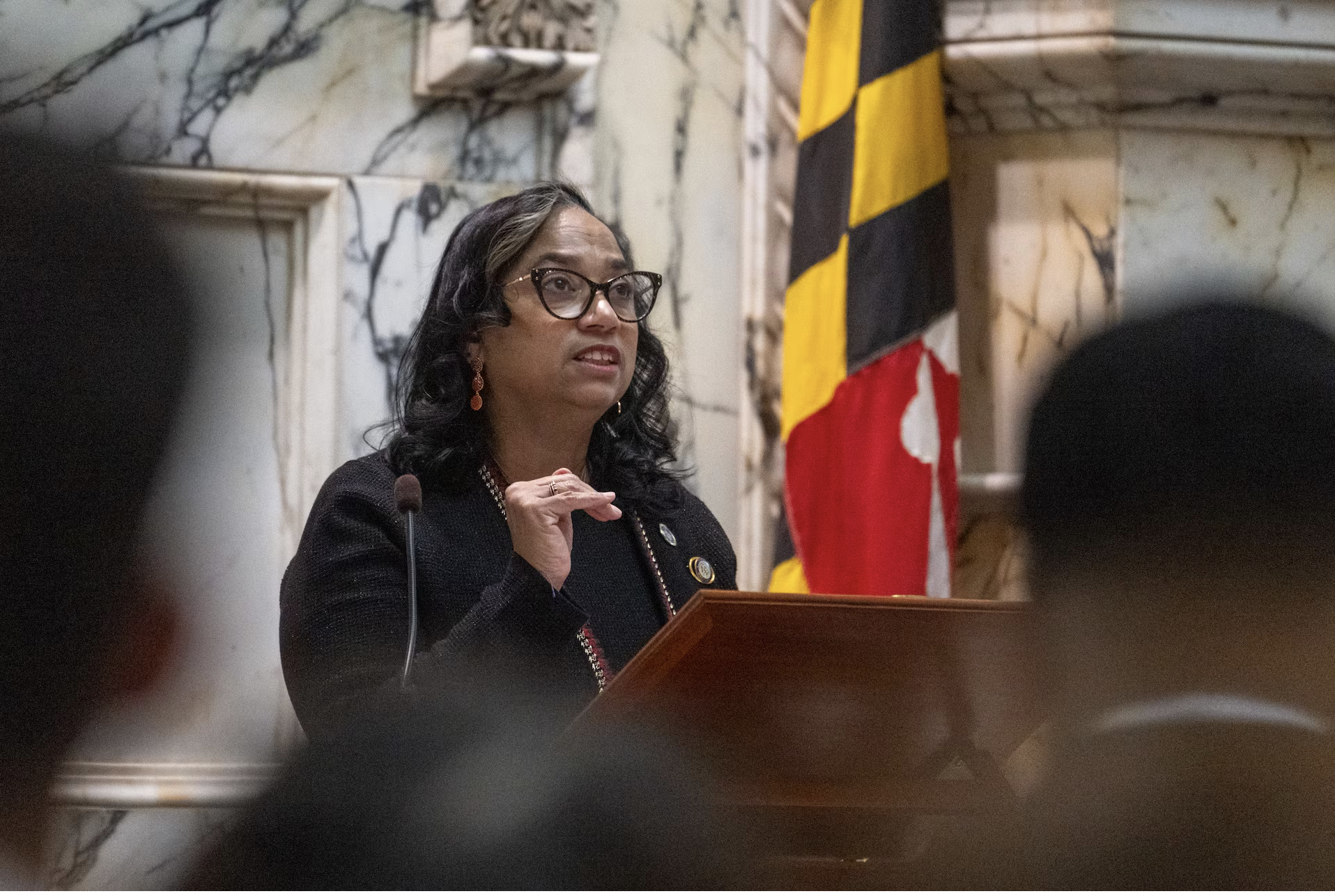
By PAMELA WOOD | Moments after being elected speaker of the Maryland House of Delegates Tuesday, state Del. Joseline Peña-Melnyk stood before the chamber and contemplated her unlikely journey to that moment.
Born in the Dominican Republic, the Peña family lived in a small wooden house with a leaky tin roof and no indoor plumbing. Some days, she said, there was no food to eat.
When she was 8 years old, the family immigrated to New York City, where Peña-Melnyk was dubbed “abogadito” or “little lawyer” for helping her mother and others by translating at social services offices.
The rest of this article can be read on the Baltimore Banner’s website.
District of Columbia
D.C. students need academic support, diverse connections for economic mobility
Region offers array of resources for families in need of assistance

Education is the blueprint of good economic mobility.
But when students aren’t set up with the proper resources to secure a quality education, it’s often low-income families that suffer the most, For Love of Children (FLOC) Executive Director LaToya Clark said. Children from low-income families on average grow up to earn $25,600 annually, according to Opportunity Insights.
D.C. families need better economic mobility, and experts say that starts with kids getting an education and breaking generational poverty cycles. Students without a high school diploma earn $738 per week on average, while those who graduated high school earn roughly $930 per week, according to the U.S. Bureau of Labor Statistics. Contrarily, those with bachelor’s degrees earn about $1,543 per week.
Students from low-income backgrounds have fewer financial advantages on their paths to securing an education, and hardships faced by public schools make it difficult for them to catch up, Clark said.
From local financial and educational assistance programs to strengthening diversity among educators, here are a few ways researchers and advocates are fighting for better economic mobility in D.C. schools.
Student assistance programs
For many students, falling behind academically is because of circumstances outside of their control, Clark said.
She said teacher shortages, large classrooms and scarce funding can lead to an educational environment not fully equipped to set students on the right path. A one-dimensional education can then hinder future professional opportunities and give students limited economic mobility.
That’s where local organizations like FLOC come in –– to fill in the academic and social gaps often left open by schools.
Clark said FLOC has multiple services that give underserved students a more individualized academic experience. For the Neighborhood Tutoring Program, students are assessed at the grade level at which they’re performing, not what grade they are in. They’re then matched with a volunteer –– ranging from college students to retirees –– who follows a curriculum that matches the student’s performance level.
There’s also the Pathways Forward Program, an afterschool opportunity for D.C. youth in 7th to 12th grades designed to increase high school graduation rates. The program supports those at risk of academic failure to find a successful way forward, and those in 10th to 12th grades to prepare for graduation or transition to postsecondary programs. Both Neighborhood Tutoring and Pathways Forward are free.
“Everything we offer is designed to close achievement gaps, help our students boost their confidence and ensure young people have the skills and support that they need to succeed in schools and beyond,” Clark said.
And that design is working for students. Clark recalled a young girl who was the oldest of six who felt a need to help her mom take care of her siblings. She was falling behind in school until she found FLOC. The girl credited her ability to go to college and find a professional job to FLOC’s individualized and accessible approach to education.
FLOC is a reliable resource for D.C. youth to get academic help, but there are numerous other organizations working to close educational gaps and improve the future economic mobility of students.
Minds Matter D.C. helps underserved students find accessible pathways to prepare for and succeed in college. The organization offers mentoring, SAT prep, access to summer enrichment programs and guidance through the college application and financial aid process.
The work Minds Matter does addresses a disproportionate statistic: While roughly 89% of students from “well-off” families attend college, only 51% of students from low-income families do so, according to a report published by Brookings. Minds Matter reported that 100% of its students attended a four-year college or university.
The D.C. Schools Project, a program of the Center for Social Justice, offers academic help and English-language tutoring for low-income and immigrant families. Each semester, roughly 60 tutors assist about 100 students, their families, and other D.C. immigrants.
D.C. CAP Scholars has a mission to connect youth with financial and academic opportunities that will help them succeed in college. Registration is now open for the organization’s Ward 7 & 8 scholarship, a $12,000 annual scholarship for students who attended high school in those D.C. wards. Those areas encompass communities such as Congress Heights, Deanwood and Anacostia, which are some of the city’s poorest areas.
RISE offers tutoring and college mentoring to underserved populations. Its primary focus is on opportunity academies, including the three in D.C.: Ballou STAY, Luke C. Moore and Garnet-Patterson STAY. These academies are “second chance” schools for students who didn’t complete high school on a traditional timeline.
RISE Executive Director Ricardo Cooper said the organization offers real-time tutors for students in these academies through its Keep Up Tutoring program. RISE also provides summer literacy “bootcamps” and college prep for underserved students.
As a native Washingtonian, Cooper said he wishes opportunities like RISE were available to him as a kid. That’s why it’s so special for him to lead the organization and help D.C. youth rise above the academic and economic barriers he used to face.
“We know that going to college and getting a degree makes you more money,” Cooper said. “Being able to have these programs to support youth in school, to make sure that they feel confident once they graduate high school, to go to college, to feel confident in completing their coursework and just understanding the material is important to raise that poverty line.”
While these programs are crucial to many students’ success, Matthew Shirrell, associate professor of educational leadership at George Washington University, said there are many fundamental solutions to supporting kids that schools should recognize.
Diverse learning opportunities
Shirrell’s research has identified a key link to the positive relationships between teachers and students: diversity.
“Having a more diverse teaching workforce would certainly benefit all students, because it’s like their teachers having access to a library with a whole bunch of different perspectives,” Shirrell said.
He said teachers have a continuously growing list of responsibilities not just academically, but in dealing with social and emotional issues that students bring to school. By having a diverse team of educators in each school, teachers are better equipped to connect with students to turn potential barriers into new pathways.
But achieving this is about more than championing diversity –– it’s a way for students to secure better futures and stay out of the criminal justice system, Shirrell said.
Shirrell pointed to the idea of “exclusionary discipline.” In his research, Shirrell found that Black and LatinX students were significantly less likely to be suspended from school when they had teachers who shared their racial or ethnic background.
Teachers of different backgrounds than their students tend to rely on harsh disciplinary action, when in reality the situation could come down to cultural misunderstandings or misconceptions, Shirrell said.
In the long run, this disciplinary bias can disproportionately impact underserved communities. Shirrell said relentless discipline can lead to the students making poor decisions outside of school and potentially ending up in the criminal justice system.
At such a formative age, students need the support, understanding and guidance that only a diverse population of educators can bring.
“You really can’t get that from a book,” Shirrell said. “The best way to learn that is from working alongside somebody who you know is doing things differently than you. There’s tremendous value to having a diverse workforce, whether that be racial, linguistic or economic.”
Securing an education from open-minded teachers is especially important in underserved pockets of D.C., such as Wards 7 and 8. D.C. youth can experience completely different lives and opportunities just by living around the block. Diverse educators can help fill social gaps, but having students from different economic backgrounds share a classroom pushes them to see different points of views and develop their critical thinking skills, Shirrell said.
Luckily, that sentiment rings true in D.C., a city with high social capital –– or the likelihood of low-income people and high-income people becoming friends or crossing paths. About 50% of the friends of low-income people have high incomes, and low-income people are only 4.7% less likely to friend high-income people they meet, according to Opportunity Insights.
Though there’s never one simple solution in growing economic mobility for students and their families, Cooper, the RISE executive director, said having educators who embody multiple perspectives –– as well as ensure students are aware of the financial and academic support programs available to them –– are strong ways to set a child on a brighter financial and professional path.
“There are a lot of factors that also go along with [improving economic mobility], but chances are better once students feel confident in who they are, confident in what they can do and go to college and excel,” Cooper said.
This article is part of a national initiative exploring how geography, policy, and local conditions influence access to opportunity. Find more stories at economicopportunitylab.com.
Virginia
DOJ seeks to join lawsuit against Loudoun County over trans student in locker room
Three male high school students suspended after complaining about classmate
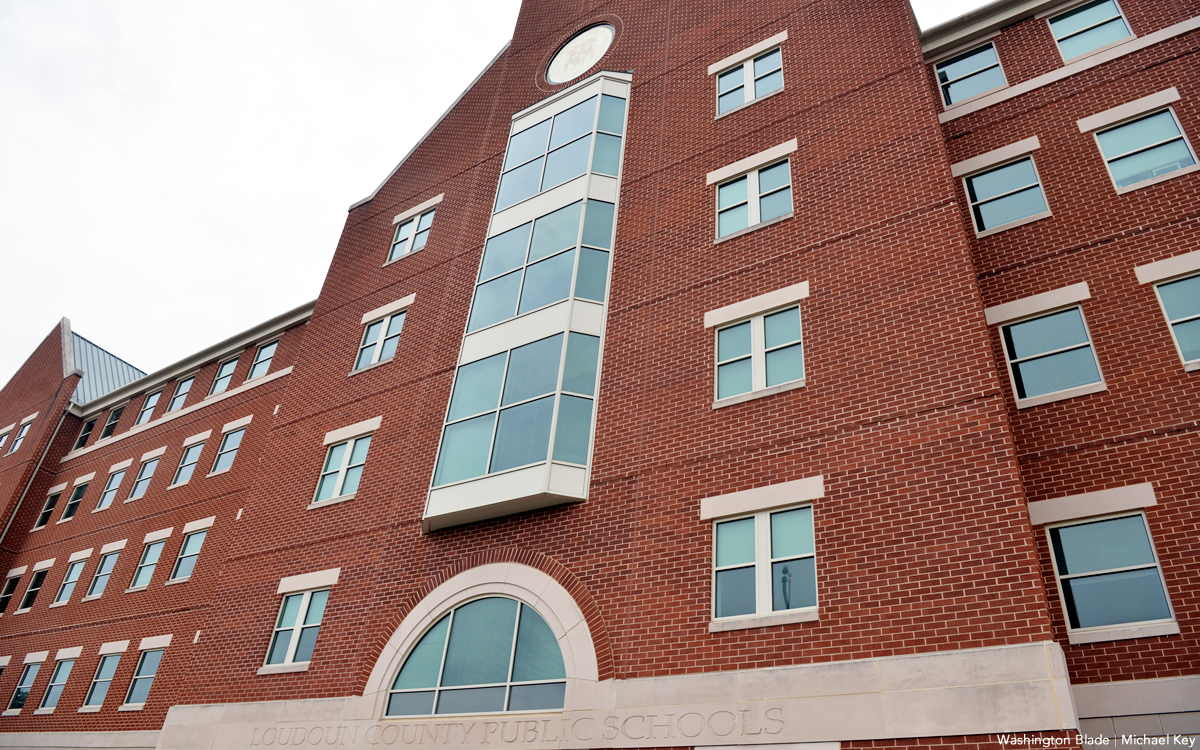
The Justice Department has asked to join a federal lawsuit against Loudoun County Public Schools over the way it handled the case of three male high school students who complained about a transgender student in a boys’ locker room.
The Washington Blade earlier this year reported Loudoun County public schools suspended the three boys and launched a Title IX investigation into whether they sexually harassed the student after they said they felt uncomfortable with their classmate in the locker room at Stone Bridge High School in Ashburn.
The parents of two of the boys filed a lawsuit against Loudoun County public schools in U.S. District Court for the Eastern District of Virginia in Alexandria. The Richmond-based Founding Freedoms Law Center and America First Legal, which White House deputy chief of staff Stephen Miller co-founded, represent them.
The Justice Department in a Dec. 8 press release announced that “it filed legal action against the Loudoun County (Va.) School Board (Loudoun County) for its denial of equal protection based on religion.”
“The suit alleges that Loudoun County applied Policy 8040, which requires students and faculty to accept and promote gender ideology, to two Christian, male students in violation of the Equal Protection Clause of the 14th Amendment to the U.S. Constitution,” reads the press release.
Assistant Attorney General Harmeet K. Dhillon of the Justice Department’s Civil Rights Division in the press release said “students do not shed their First Amendment rights at the schoolhouse gate.”
“Loudoun County’s decision to advance and promote gender ideology tramples on the rights of religious students who cannot embrace ideas that deny biological reality,” said Dhillon.
Outgoing Virginia Gov. Glenn Youngkin and outgoing Virginia Attorney General Jason Miyares in May announced an investigation into the case.
The Virginia Department of Education in 2023 announced the new guidelines for trans and nonbinary students for which Youngkin asked. Equality Virginia and other advocacy groups claim they, among other things, forcibly out trans and nonbinary students.
The U.S. Department of Education’s Office of Civil Rights in February launched an investigation into whether Loudoun County and four other Northern Virginia school districts’ policies in support of trans and nonbinary students violate Title IX and President Donald Trump’s executive order that prohibits federally funded educational institutions from promoting “gender ideology.”

Joseline Peña-Melnyk elected Md. House speaker

D.C. students need academic support, diverse connections for economic mobility

Why queer spaces often fail South Asian women

Holidays not always bright for transgender people

Rob Reiner, wife killed in LA home

EXCLUSIVE: George Santos speaks out on prison, Trump pardon, and more

White House deadnames highest-ranking transgender official

As house Democrats release Epstein photos, Garcia continues to demand DOJ transparency

Reflecting on six years on the CAMP Rehoboth board

Capital Pride announces change in date for 2026 D.C. Pride parade and festival
-

 Congress5 days ago
EXCLUSIVE: George Santos speaks out on prison, Trump pardon, and more
-
The White House4 days ago
White House deadnames highest-ranking transgender official
-
The White House4 days ago
As house Democrats release Epstein photos, Garcia continues to demand DOJ transparency
-
District of Columbia4 days ago
Capital Pride announces change in date for 2026 D.C. Pride parade and festival