Connect with us

National

Pelosi presses GOP on DOMA defense contract

Minority leader asks why Democrats excluded from negotiations

Published

on

House Minority Leader Nancy Pelosi (Blade file photo by Michael Key)

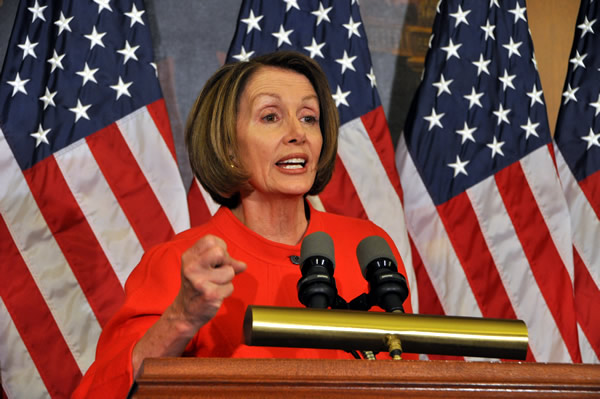
House Minority Leader Nancy Pelosi (D-Calif.) on Wednesday stepped up the pressure on Republican leadership to answer questions about cost and transparency over the recently signed contact allowing a private attorney to assist with defending the Defense of Marriage Act in court.

In an April 20 letter to U.S. House Speaker John Boehner (R-Ohio), Pelosi says questions remained unanswered about hiring Paul Clement, an attorney with King & Spalding, to help the House general counsel with defending DOMA in court because Democratic lawmakers weren’t informed of negotiations prior to the contract signing.

“Since Democratic members were excluded from all negotiations, I would appreciate your providing the following information concerning the contract’s transparency, cost, the discount and the restrictions placed upon King and Spalding’s vast lobbying practice,” Pelosi writes.

On Tuesday, the House contract with Clement was made public, revealing that House general counsel Kerry Kircher has hired the private attorney to assist with defending DOMA for a total sum that could reach $500,000 and at a blended rate of $520 an hour.

Among Pelosi’s inquiries is whether King & Spalding won the contract after a bidding process or if the selection of the firm was made as a sole source contract. The Democratic leader also asks how the $520 an hour rate for Clement was determined and the total possible sum of $500,000 for his work.

On Feb. 23, U.S. Attorney General Eric Holder notified Congress that President Obama determined DOMA was unconstitutional and that the Justice Department would no longer defend the anti-gay law against litigation in court. Following a 3-2 party-line vote in March by the Bipartisan Legal Advisory Council, Boehner directed the House general counsel to take up defense of DOMA in place of the administration.

In response to the letter, Michael Steel, a Boehner spokesperson, said he hopes Pelosi’s concern over DOMA defense costs means she’ll back the speaker’s call to redirect funds from the Justice Department to Congress to pay for the House defense of DOMA.

“The minority leader’s new-found concern for saving taxpayers money is encouraging,” Steel said. “We hope it means we can count on her support for reducing DOJ’s budget to recoup any costs incurred by the House so that taxpayers will bear no added cost for the administration’s refusal to defend the laws of the United States.”

The full text of letter of the letter follows:

April 20, 2011

The Honorable John A. Boehner
Speaker of the House
H-232, The Capitol
Washington, D.C. 20515

Dear Mr. Speaker:

The release of the contract between the House of Representatives and the law firm of King and Spalding concerning litigation on the Defense of Marriage Act (DOMA) raises many questions.  While the Democratic Members of the Bipartisan Legal Advisory Group (BLAG) opposed the decision of the Republican Members to authorize involvement in the DOMA lawsuits, that opposition in no way diminished the need for normal oversight of the terms of any contract signed by the Republican Leadership obligating the House of Representatives to pay half a million dollars of taxpayer money for private attorneys.  Yet the Democratic representatives on the BLAG, and the Democratic members of the Committee on House Administration, were provided with no information about the contract prior to or, at the time of, its being signed on April 14th. Since Democratic members were excluded from all negotiations, I would appreciate your providing the following information concerning the contract’s transparency, cost, the discount and the restrictions placed upon King and Spalding’s vast lobbying practice:

TRANSPARENCY

Did the BLAG or any House entity issue a call for bids, or was the selection of King and Spalding made as a sole source contract?  Who specifically made the decision to hire this firm, and what criteria were used?  Why was the Democratic membership of the Committee on House Administration not informed of the ongoing negotiations with King and Spalding and provided an opportunity to participate in order to assure a transparent process to prevent taxpayer dollars from being wasted?

COST

How was the $520 dollar an hour “blended rate” for attorneys negotiated, and how was the $500,000 fee established?  Was there a determination that $500,000 would be sufficient to pay for the complete legal representation in the 12 pending cases, and if so, who made that determination and how?  Is $520 an hour the regular rate normally charged by King and Spalding attorneys?  What are the specific hourly rates that will be charged by each of the King and Spalding attorneys listed in section 5 of the contract?  Is it anticipated that King and Spalding will represent the House in all 12 pending DOMA cases from the trial stage through any and all appeals?

DISCOUNT AND ETHICS

The contract states that other fees may be assessed at 75% of the firm’s regular charges.  What “other fees” are contemplated, and how was the 75% rate established?  Is it the standard practice of King and Spalding to give a 25% discount for non-attorney time to all government agencies or does the discount only pertain to the House Republican leadership?  Did the Ethics Committee review the proposed contract discount to ascertain whether it complied with all House ethics rules governing the provision of gratuities to the House by a commercial entity?  If so, please provide the written opinion of the Ethics Committee.

LOBBYING

Please provide a copy of all written restrictions imposed on King and Spalding’s extensive lobbying practice to ensure that no conflicts of interest arise on behalf of its extensive list of corporate clients while that firm is employed by the House.

Thank you for your timely response to this letter and my letter of April 18th.

Best regards,

NANCY PELOSI
Democratic Leader

Advertisement
FUND LGBTQ JOURNALISM
SIGN UP FOR E-BLAST

Florida

DNC slams White House for slashing Fla. AIDS funding

Following the”Big Beautiful Bill” tax credit cuts, Florida will have to cut life saving medication for over 16,000 Floridians.

Published

on

HIV infection, Florida, Hospitality State, gay Florida couples, gay news, Washington Blade

The Trump-Vance administration and congressional Republicans’ “Big Beautiful Bill” could strip more than 10,000 Floridians of life-saving HIV medication.

The Florida Department of Health announced there would be large cuts to the AIDS Drug Assistance Program in the Sunshine State. The program switched from covering those making up to 400 percent of the Federal Poverty Level, which was anyone making $62,600 or less, in 2025, to only covering those making up to 130 percent of the FPL, or $20,345 a year in 2026. 

Cuts to the AIDS Drug Assistance Program, which provides medication to low-income people living with HIV/AIDS, will prevent a dramatic $120 million funding shortfall as a result of the Big Beautiful Bill according to the Florida Department of Health. 

The International Association of Providers of AIDS Care and Florida Surgeon General Joseph Ladapo warned that the situation could easily become a “crisis” without changing the current funding setup.

“It is a serious issue,” Ladapo told the Tampa Bay Times. “It’s a really, really serious issue.”

The Florida Department of Health currently has a “UPDATES TO ADAP” warning on the state’s AIDS Drug Assistance Program webpage, recommending Floridians who once relied on tax credits and subsidies to pay for their costly HIV/AIDS medication to find other avenues to get the crucial medications — including through linking addresses of Florida Association of Community Health Centers and listing Florida Non-Profit HIV/AIDS Organizations rather than have the government pay for it. 

HIV disproportionately impacts low income people, people of color, and LGBTQ people

The Tampa Bay Times first published this story on Thursday, which began gaining attention in the Sunshine State, eventually leading the Democratic Party to, once again, condemn the Big Beautiful Bill pushed by congressional republicans.

“Cruelty is a feature and not a bug of the Trump administration. In the latest attack on the LGBTQ+ community, Donald Trump and Florida Republicans are ripping away life-saving HIV medication from over 10,000 Floridians because they refuse to extend enhanced ACA tax credits,” Democratic National Committee spokesperson Albert Fujii told the Washington Blade. “While Donald Trump and his allies continue to make clear that they don’t give a damn about millions of Americans and our community, Democrats will keep fighting to protect health care for LGBTQ+ Americans across the country.”

More than 4.7 million people in Florida receive health insurance through the federal marketplace, according to KKF, an independent source for health policy research and polling. That is the largest amount of people in any state to be receiving federal health care — despite it only being the third most populous state.

Florida also has one of the largest shares of people who use the AIDS Drug Assistance Program who are on the federal marketplace: about 31 percent as of 2023, according to the Tampa Bay Times.

“I can’t understand why there’s been no transparency,” David Poole also told the Times, who oversaw Florida’s AIDS program from 1993 to 2005. “There is something seriously wrong.”

The National Alliance of State and Territorial AIDS Directors estimates that more than 16,000 people will lose coverage

Continue Reading

U.S. Supreme Court

Competing rallies draw hundreds to Supreme Court

Activists, politicians gather during oral arguments over trans youth participation in sports

Published

on

Hundreds gather outside the U.S. Supreme Court on Tuesday. (Washington Blade photo by Michael Key)

Hundreds of supporters and opponents of trans rights gathered outside of the United States Supreme Court during oral arguments for Little v. Hecox and West Virginia v. B.P.J. on Tuesday. Two competing rallies were held next to each other, with politicians and opposing movement leaders at each.

“Trans rights are human rights!” proclaimed U.S. Sen. Ed Markey (D-Mass.) to the crowd of LGBTQ rights supporters. “I am here today because trans kids deserve more than to be debated on cable news. They deserve joy. They deserve support. They deserve to grow up knowing that their country has their back.”

U.S. Sen. Ed Markey (D-Mass.) speaks outside of the U.S. Supreme Court on Tuesday. (Washington Blade photo by Michael Key)

“And I am here today because we have been down this hateful road before,” Markey continued. “We have seen time and time again what happens when the courts are asked to uphold discrimination. History eventually corrects those mistakes, but only after the real harm is done to human beings.”

View on Threads

U.S. Education Secretary Linda McMahon spoke at the other podium set up a few feet away surrounded by signs, “Two Sexes. One Truth.” and “Reality Matters. Biology Matters.”

“In just four years, the Biden administration reversed decades of progress,” said McMahon. “twisting the law to urge that sex is not defined by objective biological reality, but by subjective notion of gender identity. We’ve seen the consequences of the Biden administration’s advocacy of transgender agendas.”

From left, U.S. Education Secretary Linda McMahon and U.S. Rep. Mark Takano (D-Calif.) speak during the same time slot at competing rallies in front of the U.S. Supreme Court on Tuesday. Takano addresses McMahon directly in his speech. (Washington Blade photo by Michael Key)

U.S. Rep. Mark Takano (D-Calif.), chair of the Congressional Equality Caucus, was introduced on the opposing podium during McMahon’s remarks.

“This court, whose building that we stand before this morning, did something quite remarkable six years ago.” Takano said. “It did the humanely decent thing, and legally correct thing. In the Bostock decision, the Supreme Court said that trans employees exist. It said that trans employees matter. It said that Title VII of the Civil Rights Act protects employees from discrimination based on sex, and that discrimination based on sex includes discrimination based on gender identity and sexual orientation. It recognizes that trans people have workplace rights and that their livelihoods cannot be denied to them, because of who they are as trans people.”

“Today, we ask this court to be consistent,” Takano continued. “If trans employees exist, surely trans teenagers exist. If trans teenagers exist, surely trans children exist. If trans employees have a right not to be discriminated against in the workplace, trans kids have a right to a free and equal education in school.”

Takano then turned and pointed his finger toward McMahon.

“Did you hear that, Secretary McMahon?” Takano addressed McMahon. “Trans kids have a right to a free and equal education! Restore the Office of Civil Rights! Did you hear me Secretary McMahon? You will not speak louder or speak over me or over these people.”

Both politicians continued their remarks from opposing podiums.

“I end with a message to trans youth who need to know that there are adults who reject the political weaponization of hate and bigotry,” Takano said. “To you, I say: you matter. You are not alone. Discrimination has no place in our schools. It has no place in our laws, and it has no place in America.”

Continue Reading

U.S. Supreme Court

Supreme Court hears arguments in two critical cases on trans sports bans

Justices considered whether laws unconstitutional under Title IX.

Published

on

The United States Supreme Court on Tuesday, Jan. 13. (Washington Blade photo by Michael Key)

The Supreme Court heard two cases today that could change how the Equal Protection Clause and Title IX are enforced.

The cases, Little v. Hecox and West Virginia v. B.P.J., ask the court to determine whether state laws blocking transgender girls from participating on girls’ teams at publicly funded schools violates the 14th Amendment’s Equal Protection Clause and Title IX. Once decided, the rulings could reshape how laws addressing sex discrimination are interpreted nationwide.

Chief Justice John Roberts raised questions about whether Bostock v. Clayton County — the landmark case holding that Title VII of the Civil Rights Act of 1964 protects employees from discrimination based on sexual orientation or gender identity — applies in the context of athletics. He questioned whether transgender girls should be considered girls under the law, noting that they were assigned male at birth.

“I think the basic focus of the discussion up until now, which is, as I see it anyway, whether or not we should view your position as a challenge to the distinction between boys and girls on the basis of sex or whether or not you are perfectly comfortable with the distinction between boys and girls, you just want an exception to the biological definition of girls.”

“How we approach the situation of looking at it not as boys versus girls but whether or not there should be an exception with respect to the definition of girls,” Roberts added, suggesting the implications could extend beyond athletics. “That would — if we adopted that, that would have to apply across the board and not simply to the area of athletics.”

Justice Clarence Thomas echoed Roberts’ concerns, questioning how sex-based classifications function under Title IX and what would happen if Idaho’s ban were struck down.

“Does a — the justification for a classification as you have in Title IX, male/female sports, let’s take, for example, an individual male who is not a good athlete, say, a lousy tennis player, and does not make the women’s — and wants to try out for the women’s tennis team, and he said there is no way I’m better than the women’s tennis players. How is that different from what you’re being required to do here?”

Justice Samuel Alito addressed what many in the courtroom seemed reluctant to state directly: the legal definition of sex.

“Under Title IX, what does the term ‘sex’ mean?” Alito asked Principal Deputy Solicitor General Hashim Mooppan, who was arguing in support of Idaho’s law. Mooppan maintained that sex should be defined at birth.

“We think it’s properly interpreted pursuant to its ordinary traditional definition of biological sex and think probably given the time it was enacted, reproductive biology is probably the best way of understanding that,” Mooppan said.

Justice Sonia Sotomayor pushed back, questioning how that definition did not amount to sex discrimination against Lindsay Hecox under Idaho law. If Hecox’s sex is legally defined as male, Sotomayor argued, the exclusion still creates discrimination.

“It’s still an exception,” Sotomayor said. “It’s a subclass of people who are covered by the law and others are not.”

Justice Elena Kagan highlighted the broader implications of the cases, asking whether a ruling for the states would impose a single definition of sex on the 23 states that currently have different laws and standards. The parties acknowledged that scientific research does not yet offer a clear consensus on sex.

“I think the one thing we definitely want to have is complete findings. So that’s why we really were urging to have a full record developed before there were a final judgment of scientific uncertainty,” said Kathleen Harnett, Hecox’s legal representative. “Maybe on a later record, that would come out differently — but I don’t think that—”

Kathleen Harnett, center, speaks with reporters following oral arguments at the U.S. Supreme Court on Tuesday, Jan. 13. (Washington Blade photo by Michael Key)

“Just play it out a little bit, if there were scientific uncertainty,” Kagan responded.

Justice Brett Kavanaugh focused on the impact such policies could have on cisgender girls, arguing that allowing transgender girls to compete could undermine Title IX’s original purpose.

“For the individual girl who does not make the team or doesn’t get on the stand for the medal or doesn’t make all league, there’s a — there’s a harm there,” Kavanaugh said. “I think we can’t sweep that aside.”

Justice Amy Coney Barrett questioned whether Idaho’s law discriminated based on transgender status or sex.

“Since trans boys can play on boys’ teams, how would we say this discriminates on the basis of transgender status when its effect really only runs towards trans girls and not trans boys?”

Harnett responded, “I think that might be relevant to a, for example, animus point, right, that we’re not a complete exclusion of transgender people. There was an exclusion of transgender women.”

Justice Ketanji Brown Jackson challenged the notion that explicitly excluding transgender people was not discrimination.

“I guess I’m struggling to understand how you can say that this law doesn’t discriminate on the basis of transgender status. The law expressly aims to ensure that transgender women can’t play on women’s sports teams… it treats transgender women different than — than cis-women, doesn’t it?”

Idaho Solicitor General Alan Hurst urged the court to uphold his state’s ban, arguing that allowing participation based on gender identity — regardless of medical intervention — would deny opportunities to girls protected under federal law.

Hurst emphasized that biological “sex is what matters in sports,” not gender identity, citing scientific evidence that people assigned male at birth are predisposed to athletic advantages.

Joshua Block, representing B.P.J., was asked whether a ruling in their favor would redefine sex under federal law.

“I don’t think the purpose of Title IX is to have an accurate definition of sex,” Block said. “I think the purpose is to make sure sex isn’t being used to deny opportunities.”

Becky Pepper-Jackson, identified as plaintiff B.P.J., the 15-year-old also spoke out.

“I play for my school for the same reason other kids on my track team do — to make friends, have fun, and challenge myself through practice and teamwork,” said Pepper-Jackson. “And all I’ve ever wanted was the same opportunities as my peers. But in 2021, politicians in my state passed a law banning me — the only transgender student athlete in the entire state — from playing as who I really am. This is unfair to me and every transgender kid who just wants the freedom to be themselves.”

A demonstrator holds a ‘protect trans youth’ sign outside of the U.S. Supreme Court on Tuesday, Jan. 13. (Washington Blade photo by Michael Key)

Outside the court, advocates echoed those concerns as the justices deliberated.

“Becky simply wants to be with her teammates on the track and field team, to experience the camaraderie and many documented benefits of participating in team sports,” said Sasha Buchert, counsel and Nonbinary & Transgender Rights Project director at Lambda Legal. “It has been amply proven that participating in team sports equips youth with a myriad of skills — in leadership, teamwork, confidence, and health. On the other hand, denying a student the ability to participate is not only discriminatory but harmful to a student’s self-esteem, sending a message that they are not good enough and deserve to be excluded. That is the argument we made today and that we hope resonated with the justices of the Supreme Court.”

“This case is about the ability of transgender youth like Becky to participate in our schools and communities,” said Joshua Block, senior counsel for the ACLU’s LGBTQ & HIV Project. “School athletics are fundamentally educational programs, but West Virginia’s law completely excluded Becky from her school’s entire athletic program even when there is no connection to alleged concerns about fairness or safety. As the lower court recognized, forcing Becky to either give up sports or play on the boys’ team — in contradiction of who she is at school, at home, and across her life — is really no choice at all. We are glad to stand with her and her family to defend her rights, and the rights of every young person, to be included as a member of their school community, at the Supreme Court.”

The Supreme Court is expected to issue rulings in both cases by the end of June.

Continue Reading

Popular