Local
Back to school: How campus life got better
Reflections on change as the class of 1974 meets the class of 2014 at UVA
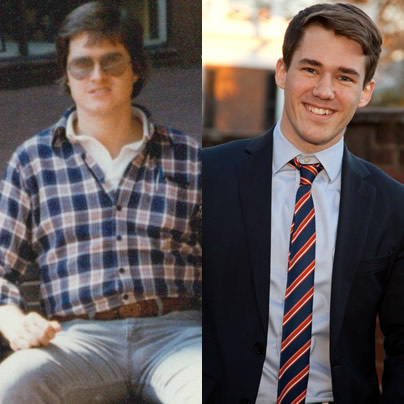
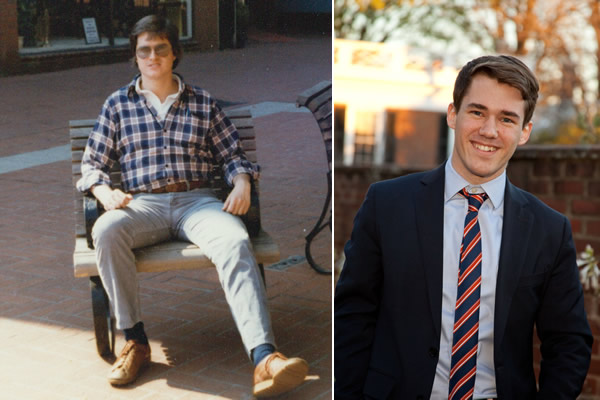
Bob Witeck (left), who graduated from the University of Virginia in 1974, shown here in Charlottesville. Brendan Maupin Wynn, class of 2014, at UVA’s Serpentine Wall on campus. (Photos courtesy of Witeck and Wynn)
Editor’s note: This is the first installment in a series assessing the LGBT climate on university campuses as told by alumni we’re pairing with current students to tell their stories. This week: Bob Witeck and the University of Virginia. Next in the series: Jeff Trammell returns to William and Mary as rector.
In 1973, Bette Midler flounced out of the Continental Baths in Manhattan to record the chart-topping gay anthem, “You Gotta Have Friends,” but for Bob Witeck, it didn’t come with an instruction manual. With nary a hint of gay life on the campus of the University of Virginia, he sought help in the library.
“There were maybe 10 titles, each of them clinical or scary,” Witeck recalled. “None gave me a sense of hope, promise or acceptance in any way.” So, he buried himself in his studies, anti-war activism and marathon bridge tournaments. He could declare and partner in bridge, but seeking one in life was too risky. Jesse Helms and Anita Bryant were hunting and killing gay civil rights wherever they could. Witeck is from an entire generation of “Friends of Dorothy” — and the gay, straight-A student was asexual.
Such was the state of gay life on America’s college campuses for many closeted students 40 years ago.
Today, brimming with hope, promise and acceptance, Brendan Maupin Wynn walks the same UVA campus that Witeck did four decades earlier — only he’s running for office, signing petitions for any number of progressive causes, and when the mood strikes him, he takes a man on a date.
“I only worry whether my date has a winning smile — never how we’ll be treated at an event,” he says. This straight-A student is gay and makes no apologies for it.
When he learned of this project for the Washington Blade and that he was being paired with Bob Witeck, Wynn responded, “Is this the Bob Witeck who’s the Washington PR magician?” The answer is yes, Brendan, and that magician did a disappearing act when he was in your shoes. Contrasting the two Cavs is the goal of this column and that progress is nothing about which to be cavalier.
LGBT rights advances can be attributed to the work of many straight allies and gay heroes — and on the UVA Grounds, to the Serpentine Society, where LGBT alumni provide straight talk beside the legendary curvy serpentine wall invented by Thomas Jefferson. The Serpentine Society was conceived in 1998 and is dedicated to advocating for LGBT alumni, faculty and students.
It’s simultaneously no one’s fault — and everyone’s — that LGBT students had to live in a quiet isolated closet over much of history. Queers have been in quads since the first Corinthian column was erected on a campus. Today they’re out in the sunshine sitting against that same column.
Who to thank for all this progress? Witeck’s gay heroes are pre-Stonewall: Frank Kameny, Barbara Gittings and Lilli Vincenz. His straight heroes are Rep. John Lewis (D- Ga.) and Julian Bond of the NAACP — black leaders who considered us their “gay brothers and sisters” even before President Obama gave an inaugural shout-out to those brave enough to be out. Imagine that from Richard Nixon in ’73. Wynn’s straight hero is Hillary Clinton and he talks about the gay-straight village it took to raise him at UVA. While Ellen DeGeneres and Rachel Maddow are high on his list of gay heroes, he need look no further than Peabody Hall on campus to find others.
“I am so lucky to have a ton of gay role models to choose from. Our dean of students, Allen Groves is the coolest guy around. Everyone on Grounds loves him!”
Our long slow march toward this equality is sort of parallel in pop culture to the goofy (and now gay) Gomer Pyle of the ‘60s TV show. The now-out Jim Nabors endured sit-com life in quiet backwards Mayberry RFD. Nabors waited until he was 82 to come out. Wynn? He grew up with Will and Grace. In comparison, his coming out was a piece of cake. Even in rural Tidewater, Va., he was able to come out to his parents and very close friends in 10th grade. He arrived at UVA to find that a freshman’s sexual orientation was indeed part of freshmen orientation.
Witeck waited until he was out of college before pursuing the authentic gay life. That year, Paul Simon topped the charts with “50 Ways to Leave Your Lover” and it’s only then that Witeck looked for one.
With courage and composure, Witeck has returned to help make the Grounds at UVA better for Wynn and the generations to follow. Witeck has worked on the Hill and in public relations. He worked for Sen. Bob Packwood and for Hill and Knowlton, the legendary PR shop, and now owns his own firm, Witeck Communications in D.C. He published the landmark book “Business Inside Out,” serves on too many LGBT boards to mention, and returned to UVA in 2001 to accept the prestigious Bernard Mayes Award.
Would he trade all that for four “out” years as a young man?
“I felt very lucky to have the quality of education UVA offers,” Witeck said. “I sometimes imagine the difference being open and honest would have allowed me to break my own self barriers. But no, I have zero regrets. What I really value is having witnessed so much of this change in 40 years and knowing that we all played a part in making it happen.” It occurs to him that childless gay boomers do have kids going to college each year — other people’s gay children who need help and guidance.
Wistful about the past, but stridently optimistic about the future, Witeck reflects, “The Serpentine Society is one of the few groups that serve as a bridge for the gay community to the entire Virginia community — to the faculty, staff and students and allows us to put LGBT and identity issues forward.”
Although UVA isn’t perfect on gay issues, and may lag behind some other major institutions, the vision of the Serpentine Society is helping bring about positive change.
Scientists recently reported that as we age, the most vivid memories we will retain will be those from 12 to 22 years. Cleverly termed “the reminiscence bump” it’s a cruel hoax on older gay folks. Those years could be lonely and isolating and when it comes to true gay identity, it’s a bump that leaves an entire generation with just a lump in their throats. Not so with Wynn.
“I can’t count the number of gay friends I have in my head! Isn’t that awesome?” He still cautions that many of his classmates are closeted and that victory isn’t complete. As Witeck says, “Students today still have their own aspirations, fears, risks and needs.”
Anyone walking the grounds at UVA must know that time has been on the side of LGBT students. Just ask Wynn and his date, sitting over on the Lawn, both with their winning smiles.
Wynn’s ancestor, Socrates Maupin, joined UVA as a student in 1828 and later returned as faculty. The Civil War occurred while he was chairman of the faculty. It was Socrates Maupin who refinanced the university on his credit, reconstituted the faculty and returned the university to the Union — clearly marking progress and forward momentum.
Today, if Socrates — or Witeck — were to return to the grounds, they’d walk past an open door on the ground floor of Newcomb Hall where Scott Rheinheimer leads the LGBT Resource Center. New to his job, he is amazed at the support and resources for the center.
“From Dean Groves to the Serpentine Society to the faculty and the administration, everyone here has welcomed me openly and warmly,” Rheinheimer said.
So, Witeck lived in a desert so today’s students, like Wynn, could enjoy an oasis.
“I think that students inherently face a number of challenges acclimating to the college environment,” said Wynn. “What’s fortunate is that the university has made great strides in being inclusive and accepting. Like Bob, many students feel they must hide their orientation — from their parents, from their classmates and even from their friends. There are still challenges to coming out, but I think that it’s getting easier, and it’s getting better.”
Brent Mundt is collecting alumni stories for a book. Reach him at [email protected].



Virginia
DOJ seeks to join lawsuit against Loudoun County over trans student in locker room
Three male high school students suspended after complaining about classmate
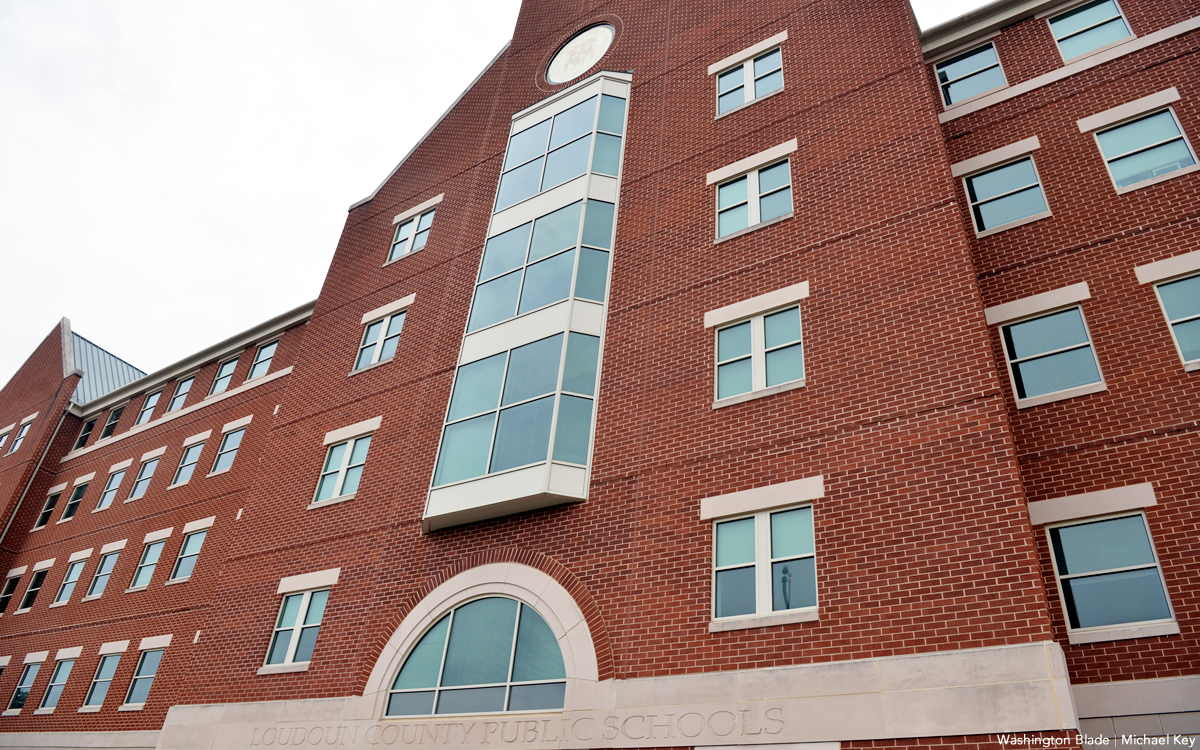
The Justice Department has asked to join a federal lawsuit against Loudoun County Public Schools over the way it handled the case of three male high school students who complained about a transgender student in a boys’ locker room.
The Washington Blade earlier this year reported Loudoun County public schools suspended the three boys and launched a Title IX investigation into whether they sexually harassed the student after they said they felt uncomfortable with their classmate in the locker room at Stone Bridge High School in Ashburn.
The parents of two of the boys filed a lawsuit against Loudoun County public schools in U.S. District Court for the Eastern District of Virginia in Alexandria. The Richmond-based Founding Freedoms Law Center and America First Legal, which White House deputy chief of staff Stephen Miller co-founded, represent them.
The Justice Department in a Dec. 8 press release announced that “it filed legal action against the Loudoun County (Va.) School Board (Loudoun County) for its denial of equal protection based on religion.”
“The suit alleges that Loudoun County applied Policy 8040, which requires students and faculty to accept and promote gender ideology, to two Christian, male students in violation of the Equal Protection Clause of the 14th Amendment to the U.S. Constitution,” reads the press release.
Assistant Attorney General Harmeet K. Dhillon of the Justice Department’s Civil Rights Division in the press release said “students do not shed their First Amendment rights at the schoolhouse gate.”
“Loudoun County’s decision to advance and promote gender ideology tramples on the rights of religious students who cannot embrace ideas that deny biological reality,” said Dhillon.
Outgoing Virginia Gov. Glenn Youngkin and outgoing Virginia Attorney General Jason Miyares in May announced an investigation into the case.
The Virginia Department of Education in 2023 announced the new guidelines for trans and nonbinary students for which Youngkin asked. Equality Virginia and other advocacy groups claim they, among other things, forcibly out trans and nonbinary students.
The U.S. Department of Education’s Office of Civil Rights in February launched an investigation into whether Loudoun County and four other Northern Virginia school districts’ policies in support of trans and nonbinary students violate Title IX and President Donald Trump’s executive order that prohibits federally funded educational institutions from promoting “gender ideology.”
District of Columbia
Capital Pride announces change in date for 2026 D.C. Pride parade and festival
Events related to U.S. 250th anniversary and Trump birthday cited as reasons for change

The Capital Pride Alliance, the D.C. based group that organizes the city’s annual LGBTQ Pride events, has announced it is changing the dates for the 2026 Capital Pride Parade and Festival from the second weekend in June to the third weekend.
“For over a decade, Capital Pride has taken place during the second weekend in June, but in 2026, we are shifting our dates in response to the city’s capacity due to major events and preparations for the 250th anniversary of the United States,” according to a Dec. 9 statement released by Capital Pride Alliance.
The statement says the parade will take place on Saturday, June 20, 2026, with the festival and related concert taking place on June 21.
“This change ensures our community can gather safely and without unnecessary barriers,” the statement says. “By moving the celebration, we are protecting our space and preserving Pride as a powerful act of visibility, solidarity, and resistance,” it says.
Ryan Bos, the Capital Pride Alliance CEO and President, told the Washington Blade the change in dates came after the group conferred with D.C. government officials regarding plans for a number of events in the city on the second weekend in June. Among them, he noted, is a planned White House celebration of President Donald Trump’s 80th birthday and other events related to the U.S. 250th anniversary, which are expected to take place from early June through Independence Day on July 4.
The White House has announced plans for a large June 14, 2026 celebration on the White House south lawn of Trump’s 80th birthday that will include a large-scale Ultimate Fighting Championship (UFC) event involving boxing and wrestling competition.
Bos said the Capital Pride Parade will take place along the same route it has in the past number of years, starting at 14th and T Streets, N.W. and traveling along 14th Street to Pennsylvania Ave., where it will end. He said the festival set for the following day will also take place at its usual location on Pennsylvania Avenue, N.W., between 2nd Street near the U.S. Capitol, to around 7th Street, N.W.
“Our Pride events thrive because of the passion and support of the community,” Capital Pride Board Chair Anna Jinkerson said in the statement. “In 2026, your involvement is more important than ever,” she said.
District of Columbia
Three women elected leaders of Capital Pride Alliance board
Restructured body includes chair rather than president as top leader
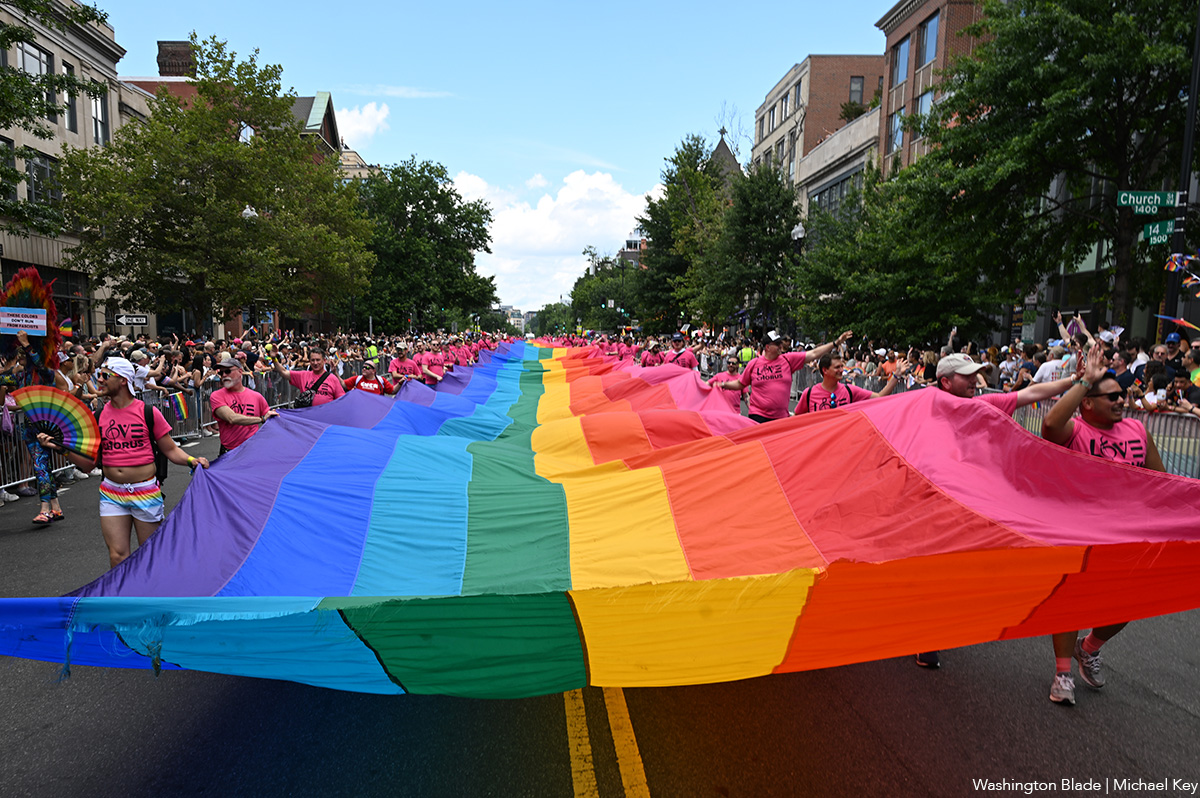
The Capital Pride Alliance, the D.C.-based group that organizes the city’s annual LGBTQ Pride events, announced it has restructured its board of directors and elected for the first time three women to serve as leaders of the board’s Executive Committee.
“Congratulations to our newly elected Executive Officers, making history as Capital Pride Alliance’s first all-women Board leadership,” the group said in a statement.
“As we head into 2026 with a bold new leadership structure, we’re proud to welcome Anna Jinkerson as Board Chair, Kim Baker as Board Treasurer, and Taylor Lianne Chandler as Board Secretary,” the statement says.
In a separate statement released on Nov. 20, Capital Pride Alliance says the restructured Board now includes the top leadership posts of Chair, Treasurer, and Secretary, replacing the previous structure of President and Vice President as the top board leaders.
It says an additional update to the leadership structure includes a change in title for longtime Capital Pride official Ryan Bos from executive director to chief executive officer and president.
According to the statement, June Crenshaw, who served as acting deputy director during the time the group organized WorldPride 2025 in D.C., will now continue in that role as permanent deputy director.
The statement provides background information on the three newly elected women Board leaders.
• Anna Jinkerson (chair), who joined the Capital Pride Alliance board in 2022, previously served as the group’s vice president for operations and acting president. “A seasoned non-profit executive, she currently serves as Assistant to the President and CEO and Chief of Staff at Living Cities, a national member collaborative of leading philanthropic foundations and financial institutions committed to closing income and wealth gaps in the United States and building an economy that works for everyone.”
• Kim Baker (treasurer) is a “biracial Filipino American and queer leader,” a “retired, disabled U.S. Army veteran with more than 20 years of service and extensive experience in finance, security, and risk management.” She has served on the Capital Pride Board since 2018, “bringing a proven track record of steady, principled leadership and unwavering dedication to the LGBTQ+ community.”
• Taylor Lianne Chandler (Secretary) is a former sign language interpreter and crisis management consultant. She “takes office as the first intersex and trans-identifying member of the Executive Committee.” She joined the Capital Pride Board in 2019 and previously served as executive producer from 2016 to 2018.
Bos told the Washington Blade in a Dec. 2 interview that the Capital Pride board currently has 12 members, and is in the process of interviewing additional potential board members.
“In January we will be announcing in another likely press release the full board,” Bos said. “We are finishing the interview process of new board members this month,” he said. “And they will take office to join the board in January.”
Bos said the organization’s rules set a cap of 25 total board members, but the board, which elects its members, has not yet decided how many additional members it will select and a full 25-member board is not required.
The Nov. 20 Capital Pride statement says the new board executive members will succeed the organization’s previous leadership team, which included Ashley Smith, who served as president for eight years before he resigned earlier this year; Anthony Musa, who served for seven years as vice president of board engagement; Natalie Thompson, who served eight years on the executive committee; and Vince Micone, who served for eight years as vice president of operations.
“I am grateful for the leadership, dedication, and commitment shown by our former executive officers — Ashley, Natalie, Anthony, and Vince — who have been instrumental in CPA’s growth and the exceptional success of WorldPride 2025,” Bos said in the statement.
“I look forward to collaborating with Anna in her new role, as well as Kim and Taylor in theirs, as we take on the important work ahead, prepare for Capital Pride 2026, and expand our platform and voice through Pride365,” Bos said.

Choose U ambassadors share lived experiences with HIV, personal reflections, and insights

DOJ seeks to join lawsuit against Loudoun County over trans student in locker room

As house Democrats release Epstein photos, Garcia continues to demand DOJ transparency

Capital Pride announces change in date for 2026 D.C. Pride parade and festival

Reflecting on six years on the CAMP Rehoboth board

EXCLUSIVE: George Santos speaks out on prison, Trump pardon, and more

The harsh truth about HIV phobia in gay dating

Cynthia Erivo, Eva Victor, and ‘Blue Moon’ bring queer representation to Golden Globe film nominations

Victory Institute honors transgender Spanish senator in D.C.

Kazakh Senate tables anti-LGBTQ propaganda bill
-

 Congress1 day ago
EXCLUSIVE: George Santos speaks out on prison, Trump pardon, and more
-
Health4 days ago
The harsh truth about HIV phobia in gay dating
-
Arts & Entertainment5 days ago
Cynthia Erivo, Eva Victor, and ‘Blue Moon’ bring queer representation to Golden Globe film nominations
-
Spain3 days ago
Victory Institute honors transgender Spanish senator in D.C.