Local
D.C. Council candidates court LGBT voters
Graham, Bonds face opposition in April primary
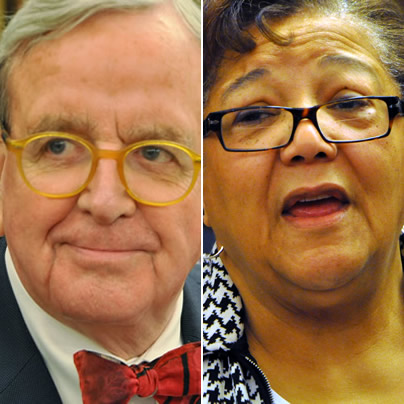
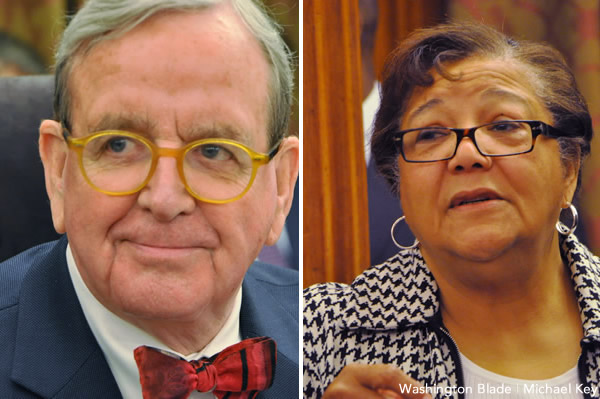
Council members Jim Graham and Anita Bonds are seeking re-election and facing Democratic opposition in the April primary. (Washington Blade file photos by Michael Key)
LGBT voters could play a key role in determining the nominees for at least three of the six D.C. Council seats up for grabs in the city’s April 1 Democratic primary, according to activists familiar with the candidates.
Similar to past years, nearly all of the candidates who are favored to win or who have a shot at winning their primary contests and the general election in November are strong supporters of LGBT rights.
In the April primary, D.C. Council Chair Phil Mendelson (D-At-Large), Council member Mary Cheh(D-Ward 3), and Council member Kenyan McDuffie (D-Ward 5) are considered strong favorites to win in the primary and general election. Cheh is running unopposed in the primary.
Mendelson and Cheh are longtime supporters of the LGBT community and McDuffie has been supportive on LGBT issues since winning his seat in a special election in 2012.
Council member Anita Bonds (D-At-Large) and four-term Council member Jim Graham (D-Ward 1), who’s gay, are running in competitive races in the primary, in the opinion of some political observers, although most knowledgeable observers consider them the clear front-runners.
Bonds, who has been involved in D.C. politics since the early 1980s, has a long record of support for LGBT rights. And Graham, the former head of the Whitman-Walker Clinic, has been among the Council’s strongest advocates on LGBT and AIDS issues during his more than 15 years as a Council member.
The remaining Council race on the primary ballot will be for an open seat in Ward 6, which is being vacated by Council member Tommy Wells, a Democrat who’s running for mayor. Three Democratic candidates running in the primary – Charles Allen, Wells’ former chief of staff; Darrel Thompson, and Shelonda Tillman – have expressed strong support on LGBT issues and are expected to compete for support from the large number of LGBT residents that live in Ward 6.
Graham’s longstanding reputation as a champion for his Ward 1 constituents — both gay and straight — would normally make him a shoo-in for winning election to a fifth term. But an 11-2 vote by his Council colleagues last spring to reprimand him on grounds that he violated the Council’s ethics rules in 2008 by improperly interfering with negotiations over a Metro development contract have raised questions over whether his support in the ward has eroded.
The Council’s vote to reprimand Graham came shortly after the city’s independent ethics board, headed by gay former D.C. Attorney General Robert Spagnoletti, issued an opinion saying Graham did not violate any laws but committed an ethical breach as a city official by intervening in the contract process.
Graham has disputed the claim that he did anything improper, saying he pushed for awarding the contract to one developer over another because the one he favored was better qualified to do the work on a project located in his ward.
Lesbian Democratic activist Barbara Helmick, a longtime resident of Ward 1, said she has voted for Graham in the past but is undecided on whether to vote for him this time.
“Certainly the ethics question has raised eyebrows,” Helmick said. “But Jim has done a lot as a Council member and he has basically done a good job for his constituents.”
Helmick, like other Ward 1 residents, said she’s looking at Graham’s two remaining opponents in the primary, civic activists Bryan Weaver and Brianne Nadeau. Both have been strong supporters of the LGBT community. A third opponent, Beverly Wheeler, a former aide to Council Chair Mendelson, dropped out of the race last week, citing family related issues.
Ward 1 is believed to have the largest concentration of LGBT residents among the city’s eight wards and is home to two LGBT community centers, one of which – Casa Ruby – reaches out to the LGBT Latino community. Activists say that Graham’s prospects for winning the primary would increase significantly if he can retain the support of LGBT voters who have backed him overwhelmingly in past elections.
No Republican, Statehood Green Party or Libertarian Party candidate entered the Ward 1 Council race this year, a development that means Graham would likely face one or more lesser known independent candidates in the November general election if he wins the Democratic nomination in the primary.
Bonds, meanwhile, is being challenged by four other Democrats in the primary in her race for one of two at-large Council seats that will be on the ballot in the November general election. In a process that has often confounded voters, one of the two seats is reserved for a non-majority party candidate under the city’s election law, which means a Democrat cannot compete for the second seat.
Gay D.C. Council member David Catania (I-At-Large) has held the so-called non-Democratic seat since 1997, when he won a special election to fill the then vacant seat. He has been re-elected four times since then, but this year Catania said he’s strongly considering giving up his Council seat to run for mayor.
As an independent, he doesn’t have to make a final decision on whether to seek re-election to the Council or enter the mayoral race until June. Many of the city’s political pundits believe Catania will run for mayor, clearing the way for others to compete for his Council seat.
Gay Republican activist Marc Morgan, a Ward 1 Advisory Neighborhood Commissioner, is running unopposed in the Republican primary for one of the two at-large seats. Should Catania run for mayor, Morgan could be in a strong position to compete for the non-Democratic seat.
A Libertarian Party candidate, who is running unopposed in his party’s primary, and one of two Statehood Green Party candidates running in that party’s primary, will be competing with Morgan for the non-Democratic seat in the November election.
Another openly gay candidate, Libertarian Party activist Martin Moulton, is running unopposed in the Libertarian primary for the city’s U.S. shadow representative seat. Moulton is expected to compete for the shadow seat in the November general election against Democrat Franklin Garcia, who’s running unopposed in the Democratic primary in April.
Out of the four Democrats running against Bonds in the primary, Nate Bennett-Fleming, who currently holds the U.S. shadow representative seat, is considered to be her strongest opponent. Bennett-Fleming has expressed strong support for LGBT rights and won the endorsement of the Gertrude Stein Democratic Club, the city’s largest LGBT political group, when he ran for the seat in 2012.
The city created shadow U.S. Senate seats and one shadow House of Representatives seat as unpaid lobbying positions to advocate for D.C. statehood and voting representation in Congress.
Although some consider the shadow seats to be of little value because they have no official connection with the U.S. Congress, Bennett-Fleming received more than 43,000 votes when he won the Democratic primary for the seat in 2012. In the 2012 general election, Bennett-Fleming received nearly 207,000 votes.
When Bonds won the at-large seat in a special election last April she received 18,027 votes, or 31.4 percent, in a seven-candidate race with one of the lowest voter turnouts of any D.C. election ever held.
The voter turnout is expected to be larger in this year’s April 1 primary and Bonds’ wider name recognition and longstanding involvement in city politics gives her an edge over Bennett-Fleming and the other three candidates, according to most pundits. But Bonds and her LGBT supporters say she is waging an aggressive outreach effort to capture the LGBT vote to boost her re-election prospects.
Elissa Silverman, a Democrat who came in second behind Bonds in the 2012 special election, reportedly is considering changing her party affiliation from Democrat to independent to run for the non-Democratic at-large seat in the general election.



Virginia
DOJ seeks to join lawsuit against Loudoun County over trans student in locker room
Three male high school students suspended after complaining about classmate

The Justice Department has asked to join a federal lawsuit against Loudoun County Public Schools over the way it handled the case of three male high school students who complained about a transgender student in a boys’ locker room.
The Washington Blade earlier this year reported Loudoun County public schools suspended the three boys and launched a Title IX investigation into whether they sexually harassed the student after they said they felt uncomfortable with their classmate in the locker room at Stone Bridge High School in Ashburn.
The parents of two of the boys filed a lawsuit against Loudoun County public schools in U.S. District Court for the Eastern District of Virginia in Alexandria. The Richmond-based Founding Freedoms Law Center and America First Legal, which White House deputy chief of staff Stephen Miller co-founded, represent them.
The Justice Department in a Dec. 8 press release announced that “it filed legal action against the Loudoun County (Va.) School Board (Loudoun County) for its denial of equal protection based on religion.”
“The suit alleges that Loudoun County applied Policy 8040, which requires students and faculty to accept and promote gender ideology, to two Christian, male students in violation of the Equal Protection Clause of the 14th Amendment to the U.S. Constitution,” reads the press release.
Assistant Attorney General Harmeet K. Dhillon of the Justice Department’s Civil Rights Division in the press release said “students do not shed their First Amendment rights at the schoolhouse gate.”
“Loudoun County’s decision to advance and promote gender ideology tramples on the rights of religious students who cannot embrace ideas that deny biological reality,” said Dhillon.
Outgoing Virginia Gov. Glenn Youngkin and outgoing Virginia Attorney General Jason Miyares in May announced an investigation into the case.
The Virginia Department of Education in 2023 announced the new guidelines for trans and nonbinary students for which Youngkin asked. Equality Virginia and other advocacy groups claim they, among other things, forcibly out trans and nonbinary students.
The U.S. Department of Education’s Office of Civil Rights in February launched an investigation into whether Loudoun County and four other Northern Virginia school districts’ policies in support of trans and nonbinary students violate Title IX and President Donald Trump’s executive order that prohibits federally funded educational institutions from promoting “gender ideology.”
District of Columbia
Capital Pride announces change in date for 2026 D.C. Pride parade and festival
Events related to U.S. 250th anniversary and Trump birthday cited as reasons for change

The Capital Pride Alliance, the D.C. based group that organizes the city’s annual LGBTQ Pride events, has announced it is changing the dates for the 2026 Capital Pride Parade and Festival from the second weekend in June to the third weekend.
“For over a decade, Capital Pride has taken place during the second weekend in June, but in 2026, we are shifting our dates in response to the city’s capacity due to major events and preparations for the 250th anniversary of the United States,” according to a Dec. 9 statement released by Capital Pride Alliance.
The statement says the parade will take place on Saturday, June 20, 2026, with the festival and related concert taking place on June 21.
“This change ensures our community can gather safely and without unnecessary barriers,” the statement says. “By moving the celebration, we are protecting our space and preserving Pride as a powerful act of visibility, solidarity, and resistance,” it says.
Ryan Bos, the Capital Pride Alliance CEO and President, told the Washington Blade the change in dates came after the group conferred with D.C. government officials regarding plans for a number of events in the city on the second weekend in June. Among them, he noted, is a planned White House celebration of President Donald Trump’s 80th birthday and other events related to the U.S. 250th anniversary, which are expected to take place from early June through Independence Day on July 4.
The White House has announced plans for a large June 14, 2026 celebration on the White House south lawn of Trump’s 80th birthday that will include a large-scale Ultimate Fighting Championship (UFC) event involving boxing and wrestling competition.
Bos said the Capital Pride Parade will take place along the same route it has in the past number of years, starting at 14th and T Streets, N.W. and traveling along 14th Street to Pennsylvania Ave., where it will end. He said the festival set for the following day will also take place at its usual location on Pennsylvania Avenue, N.W., between 2nd Street near the U.S. Capitol, to around 7th Street, N.W.
“Our Pride events thrive because of the passion and support of the community,” Capital Pride Board Chair Anna Jinkerson said in the statement. “In 2026, your involvement is more important than ever,” she said.
District of Columbia
Three women elected leaders of Capital Pride Alliance board
Restructured body includes chair rather than president as top leader
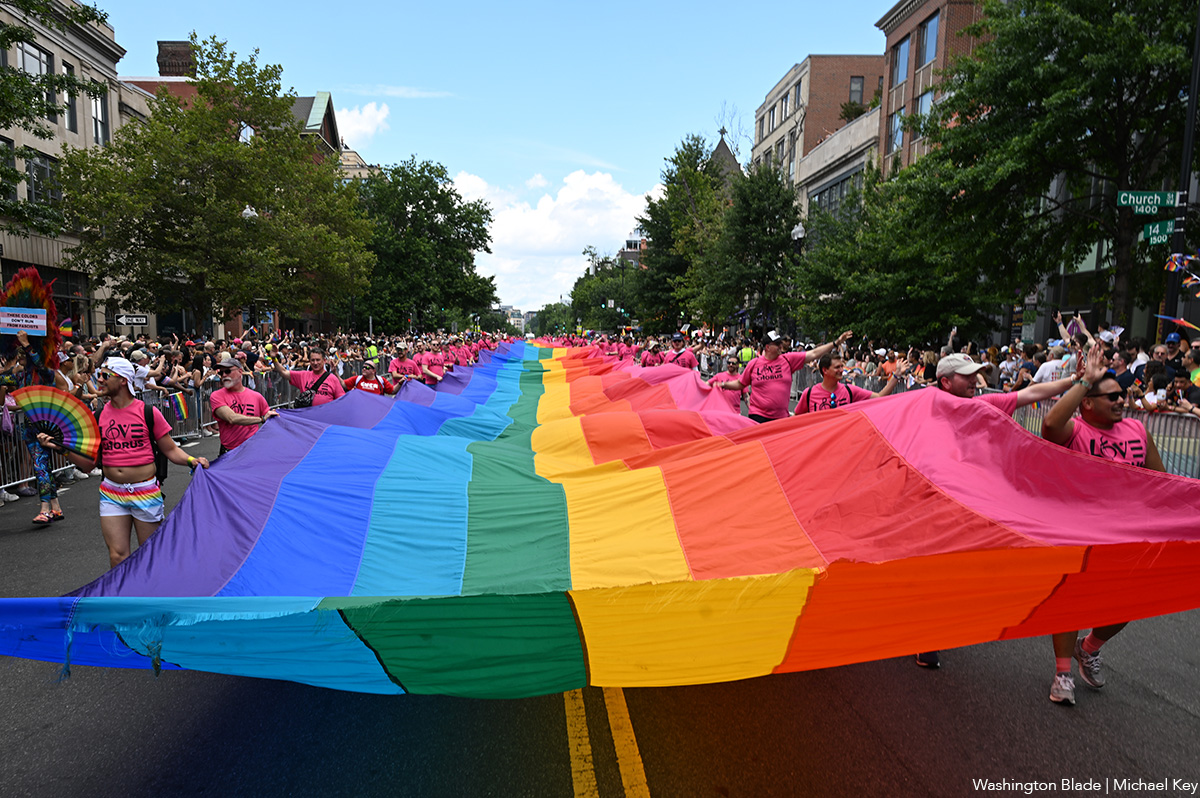
The Capital Pride Alliance, the D.C.-based group that organizes the city’s annual LGBTQ Pride events, announced it has restructured its board of directors and elected for the first time three women to serve as leaders of the board’s Executive Committee.
“Congratulations to our newly elected Executive Officers, making history as Capital Pride Alliance’s first all-women Board leadership,” the group said in a statement.
“As we head into 2026 with a bold new leadership structure, we’re proud to welcome Anna Jinkerson as Board Chair, Kim Baker as Board Treasurer, and Taylor Lianne Chandler as Board Secretary,” the statement says.
In a separate statement released on Nov. 20, Capital Pride Alliance says the restructured Board now includes the top leadership posts of Chair, Treasurer, and Secretary, replacing the previous structure of President and Vice President as the top board leaders.
It says an additional update to the leadership structure includes a change in title for longtime Capital Pride official Ryan Bos from executive director to chief executive officer and president.
According to the statement, June Crenshaw, who served as acting deputy director during the time the group organized WorldPride 2025 in D.C., will now continue in that role as permanent deputy director.
The statement provides background information on the three newly elected women Board leaders.
• Anna Jinkerson (chair), who joined the Capital Pride Alliance board in 2022, previously served as the group’s vice president for operations and acting president. “A seasoned non-profit executive, she currently serves as Assistant to the President and CEO and Chief of Staff at Living Cities, a national member collaborative of leading philanthropic foundations and financial institutions committed to closing income and wealth gaps in the United States and building an economy that works for everyone.”
• Kim Baker (treasurer) is a “biracial Filipino American and queer leader,” a “retired, disabled U.S. Army veteran with more than 20 years of service and extensive experience in finance, security, and risk management.” She has served on the Capital Pride Board since 2018, “bringing a proven track record of steady, principled leadership and unwavering dedication to the LGBTQ+ community.”
• Taylor Lianne Chandler (Secretary) is a former sign language interpreter and crisis management consultant. She “takes office as the first intersex and trans-identifying member of the Executive Committee.” She joined the Capital Pride Board in 2019 and previously served as executive producer from 2016 to 2018.
Bos told the Washington Blade in a Dec. 2 interview that the Capital Pride board currently has 12 members, and is in the process of interviewing additional potential board members.
“In January we will be announcing in another likely press release the full board,” Bos said. “We are finishing the interview process of new board members this month,” he said. “And they will take office to join the board in January.”
Bos said the organization’s rules set a cap of 25 total board members, but the board, which elects its members, has not yet decided how many additional members it will select and a full 25-member board is not required.
The Nov. 20 Capital Pride statement says the new board executive members will succeed the organization’s previous leadership team, which included Ashley Smith, who served as president for eight years before he resigned earlier this year; Anthony Musa, who served for seven years as vice president of board engagement; Natalie Thompson, who served eight years on the executive committee; and Vince Micone, who served for eight years as vice president of operations.
“I am grateful for the leadership, dedication, and commitment shown by our former executive officers — Ashley, Natalie, Anthony, and Vince — who have been instrumental in CPA’s growth and the exceptional success of WorldPride 2025,” Bos said in the statement.
“I look forward to collaborating with Anna in her new role, as well as Kim and Taylor in theirs, as we take on the important work ahead, prepare for Capital Pride 2026, and expand our platform and voice through Pride365,” Bos said.

DOJ seeks to join lawsuit against Loudoun County over trans student in locker room

As house Democrats release Epstein photos, Garcia continues to demand DOJ transparency

Capital Pride announces change in date for 2026 D.C. Pride parade and festival

Reflecting on six years on the CAMP Rehoboth board

Mixtape Sapphics hosts holiday party on Dec. 13

EXCLUSIVE: George Santos speaks out on prison, Trump pardon, and more
Trump’s shocking East Wing amputation—and the painful fallout Americans won’t ignore

The harsh truth about HIV phobia in gay dating

Third LGBTQ candidate running for Ward 1 D.C. Council seat

Cynthia Erivo, Eva Victor, and ‘Blue Moon’ bring queer representation to Golden Globe film nominations
-

 Congress12 hours ago
EXCLUSIVE: George Santos speaks out on prison, Trump pardon, and more
-

 The White House4 days ago
Trump’s shocking East Wing amputation—and the painful fallout Americans won’t ignore
-
Health4 days ago
The harsh truth about HIV phobia in gay dating
-
District of Columbia5 days ago
Third LGBTQ candidate running for Ward 1 D.C. Council seat