Books
Sondheim book makes you feel like you’re having drinks with an icon
‘FINALE’ will be catnip to lovers of musicals
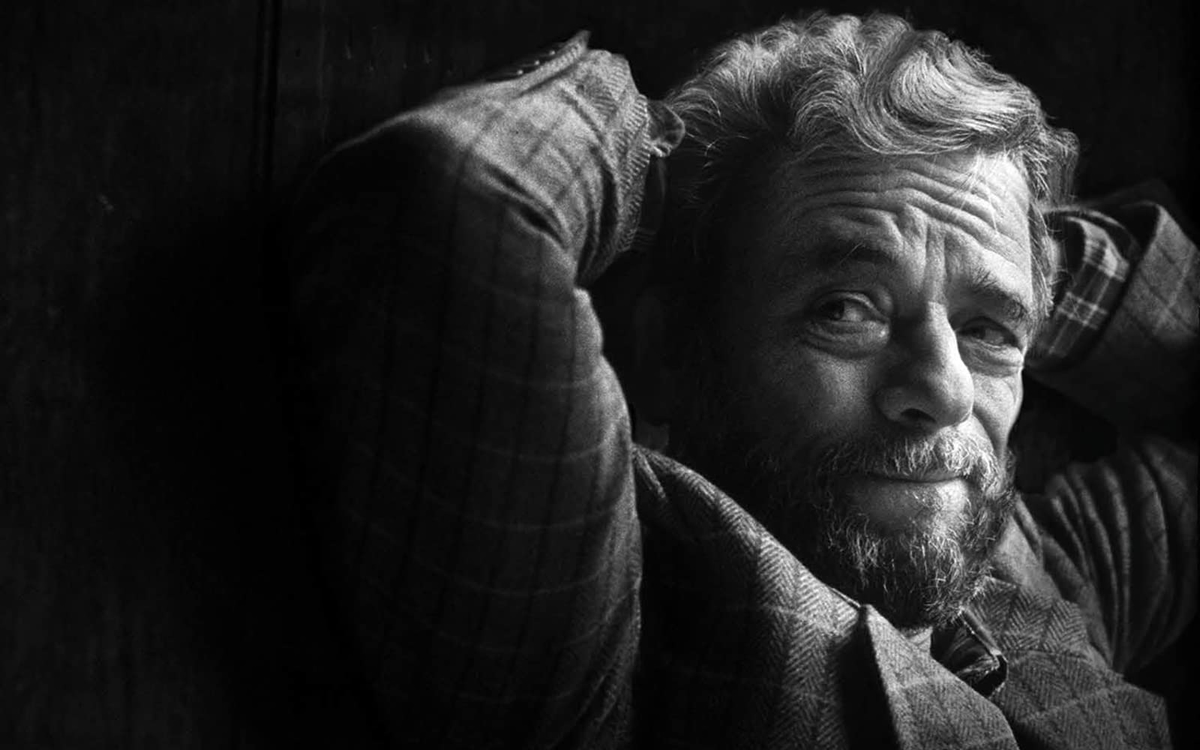
‘FINALE: Late Conversations With Stephen Sondheim’
By D.T. Max
c.2022, Harper/HarperCollins
$20.99/225 pages
“My idea of heaven is not writing,” the iconic gay composer and lyricist Stephen Sondheim is reported to have said.
“On the other hand,” Sondheim, who died last year at 91, was, thankfully, as he reportedly said, “obviously compulsive about it.”
“FINALE: Late Conversations With Stephen Sondheim,” a new book by New Yorker staff writer D.T. Max is good news for Sondheim’s multitudes of aficionados.
“I’m not good. I’m not nice. I’m just right. I’m the witch. You’re the world,” Sondheim wrote in “Into the Woods.”
Whether you’re a teen in a production of “Into the Woods,” a Boomer who came of age with “Company,” an 80-something who fondly remembers “Gypsy” or an artist who identifies with “Sunday in the Park with George,” you know you couldn’t have hung out in Sondheim’s world.
Frequently, profiles of celebrities are take-downs or suck-ups. Max avoids these pitfalls.
In “FINALE,” sometimes Sondheim is witty, entertaining, hospitable (his staff offer Max wine) and generous (Sondheim tries to help Max find a puppy for his family). At other times, Sondheim talks hatefully about his mother (who sounds like a cool customer) and cops to not reading much, though he loves “The Catcher in the Rye” because of its dialogue. Sondheim veers away from the orthodox take on Hitchcock. “Vertigo,” he says, is overrated. His fave “Hitchcock” movie was “Shadow of A Doubt.”
In “FINALE,” Max makes us feel like we’re having drinks with Sondheim.
It wasn’t easy for Max to have informal, entertaining, illuminating conversations with Sondheim.
There’s always some drama, metaphorically, some seduction involved when a reporter attempts to interview a celeb. This was even truer with Sondheim, who zealously guarded his privacy.
“Profiles are fraught efforts,” Max writes, “Profiles of the famous famously fraught.”
Some writers don’t bring the difficulties of their work (from getting the interview to coaxing candor and new reveals from interview subjects who’ve been burned by social media) into their reporting.
But in “FINALE,” Max doesn’t just clue readers into the vexations involved in nailing and conducting his interviews with Sondheim. “FINALE” is structured around his quest to discover revelations about Sondheim. His search for insights into Sondheim’s life and creative process becomes, figuratively, a Broadway show. In this vein, the book’s chapter titles range from “Prelude” to “Audition, January 2016″ to “Opening Night, April 2017″ to “Closing Night, March 2019″ to “Curtain.”
The main focus of “FINALE” is Sondheim. But Max is a character in the narrative.
Sometimes this is off-putting. Do we need to learn where Max went to school, where he grew up or what movies he enjoys? (He agrees with Sondheim about “Vertigo.”)
Does it shed light on Sondheim when Max spills his feelings (from angst to enthrallment to disappointment when Sondheim cancelled appointments) around writing about Sondheim?
But though, at times, there’s too much of Max, sometimes his presence adds to the story.
Max, like many who’ll read this book, grew up loving Sondheim. Max’s uncle was a playwright, and he was introduced to Sondheim, when his mother brought home a signed recording of “Side By Side” after a benefit. But he’s not an expert on musical theater.
He views Sondheim with the admiring, but unprofessional, gaze of many theatergoers. This serves readers well. It keeps the conversations lively and un-pedantic.
Most of the book is a series of one-on-one conversations that Max has with Sondheim at his home in New York City and his house in Connecticut. Sondheim’s dogs and husband Jeff Romley wander in and out. Sondheim talks about not being able to finish a musical that he’s working on. He remembers that decades ago, one day, Katharine Hepburn, then his neighbor, came by when he was playing the piano, composing. “Pipe down! she told him.
It’s doubtful that Sondheim, given the time when he grew up, would have talked about being gay. (Though he never denied his sexuality.) Still, I wish Max had asked him about it.
This is a minor quibble. “FINALE” will be catnip to lovers of musicals.
The Blade may receive commissions from qualifying purchases made via this post.




Books
‘90s club kids will love Mark Ronson’s new book
‘Night People’ part esoteric hip-hop discography, part biography
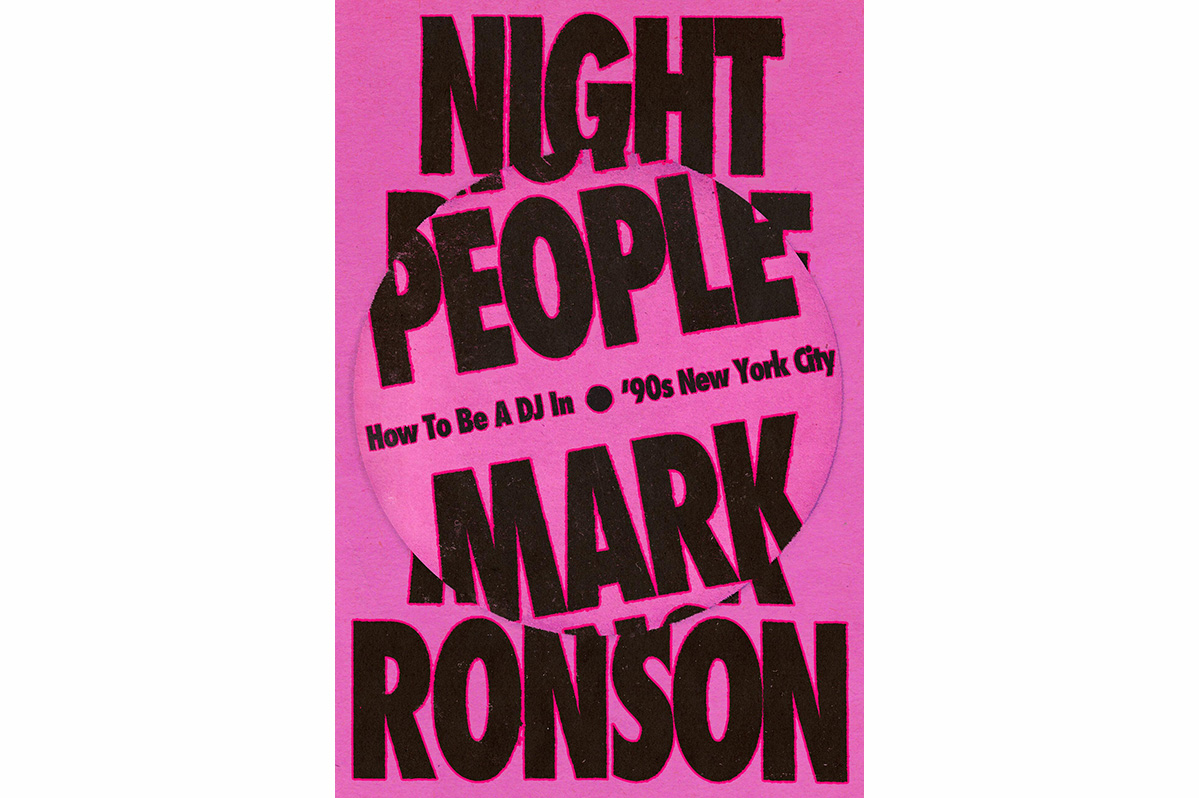
‘Night People’
By Mark Ronson
c.2025, Grand Central
$29/256 pages
You just can’t hold still.
The music starts and your hips shake, your shoulders bounce, your fingers tickle the sky to match a beat. Your air guitar is on-point, your head bops and your toes tap. You can’t help it. As in the new memoir, “Night People” by Mark Ronson, you just gotta dance.

With a mother who swanned around with rock bands, a father who founded a music publishing company, and a stepfather who founded the band, Foreigner, it was natural that Mark Ronson would fall into a music career of some sort. He says he was only 10 years old when he realized the awesome power of music.
As a pre-teen, he liked to mix music in his stepfather’s studio. As a teenager, he formed a band with Sean Lennon that didn’t quite catch on. In the fall of his senior year of high school, Ronson began sneaking into Manhattan clubs to listen to music, dance, and find drugs. It was there that he noticed the alchemy that the DJs created and he searched for someone who’d teach him how to do that, too. He became obsessed.
Finding a gig in a New York club, though, was not easy.
Ronson worked a few semi-regular nights around New York City, and at various private parties to hone his skills. His mother purchased for him the electronic equipment he needed, turntables, and amps. He befriended guys who taught him where to get music demos and what to look for at distributor offices, and he glad-handed other DJs, club owners, and music artists.
That, and the rush he got when the dance floor was packed, made the job glamorous. But sometimes, attendance was low, DJ booths were located in undesirable places, and that totally killed the vibe.
Some people, he says, are mostly day people. For others, though, sunlight is something to be endured. Nighttime is when they when they feel most alive.
Part esoteric hip-hop discography, part biography, part SNL’s Stefan, and part cultural history, “Night People” likely has a narrow audience. If you weren’t deep into clubbing back in the day, you can just stop here. If you were ages 15 to 30, 30 years ago, and you never missed club night then, keep reading. This is your book.
Author Mark Ronson talks the talk, which can be good for anyone who knows the highs of a jam-packed club and the thrill of being recognized for skills with a turntable. That can be fun, but it may also be too detailed: mixology is an extremely heavy subject here. Many of the tunes he names were hits only in the clubs and only briefly, and many of the people he name-drops are long gone. Readers may find themselves not particularly caring. Heavy sigh.
This isn’t a bad book, but it’s absolutely not for everyone. If you weren’t into clubbing, pass and you won’t miss a thing. If you were a die-hard club kid back then, though, “Night People” will make your eyes dance.
Want more? Then check out “What Doesn’t Kill Me Makes Me Weirder and Harder to Relate To” by Mary Lucia (University of Minnesota Press). It’s Lucia’s tale of being a rock DJ in Minneapolis-St. Paul, life with legions of listeners, and not being listened to by authorities for over three harrowing, terrifying years while she was stalked by a deranged fan.
The Blade may receive commissions from qualifying purchases made via this post.
Books
Pioneering gay journalist takes on Trump 2.0 in new book
Nick Benton’s essays appeared in Fall Church News-Press

Nicholas Benton is a well-known local LGBTQ advocate and journalist and the longtime owner and editor of the Falls Church News-Press, a weekly newspaper.
In his eighth book out now, Benton offers a new set of remarkable essays all crafted in the first eight months of Trump 2.0 and its wholesale effort at dismantling democracy and the rule of law. Most were published in the Falls Church News-Press, but he adds a new piece to this volume, as an addendum to his “Cult Century” series, revealing for the first time his experiences from decades ago in the political cult of Lyndon LaRouche, aimed at providing a clearer grasp of today’s Cult of Trump.
His “Please Don’t Eat Your Children” set takes off from the satire of Jonathan Swift to explore society’s critical role of drumming creativity out of the young.
Below is an excerpt from “Please Don’t Eat Your Children, Cult Century, and other 2025 Essays.”
Please Don’t Eat Your Children
In his famous short essay, “A Modest Proposal: For Preventing the Children of Poor People in Ireland From Being a Burden to Their Parents or Country and for Making Them Beneficial to the Public,” author and Anglican priest Jonathan Swift (1667-1745) uses cutting satire to suggest that cannibalism of the young might help solve a battery of social ills.
As we examine our broken society today, it seems to me that reflecting on Swift’s social critique can be quite useful. Now we face a nation filled with anger and division and there is little to suggest any real solutions other than insisting people “don’t do that!” We can start out with the observation that young children, left to their own, are neither hateful nor cruel. How do they get that way later on in their lives? What drives them toward such emotional states and behaviors? It is not a problem only for the margins of society, for the extreme misfits or troubled. It is defining the very center of our culture today. Our divisions are not the cause, but the result of something, and nobody is saying what that is.
Swift doesn’t say what it is in his biting little essay. But it is implied by a context of a lack of bounty, or poverty, on the one hand, and an approach to it characterized by obscenely cruel indifference, on the other. He coined the phrase “useless eaters” in defining his radical solution. In Hitler’s Germany, that term resonated through the death camps and some in our present situation are daring to evoke it again as the current administration pushes radical cuts in Medicaid funding.
But while that refers to the old and infirm, mostly, it is the young we are talking about here. The problem is that our society is structured to devour our young and as they begin to find that out, they rebel. Not in all cases is this the practice, of course. Where there is little or no lack, things are different. We nurture our young, as we should, and we love them. Lucky is the child who is born to parents who are of means, and in a community where nurture is possible and valued. But even such children are ultimately not immune from facing a destiny of pale conformity battered by tightly delimited social expectations and debt slavery. If they have enough ambition, education and doors opened for them, some can run the gauntlet with relative effectiveness. Otherwise, our young are raised to die on battlefields, or to struggle in myriad other painful social conflicts aimed at advancing the world of their elders. In the Bible, there is a great admonition against this process that comes at the very precondition for the tradition it represents that begins with Abraham.
It is in the book of Genesis at the beginning of the Biblical story when, as that story goes, God commanded Abraham to kill his son, Isaac, as a sacrifice. As Abraham is about to obey, God steps in and says no. The entire subsequent eons-long struggle to realize Abraham’s commission by God to make a great nation that would be a light to the world would have been cut short right then if Abraham had slain his own son. The message is that all of the Abrahamic traditions, Judaism, Islam and Christianity, owe their source, and in fact are rooted, in God’s command to reject the sacrifice of children to the whims of their elders. The last thousands of years can be best defined in these terms, where nurture is pitted against exploitation of our young with, at best, vastly mixed results. Scenes like that at the opening of “All Quiet on the Western Front,” the World War I novel and film where a teacher rallies a classroom full of boys to enlist in the war, is bone chilling. Or, the lyric in Pink Floyd’s iconic song, Comfortably Numb, “When I was a child, I caught a fleeting glimpse out of the corner of my eye. I turned to look but it was gone. I cannot put my finger on it now. The child is grown, the dream is gone.”
Nick Benton’s new book is available now at Amazon.
The Blade may receive commissions from qualifying purchases made via this post.
Books
New book highlights long history of LGBTQ oppression
‘Queer Enlightenments’ a reminder that inequality is nothing new
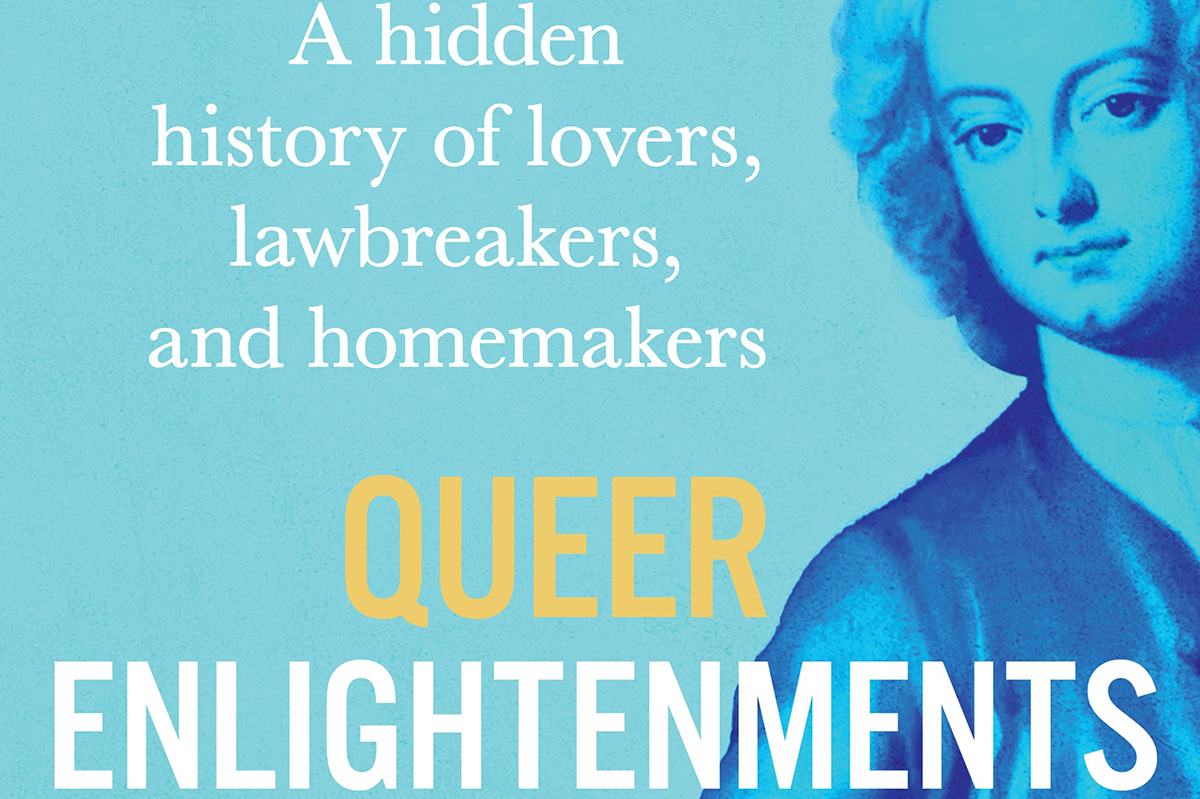
‘Queer Enlightenments: A Hidden History of Lovers, Lawbreakers, and Homemakers’
By Anthony Delaney
c.2025, Atlantic Monthly Press
$30/352 pages
It had to start somewhere.
The discrimination, the persecution, the inequality, it had a launching point. Can you put your finger on that date? Was it DADT, the 1950s scare, the Kinsey report? Certainly not Stonewall, or the Marriage Act, so where did it come from? In “Queer Enlightenments: A Hidden History of Lovers, Lawbreakers, and Homemakers” by Anthony Delaney, the story of queer oppression goes back so much farther.
The first recorded instance of the word “homosexual” arrived loudly in the spring of 1868: Hungarian journalist Károly Mária Kerthbeny wrote a letter to German activist Karl Heinrich Ulrichs referring to “same-sex-attracted men” with that new term. Many people believe that this was the “invention” of homosexuality, but Delaney begs to differ.
“Queer histories run much deeper than this…” he says.
Take, for instance, the delightfully named Mrs. Clap, who ran a “House” in London in which men often met other men for “marriage.” On a February night in 1726, Mrs. Clap’s House was raided and 40 men were taken to jail, where they were put in filthy, dank confines until the courts could get to them. One of the men was ultimately hanged for the crime of sodomy. Mrs. Clap was pilloried, and then disappeared from history.
William Pulteney had a duel with John, Lord Hervey, over insults flung at the latter man. The truth: Hervey was, in fact, openly a “sodomite.” He and his companion, Ste Fox had even set up a home together.
Adopting your lover was common in 18th century London, in order to make him a legal heir. In about 1769, rumors spread that the lovely female spy, the Chevalier d’Éon, was actually Charles d’Éon de Beaumont, a man who had been dressing in feminine attire for much longer than his espionage career. Anne Lister’s masculine demeanor often left her an “outcast.” And as George Wilson brought his bride to North American in 1821, he confessed to loving men, thus becoming North America’s first official “female husband.”
Sometimes, history can be quite dry. So can author Anthony Delaney’s wit. Together, though, they work well inside “Queer Enlightenments.”
Undoubtedly, you well know that inequality and persecution aren’t new things – which Delaney underscores here – and queer ancestors faced them head-on, just as people do today. The twist, in this often-chilling narrative, is that punishments levied on 18th- and 19th-century queer folk was harsher and Delaney doesn’t soften those accounts for readers. Read this book, and you’re platform-side at a hanging, in jail with an ally, at a duel with a complicated basis, embedded in a King’s court, and on a ship with a man whose new wife generously ignored his secret. Most of these tales are set in Great Britain and Europe, but North America features some, and Delaney wraps up thing nicely for today’s relevance.
While there’s some amusing side-eyeing in this book, “Queer Enlightenments” is a bit on the heavy side, so give yourself time with it. Pick it up, though, and you’ll love it til the end.
The Blade may receive commissions from qualifying purchases made via this post.

Choose U ambassadors share lived experiences with HIV, personal reflections, and insights

DOJ seeks to join lawsuit against Loudoun County over trans student in locker room

As house Democrats release Epstein photos, Garcia continues to demand DOJ transparency

Capital Pride announces change in date for 2026 D.C. Pride parade and festival

Reflecting on six years on the CAMP Rehoboth board

EXCLUSIVE: George Santos speaks out on prison, Trump pardon, and more

The harsh truth about HIV phobia in gay dating

Victory Institute honors transgender Spanish senator in D.C.

Kazakh Senate tables anti-LGBTQ propaganda bill