News
Don’t miss today’s Blade town hall with the mayor!
Watch today’s LGBT town hall live here at the Blade. We will ask the mayor about the issues you are most interested in.
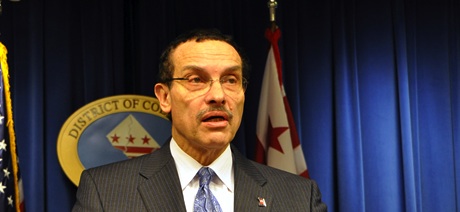
Mayor Gray will address the Washington D.C. LGBT community's questions on June 2 at the Wilson Building. (Washington Blade photo by Michael Key)
The Washington Blade and Mayor Vince Gray will be discussing the issues most pressing for the DC LGBT community today at 5:30 P.M. and you can be part of the discussion!
All week we’ve been taking your questions for the mayor. Now make sure you log in at 6:30 to watch our LIVE coverage of the conversation at our dedicated page http://washingtonblade.com/beheard.
Get ready to be heard. “A Conversation With The Mayor,” Town Hall Event during DC’s LGBT Pride month with Mayor Vincent Gray, will feature questions submitted through the Blade website, Facebook and Twitter. If you’re watching with us, use the hashtag #DCLGBT.
The Washington Blade invites you to “A Conversation with the Mayor” today, as part of our Pride month celebrations. At the event, Blade editor Kevin Naff will interview Mayor Vincent Gray on LGBT issues. The mayor will also answer questions submitted by the public.
Join us at 5:30 p.m. for a reception and the opening of SMYAL’s youth advocacy project photography exhibit exploring heterosexism. The exhibit will be on display from June 2, 2011 through June 13, 2011.
“We are honored that Mayor Vincent Gray will join us for a candid discussion about the topics that are of greatest concern to the District’s LGBT community,” said Naff. “This will be a wonderful forum for the mayor to interact with a community that has been incredibly supportive of his efforts to push for autonomy from congressional interference in city affairs, including the marriage equality law.”
The event will include a question and answer session following Naff’s interview with Gray. Members of the public will have the opportunity to submit questions for the mayor through the newly re-launched Blade website, Facebook and Twitter.
“A Conversation with the Mayor” will be held at the John A. Wilson Building. The event will be preceded by a reception. Both events are open to the public and all members of the DC metro area community are invited to attend.
If you can’t be there in person, be there with us for our live coverage at http://washingtonblade.com/beheard!
WHO: Washington Blade
Washington DC Mayor Vincent Gray
Washington Blade editor Kevin Naff
WHAT: “A Conversation with the Mayor,” a Capital Pride town hall event
WHEN: June 2nd, 2011
6 to 6:30 p.m. – reception
6:30 to 7 p.m. – interview with the mayor
7 to 7:30 p.m. – question and answer session
WHERE: John A. Wilson Building
If you require accommodations to participate in this event, please inform The District of Columbia Office of Disability Rights at 202-724-5055.
Make sure that you “like” our Facebook Page, and “follow” our Twitter Page so that you can see what others in D.C. are asking the mayor. You can also get all of the best local and national news and info on the hottest upcoming events in and around Washington.





District of Columbia
Capital Pride chair resigns from board after just 10 months
Anna Jinkerson ‘taking step back to move forward’

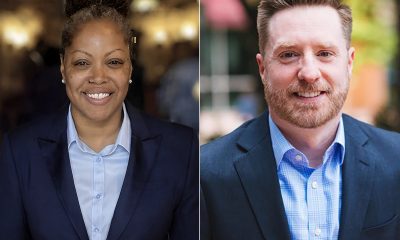
Anna Jinkerson, who has served as chair of D.C.’s Capital Pride Alliance Board of Directors for the past 10 months and has served on the board for the past four years, confirmed she is resigning from the board effective Sept. 30.
Capital Pride Alliance serves as the lead organizer of D.C.’s annual LGBTQ Pride events.
“I am taking a step back to move forward and plan to stay engaged in the community,” Jinkerson told the Washington Blade in a statement. “Serving as a volunteer leader during a period of transition following World Pride was both an honor and a challenge,” she said.
“Throughout my tenure, I focused on strengthening accountability, improving communications, supporting staff and volunteers, and helping position the organization for long-term success,” she told the Blade in her statement. “Meaningful organizational progress requires collaboration, dedication, and a shared commitment to serving the community, and I am proud of the work accomplished during this period.”
In February of this year, during Jinkerson’s tenure on the board, Capital Pride announced it had expanded the size of its board from 12 to 25 members.
Around that same time one of the existing board members, transgender activist Taylor Lianne Chandler, announced in a letter to fellow board members that the Blade obtained from an anonymous sender that she was resigning from the board. Among her reasons for resigning, she said in the letter, was the board’s failure to address “sexual misconduct” within the Capital Pride organization.
In the letter, which she confirmed for the Blade was authentic, Chandler said she and other board members raised “credible concerns” of alleged sexual misconduct within the Capital Pride organization and the board chose not to adequately respond to those concerns.
Chandler told the Blade a Capital Pride investigation identified an individual implicated in a “pattern” of sexual harassment related behavior, but said she was bound by a Non-Disclosure Agreement that applied to all board members and she could not provide further details.
When the Blade contacted Capital Pride for comment on Chandler’s allegations, Jinkerson responded with a statement saying Capital Pride was addressing her concerns.
“When concerns are brought to CPA, we act quickly and appropriately to address them,” Jinkerson said. “As we continue to grow our organization, we’re proactively strengthening the policies and procedures that shape our systems, our infrastructure, and the support we provide to our team and partners,” she said.
In her statement to the Blade this week commenting on her planned resignation from the Capital Pride board, Jinkerson appeared to refer to the concern raised by Chandler.
“I am proud to have advocated for sexual harassment training, supported staff and volunteers when concerns were raised, engaged community leaders in important conversations, and helped advance practices that strengthen safety, transparency, and accountability,” she said.
“As I step away from board service, I do so with gratitude for the opportunity to serve and with confidence in the organization’s future,” she added. “I am taking a step back to move forward, and I look forward to remaining actively engaged in our community and continuing to support efforts that advance equality, belonging, and pride for all.”
Fiji
Spike in HIV cases prompts Fiji to declare national emergency
Country recorded 2,016 new diagnoses in 2025

Fiji, a small Pacific island nation, on Sept. 15 declared a national emergency as it confronted one of the sharpest increases in new HIV infections globally.
The surge had been building for years, prompting the government to begin intensifying its response two years before the emergency declaration.
In 2024, the government adopted a four-year HIV Surge Strategy, covering 2024 through 2027, and later put in place a national plan to respond to the outbreak. UNAIDS and the World Health Organization have supported that effort.
The scale of the crisis is stark.
An estimated 9,100 people were living with HIV in Fiji in 2025, according to UNAIDS — a 12-fold increase from 2010. HIV has no cure, but effective treatment can suppress the virus, allowing people living with HIV to live long, healthy lives, and preventing sexual transmission when the virus remains undetectable.
In announcing the emergency, Health and Medical Services Minister Ratu Atonio Lalabalavu said the country recorded 2,016 new HIV diagnoses in 2025, the highest annual total on record. He called the figures a sign of the “seriousness of the epidemic and the urgent, coordinated response our country now needs.”
The crisis is also affecting children.
Save the Children Fiji said this week that a two-month-old baby is currently the youngest patient in the country living with both HIV and tuberculosis. The organization said 59 babies acquired HIV through mother-to-child transmission in 2025, while 67 new HIV cases were recorded among children under 15.
Five years ago, about one in every 167 people in Fiji was estimated to be living with HIV, according to government figures cited by the Associated Press. Since then, Fiji has also emerged as an important transit point in the regional drug trade, with international criminal networks moving narcotics from Latin America and Asia toward markets including Australia and New Zealand. Some of those drugs are also reaching Fiji’s domestic market, where injecting drug use has become an increasingly important route of HIV transmission.
Sexual transmission has continued to fuel the outbreak, with health officials pointing to inconsistent condom use and gaps in HIV testing. Stigma and misinformation have made the problem harder to confront, according to UNAIDS Pacific adviser Renata Ram, who has warned that limited knowledge about HIV can discourage people from seeking testing and care.
In a statement to the Washington Blade, Eamonn Murphy, UNAIDS’ regional director for Asia and the Pacific and Eastern Europe and Central Asia, cautioned against viewing Fiji’s epidemic through the lens of a single behavior or community. Among cases where the mode of transmission is known, he said, more than half are linked to sexual transmission and more than 42 percent to injecting drug use.
“The rise in infections among women and infants also shows that HIV has reached more widely across society,” Murphy said. “What stands out is how quickly the epidemic changed compared with the pace of the response. Access to PrEP and harm reduction remained limited, Fiji did not yet have a needle and syringe programme, and stigma and policy barriers continued to keep some people away from services.”
Murphy noted only 39 percent of people with HIV in Fiji knew their status in 2025, and only 22 percent of them were receiving treatment. He also pointed out a wider system-level problem.
“COVID-19 and the years that followed disrupted services, shifted attention and resources, and left community-led outreach operating below the scale that was increasingly needed,” said Murphy. “The epidemic moved faster than the response.”
Murphy said the immediate challenge is to bring HIV prevention and treatment closer together and make both easier to access at scale. He said PrEP, condoms, testing and harm reduction — including Fiji’s planned needle and syringe program — need to reach people earlier. At the same time, people diagnosed with HIV need a clear path into same-day treatment, care and support that helps them remain in treatment.
The tool at the center of the harm-reduction debate is hardly new.
Needle and syringe programs provide people who inject drugs with sterile equipment, helping them avoid sharing needles and reducing the risk of HIV and other blood-borne infections. Decades of evidence have found that NSPs reduce HIV transmission without increasing drug use, and WHO describes them as a proven and cost-effective public health intervention. Such programs operate in more than 90 countries worldwide. Yet Fiji, even as injecting drug use has become an increasingly important route of HIV transmission, is only now moving toward introducing one.
“Trust is just as important as access,” Murphy told the Blade. “People most affected by HIV are more likely to use services when they are confidential, respectful and connected to organisations they already know. Community groups and peer workers are increasingly part of Fiji’s response, including the rollout of free PrEP, and that closer link with the health system can make a real difference.”
“As UNAIDS has stated, the national crisis declaration is ‘a call for action, not fear,’” he added. “Fiji has the tools to change the trajectory; the priority now is to turn political commitment into rapid, coordinated action that reaches people at scale. The UN Joint Team is working to support the national response.”
Joeli Colati, executive director of Fiji Network Plus, a nongovernmental support and advocacy network established by and for people living with HIV, told the Blade that HIV affects people in ways that extend far beyond their health. Some people are afraid to get tested because they fear being judged or worry that others will discover their HIV status. Others fear the consequences for their families, jobs and relationships, as well as stigma and gossip. For LGBTQ people and other vulnerable populations, Colati said, those fears can be even harder to navigate because some already face discrimination. When people do not feel safe, he said, they may avoid testing, treatment and other HIV services.
Fiji does not have a reliable national count of its broader LGBTQ population.
UNAIDS estimates that about 16,000 men who have sex with men and transgender people live in the country, though that figure should not be treated as an estimate of the entire LGBTQ community.
“We are also seeing a lot of HIV misinformation, especially on social media. This includes people sharing wrong information about how HIV is spread, how it is treated, and what it means to live with HIV,” said Colati. “Another serious concern is the increase in herbal healers claiming they can cure HIV. There is currently no cure for HIV. These claims can be dangerous if they make people stop or delay their HIV treatment. Herbal medicine should never be promoted as a replacement for antiretroviral therapy (ART).”
Colati said HIV peer counselors and NGO outreach workers are helping people at the community level, from supporting those newly diagnosed and helping them stay in care to reaching people who may not visit clinics, providing accurate information and connecting them with testing and treatment. He said people are often more comfortable seeking help from someone who understands what they are going through.
“As someone living with HIV myself for 19 years, I know that a person who is newly diagnosed needs more than medicine. They also need support, correct information and hope. With treatment, people living with HIV can live long and healthy lives,” Colati said. “We also need people to understand undetectable equals untransmittable, or U=U: when a person living with HIV takes treatment and maintains an undetectable viral load, they do not sexually transmit HIV. That is both a prevention message and a powerful message against stigma. Fiji Network Plus, the national network for people living with HIV, reinforced this message in our response to Fiji’s national HIV crisis.”
Asaeli Sinusetaki, acting chief executive of Rainbow Pride Foundation, an LGBTQ advocacy group based in Suva, the Fijian capital, in a statement to the Blade said the organization welcomed the government’s declaration because it showed officials now recognized the seriousness of the situation.
“It is unfortunate that it took this long to respond, because the warning signs were always there,” Sinusetaki added.
“For LGBTQ+ people, experiences can differ depending on how comfortable they are accessing services,” Sinusetaki said. “At the same time, LGBTQ+ communities in Fiji have been one of the driving forces behind prevention efforts. Yes, accessing services independently can be a challenge because of fear, particularly stigma and discrimination. But because many LGBTQ people are also part of the Peer Outreach Worker network, they have established trust within their communities and networks to help people access information and services.”
Sinusetaki said access to HIV testing remains a major challenge, with testing unavailable at many local health centers, forcing some people to travel to sexual and reproductive health clinics or hospitals. He said that can be a significant barrier in a country where people often do not seek medical care unless they are already sick, making it unlikely that someone would make a separate trip simply to get an HIV test.
“The emergency has also highlighted that HIV cannot be treated as a stand-alone issue,” said Sinusetaki. “LGBTQ people need access to a broader package of sexual and reproductive health services, STI screening and treatment, mental health and psychosocial support, prevention information, condoms and lubricants, PrEP and PEP and, where relevant, harm-reduction services.”
“For people who receive a positive diagnosis, the challenge does not end with testing,” Sinusetaki added. “We need to ensure that they are linked rapidly to treatment, supported to remain in care and treated with dignity throughout that journey.
The Blade reached out to Lalabalavu multiple times for comment, but did not receive a response.
National
For lesbian victims of domestic violence, competent care is scare
Heteronormative assumptions, funding cuts contribute to lack of resources for survivors

Uncloseted Media published this story on Sept. 22.
By EMMA PAIDRA | Claire, a 25-year-old Los Angeles resident, distinctly remembers the night she and her ex-girlfriend broke up.
“She was strangling me in a CVS parking lot,” Claire recalls, adding how she was gasping for air as bystanders looked on. “I made eye contact with one man who just kept walking, and we were right behind a car that was trying to reverse out of a parking spot. No one got out of the car. They didn’t honk; they didn’t do anything.”
Claire, who asked to use a pseudonym due to safety concerns regarding her ex, says she managed to fight her way out of her then-girlfriend’s grasp. It was at this moment in 2024 she realized things had reached a breaking point.
While research on intimate-partner violence has traditionally focused on opposite-sex couples, two recent reports found that queer women, like Claire, are not immune to this type of abuse. An international research review published last year in the Journal of Media Critiques found “IPV rates in same-sex relationships are comparable to or exceed those in heterosexual relationships,” with up to 46 percent of lesbians encountering such abuse, compared to 36 percent of straight women. A separate review published earlier this year found that nearly 27 percent of lesbians surveyed had experienced IPV.
Despite the prevalence of IPV in lesbian relationships, heteronormative and outdated assumptions have left many queer women feeling like they have nowhere to turn for competent services and support, according to experts, advocates and victims interviewed by Uncloseted Media.
“Queer folks are joining the conversation to say, ‘This is happening in our communities, too, and we need the same resources and support services that straight women are offered,’” Tori Stranges, a professor of women’s studies at the University of British Columbia, told Uncloseted Media.
A frequently overlooked problem
Stranges says the false notion that only men are domestic abusers can result in violent same-sex relationships not being taken seriously.
“People assume that violence is perpetrated by men against women,” she says, adding that this “has left queer people out of the conversation.”
“If it was a man that was doing all these things, and people heard and saw it, I’m sure I would have been taken seriously,” says Claire. “People saw a 5-foot-7 woman who didn’t look that strong — and above all, she was a woman. Men, especially, don’t really see that as a threat. So they’re like, ‘If I’m not threatened, then I’m sure it’s not a big deal.’”
Outdated assumptions about IPV can even result in victims themselves overlooking their abuse.
“When it comes to abuse in heterosexual relationships, there are national campaigns, there are resources that you can access,” Stranges says. “There are people coming into the school systems to talk about relationship violence. We don’t have similar recognition and the same conversations about queer people.”
Claire says the violence she was subjected to was paired with moments of intense affection, which made it harder for her to recognize the abuse.
“We would get into a fight, and she would physically abuse me, and then apologize. She was actually also very gentle with me sometimes,” Claire recalls. “That kind of cycle can be really addicting. I would always wait for the good parts.”
The role of mental illness
K.P., a 47-year-old lesbian living in Maine, was with her abusive ex-girlfriend for five years before ending the relationship in 2023. During their time together, K.P. says her ex, who struggled with panic disorders, ADHD and depression, experienced a decline in her mental health, which contributed to more frequent outbursts of rage. When it comes to the link between rage and violence, one 2022 meta-analysis found that “anger was a significantly stronger correlate of IPV perpetration for women than men.”
K.P., who was working from home at the time and felt like she had no escape, says her ex’s verbal abuse spiraled into physical violence.
“I was on the couch with my laptop, trying to work, and she was just being belligerent,” recalls K.P., who asked to be identified by only her initials because of safety concerns. “I tuned her out, but when she realized I wasn’t giving her the attention that she expected, she went to the kitchen, grabbed two knives and started coming at me.”
K.P. ran outside, trying to get away. Her ex ran after her and then chased her back inside to avoid being seen by neighbors.
Once inside, her partner hid her phone. K.P. used this brief window to message a co-worker on her laptop, asking him to call the police.
“I was confused and afraid,” K.P. told Uncloseted Media. “I’d never been chased with a knife before, let alone by someone who I cared about.”
Research shows LGBTQ people have higher rates of mental health conditions than their non-LGBTQ peers. A study published last year in JAMA Network Open found sexual and gender minorities had “significantly higher odds of at least four of 10 commonly diagnosed mental health conditions,” including post-traumatic stress disorder and bipolar disorder.
IPV may also contribute to negative mental health effects, with research finding that victims experience an increase in depression, anxiety and PTSD and a reduction in life satisfaction.
“After we broke up, I was messed up,” K.P. says. “It took me a good six or eight months to feel like I could breathe again.”
Trapped in a ‘double closet’
In addition to mental health, the stigma of being queer may affect a victim’s response to being in an abusive relationship. When Claire first came out to her family, she says they kicked her out of their home until she returned to the proverbial closet. They eventually accepted her sexuality, but Claire says the residual shame she carried afterwards led her to avoid the added stigma she feared she’d experience if she admitted to being in an abusive relationship.
“All of that combined made me feel so trapped. I just thought, ‘Oh my god, I’m being judged from every single angle,’” she says. “There was just nowhere to go.”
Letícia Yuki de Araujo Furukawa, a clinical psychologist specializing in supporting survivors of IPV, says this kind of thinking is not uncommon among queer women in abusive relationships.
“Sometimes lesbian women who are experiencing IPV relationships start to isolate themselves, to prevent themselves from the shame and judgment they think they are going to suffer,” she says.
Furukawa says this impulse is rooted in the layers of stigma queer women face.
“It comes down to two things that make it like a double closet: We have the closet of being a lesbian, and you have the other one that comes from being in a violent relationship.”
According to Furukawa, having a supportive family can decrease the risk of entering an abusive relationship. Unfortunately, strained familial relationships are common among queer people: A 2022 study in the Journal of Marriage and Family found that 32 percent of gay and lesbian adult children — compared to 22 percent of their heterosexual counterparts — were estranged from their fathers.
Because of the shame Claire faced from her family when she came out, she was reluctant to admit there was a problem in her relationship when her mother and sister expressed concern. She worried that if her family knew her lesbian relationship was abusive, they would stop accepting her queer identity.
“My mom and sister would say to me during the relationship that they thought my ex looked evil, and that I changed so much. I used to be such a bubbly girl, and my personality made a complete 180,” she remembers. “In my head, I was like, ‘I can’t admit that it’s true.’”
‘Gaps in, policy, care, and services’
When queer women have the courage to report IPV, some don’t receive the response they’re hoping for. When police arrived at K.P.’s home following the knife-wielding incident, she says they opened a case file and wrote an incident report but said there was nothing else they could do because her ex had fled the scene.
“It was a little frustrating that since my ex-girlfriend drove away, the police couldn’t do anything,” K.P. explains.
Laura Elizabeth, an assistant professor of criminal justice at Virginia Union University who researches IPV, says there may have been additional steps police could have taken to support K.P., including connecting her with resources for domestic-violence survivors.
“It is vital that [police] make the proper referrals, and that it not just be limited to handing the victim a brochure,” she says. “There needs to be an active discussion with victims about what their options are in terms of who they can reach out to, who can offer what services.”
Kimberley Jackson, an associate professor at the Arthur Labatt Family School of Nursing at Western University, says lack of research on same-sex domestic violence also impacts the support services available to lesbian victims.
“The intersection of IPV and the LGBTQ community is really not well understood,” Jackson told Uncloseted Media. “What we can tell you based on really limited evidence, is that there are huge gaps in policy, care and services. And with respect to shelters, we haven’t really moved the needle very far.”
One area in which shelters may be failing lesbian victims has to do with both the perpetrator and the victim being able to access the same shelter.
“This issue is further compounded in rural areas, where there’s likely only one shelter,” Jackson says. “There’s a chance they won’t be able to turn someone away, even if they’re the perpetrator.”
Jackson says queer victims of domestic violence who aren’t open about their sexuality may face additional obstacles.
“With respect to anonymity, in a lot of rural places, you’re going to know people in the community,” she says. “There are issues with accessing help if you’re worried about outing yourself.”
Calls for change
Experts and victims say LGBTQ training for shelter workers and law enforcement, as well as funding for research, could help prevent same-sex IPV and address the damage done by such abuse.
But under the Trump-Vance administration, these funding resources are slipping away. In March of last year, the administration canceled at least 68 grants, totaling nearly $40 million, that were focused on LGBTQ health. A second round of cuts followed two months later, during which $800 million worth of grants dedicated to researching LGBTQ health were terminated.
Rebecca Hobbs, co-executive director of Through These Doors, a domestic violence resource and advocacy center in Portland, Maine, says LGBTQ training materials are essential to ensuring shelters can support lesbian victims.
“LGBTQ people will not come to us unless they see themselves reflected in our materials,” Hobbs says. “We want our advocates to be well versed in understanding the additional barriers and challenges that LGBTQ people might experience.”
Advocates say police departments could also benefit from LGBTQ-awareness training.
The state of California and a number of large cities — including Atlanta, Chicago, Los Angeles, Houston, New Orleans, New York, Philadelphia and D.C. — have implemented some form of LGBTQ-sensitivity training.
But Greg Miraglia, founder and CEO of Out to Protect, a national organization supporting LGBTQ police officers and equipping all officers to serve queer people, says these programs are the exception, not the rule.
“Most other states do not require any type of LGBT awareness training,” Miraglia, a retired police officer who is based in California., told Uncloseted Media “There are over 18,000 law enforcement agencies out there, and I don’t think we’ve scratched the surface.”
“The problem comes about when law enforcement goes into a domestic violence incident with a same-sex couple without any training, carrying a lot of stereotypes that are common,” Miraglia adds. “They’re not picking up the fact that this is a couple that’s involved in an intimate relationship, and therefore domestic violence laws in that state apply.”
Claire says she wishes someone had intervened when her ex abused in the CVS parking lot and on her college campus. “The police had the biggest missed opportunity to intervene, as well as campus security,” she says. “A lot of our fights were in public, and she would get very loud. I made a promise to myself that if I ever saw anything like that in public, I would say something, because that’s all I needed at the time.”

Clavicular charged in alleged rape of teenage influencer

Gov. Whitmer to serve as keynote speaker for Saturday’s HRC National Dinner

Capital Pride chair resigns from board after just 10 months

Spike in HIV cases prompts Fiji to declare national emergency

United States Conference on HIV/AIDS grapples with federal budget cuts

Activists protest outside Turkish Embassy in D.C.

A roundup of fall events not to be missed

Over 2,000 turn out for Hands Around the Kennedy Center protest

Furries take over the Metro